
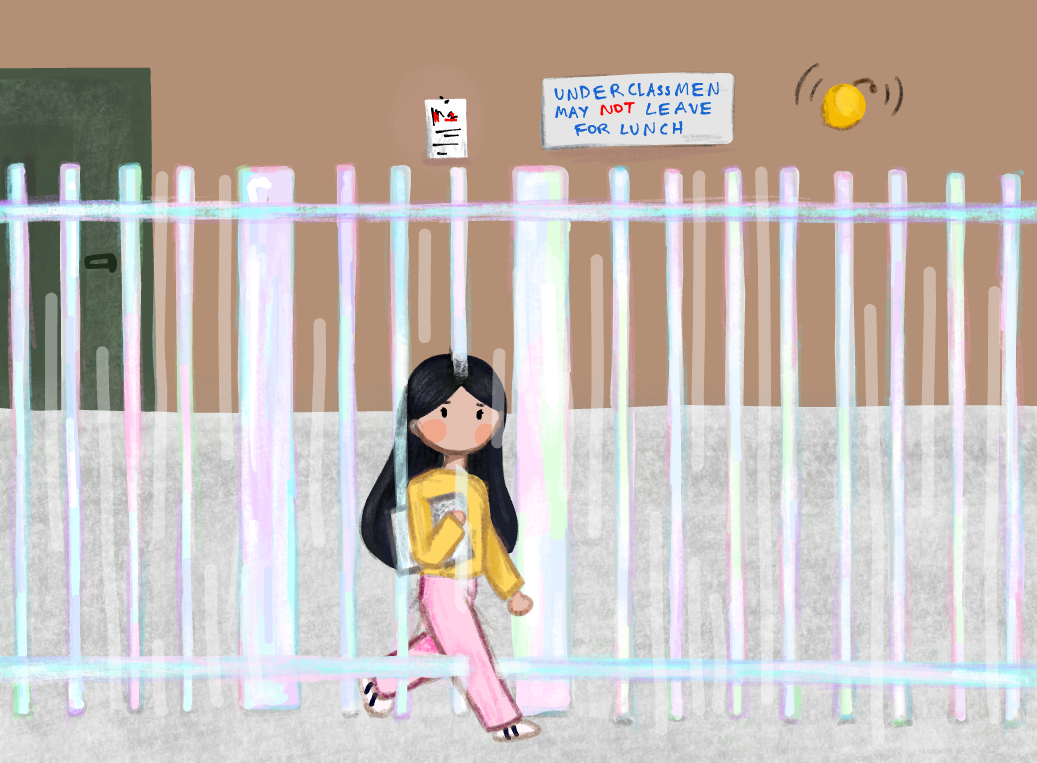
Right as the bell rings at 1:05 p.m., students rush out of classroom doors, bolting to their cars, speeding away for lunch or taking their journey on foot to a popular location only 0.8 miles away, the Del Mar Highlands Town Center. Beyond lunch time, students can be found skipping classes, left unaccounted for, often found in a much different location than where they should be.
These real-life situations are just one of the effects that stem from the school’s open campus system. More often than not, unidentified individuals are seen walking across campus, and parents can enter the campus without a visitor pass, leaving parents and teachers concerned with the safety of students and staff. Regardless, so far, there are no extraneous measures taken to regulate campus access or departures. Ultimately, these actions question the measures set by the school and, most importantly, their effectiveness.
Many argue that the school board should look into various ways to restrict communal access to the public by building a gate or increasing campus security. Although the present issues at hand are clear, the historical lack of measures were taken, and the school’s lenient culture, make it unlikely to implement new ones. Unless the school takes extreme measures, a few half-hearted actions to barely suffice would not be worth the time, money and energy to implement. If the school were to take action and exceptionally rewrite their current systems to ensure this, the school would need a sizable number of campus supervisors to control movement and install extensive gate yardage and full bulletproof doors and windows.
Regardless, the school still actively possesses a great deal of responsibility for all its students, especially for underclassmen.
Specifically, the departure during lunch raises questions about legal liability, which would justify these precautions. Following the TPHS Policies and Procedures Packet 2023-2024, the most up-to-date version online, outlines guidelines and regulations for both on- and off-campus activities throughout the day. In the “Behavior Expectations and Discipline Policies” section, the packet states that “Freshmen and Sophomores must remain on campus during the lunch break. Juniors and Seniors have the privilege of leaving campus at lunch; they are welcome to stay on campus too.”
For upperclassmen, the school does not hold any legal liability for juniors and seniors leaving campus under statuses like California Education Code § 44808, which explains that public schools are not responsible for the safety of upperclassmen once off campus if they leave accordingly. But, since many students who leave campus are not authorized, the school may be liable if it neglects enforcing policies, which then causes a lack of supervision. Newly licensed sophomores and clumsy freshmen crowd the streets and cause concern for many spectators.
It becomes glaringly apparent that the school is lenient toward its own policies, as it demonstrates a lack of enforcement by establishing an open campus system.
The argument for lack of apparent enforcement can be tied back to the amount of campus supervision present. The school, which has three campus supervisors, also has the largest student population in the San Dieguito Unified High School District of around 2,600, but still employs the same number of campus supervisors as the District’s other high schools. Comparatively, La Costa Canyon High School, which has around 1,700 students, possesses four campus supervisors.
By adding campus supervisors, the school could become a more secure enforcement for off-campus lunch exits. As the school outlined, “students who are off-campus during the school day are subject [to] progressive discipline as it relates to truancy.” It briefly states that “San Diego Police may issue a citation for daytime loitering. Repeated truancy violations will be considered defiance and will be addressed as such with the school’s administration.” Since the school has outlined these measures for itself, one can expect it to be implied. Although these consequences are not yet enforced for student unauthorized departure, if the school wanted to create a better environment to enforce this, then adding campus supervisors would be the logical choice.
Once again, with hundreds of students leaving, the current policies are practically useless, and it is difficult to envision what this “Off-Campus Lunch Policy” would even look like. Would campus supervisors stake out by the edge of the school campus, urging students to flash an ID for proof of upperclassman identity? Probably not.
Still, parents and even students are concerned about safety. Yet, there is only so much that public schools can do to ensure this safety, given their limitations on resources and budgets.
In practice, building a gate around campus is extremely unrealistic, as the process of building and developing a gate would cause the school board to take out high amounts of allocated budgets. Instead of spending that value on fencing, the school could invest in higher quality lunches in the school’s eatery to actually attract the staying on campus during lunch period.
Regardless, if a gate were built, who is to say that it would genuinely stop students from leaving school at all? It could even be the source to enhance student absenteeism, as it may make going off campus during lunch or school a more rebellious action.
Another prominent cause for this protection is the comfort of having a barrier against threats from school shooters. Some suggest that the school take a look into implementing closed campus regulations, such as building a gate, not only to secure lunch culture but also to protect from opposing harms like possible shooter threats. Still others remark that these issues as non-existent because nothing has happened yet. However, just because no serious event occurred in recent years does not mean that it cannot. Recent years have shown us that shooter threats are very real and demonstrate that the possibilities of “something happening” are not nonexistent. Even in California, there have been around 349,000 incidents of gun violence in the state of California, with 87 killed since 1970, according to the California School Boards Association.
Many often urge the school to look into respective policies and arrange systems in place that do not make it easy to walk onto a campus with an active gun, such as a gate around the school. The National Education Association explains how “school districts can use multiple layers of controls to mitigate violence when a single layer may be less effective.” They explain that the more protections that are placed in a school system, the safer an environment a campus can be, which is true because measures like this would delay entry or force an alteration of plans for the individual.
However, when taking a look at the school’s layout, the implementation of a gate would not be the only logical barrier that needs to be set in place if we choose to go down this route. Familiar to any student walking across the school, the majority of the doors are open, and the ones that are closed are still open by a handle grab. So, how effective would a gate be if we chose not to implement these other measures? Although the school has emergency measures set in place, the situation of campus culture still is cause for concern.
For these reasons, concerns for shootings should be discussed on a legislative level, such as preventing initial weapon seizure to limit dangers.
At the end of the day, parents and students must understand that, regardless of any precautions that could be placed to eliminate the presence of an open campus that is so prominent at the school, those legendary protections would not follow students everywhere they go. For example, just as easily, students can walk down to the Del Mar Highlands at 3:25 p.m. in the same manner they did at 1:05 p.m. How is this any different?
We must ask ourselves if drawing up these precautions would truly be worth it in a world where anything can happen. We cannot hold up wires around our bodies for safety at all times.