
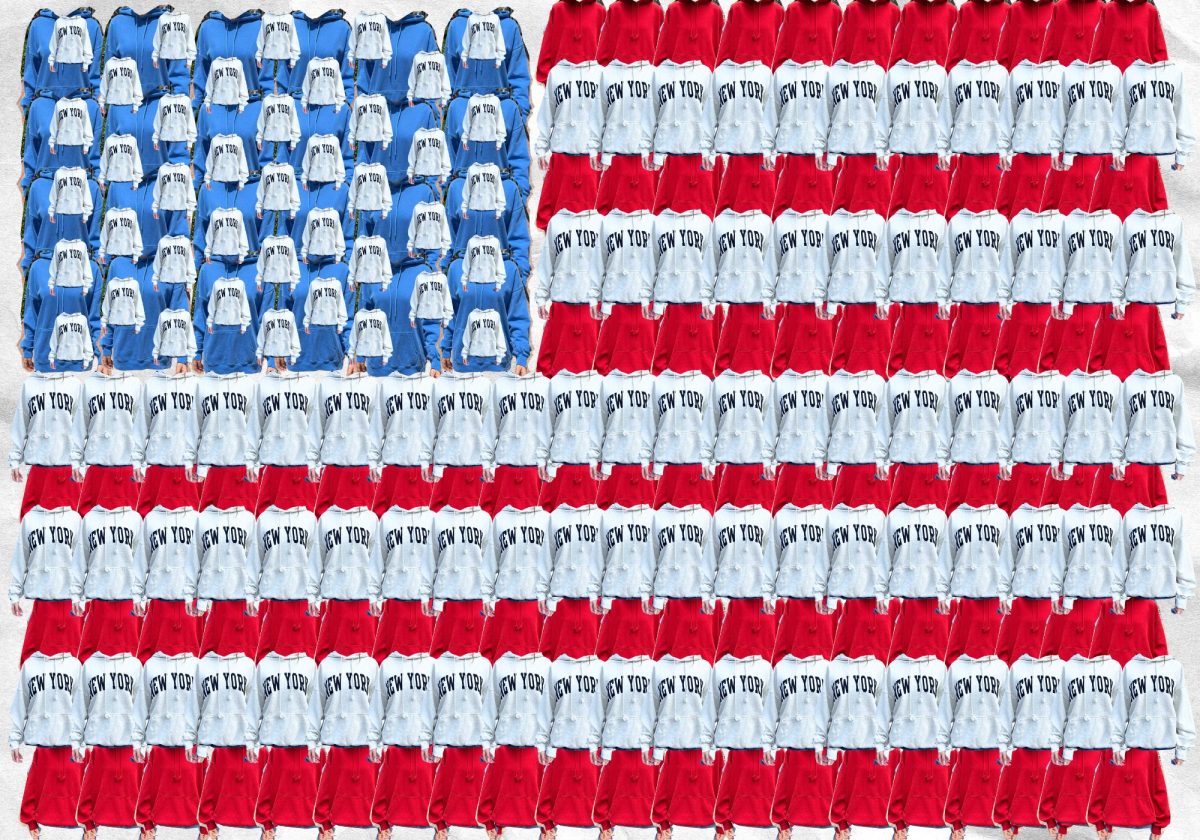
You step foot onto campus in the early morning, your groggy eyes still fighting to remain open and recalibrating after a late night of studying. Your steps are languid and heavy, weighed down by the dread of an upcoming test, when an armada of electric blue Brandy Melville hoodies blinds you out of your stupor. As the new high school fashion fad, it seems as though every student walking by is wearing this bright, fluorescent garment, a proud symbol of their social adeptness and agile adoption of digital-age mode.
With the rise of fast fashion, the clothing industry became a machine of production, cranking out garments at a rapid pace and low prices, all while keeping up with ever-changing trends largely dictated by social media.
By adhering to these trends, society generates a fashion groupthink that relinquishes individuality and impedes personal expression, especially during the developing years of adolescence.
Studies on the period of adolescence show that teens’ brains undergo changes that make them highly attuned to social situations. At the same time, the reward system in the teen brain becomes extra sensitive. This increases the desire to fit in, with factors like similar clothing choices facilitating the assimilation necessary to satiate this need.
The growing fast fashion industry profits from this tendency by selling clothing that replicates current social media trends. The digital prominence of these trends within posts and short-form content generates a fear of missing out and causes viewers to “look to keep up with what’s fashionable,” as stated by the Ohio State University College of Education and Human Ecology, a behavior amplified by the aforementioned need for assimilation.
According to Uniform Market, fast fashion is a growing industry worth $150.82 billion, and is estimated to reach $291.1 billion by 2032. Despite fast fashion’s notoriety as an unethical industry—especially due to its environmental impacts— its popularity and growth originate from its production methods, which are cheap, rapid and in accordance with trends.
Unfortunately, when the majority of clothes sold by the stores mimic and multiply a specific formula, its customers lose diversity within their personal clothing choices, while simultaneously forfeiting their individuality within a social setting. This mass production and purchasing of similar styles creates a uniform consumer population, as seen in today’s teenagers and young adults.
This conformity is evident in the emergence and waning of micro-trends, such as bows, polka dots, wildlife camouflage patterns and metallic disc belts, which have been sold by fast fashion brands such as Hollister, Brandy Melville and Pacsun.
What these stores have in common is their customer demographics, as they cater to adolescents through their aesthetics and popularity among other people within the age group.
Brandy Melville largely promotes to adolescent and young women, with 28.13% of customers aged 18 to 24 and 87.23% female. By targeting young women’s inherent desire to be part of an in-group — attributed to their specific psychological traits during this period of development — Brandy Melville, alongside other fast fashion brands, further conformity and, in turn, uniformity within this population.
When there is an increase in people partaking in one activity within a group, it stimulates a fashion FOMO that influences people to abandon their previous sense of expression that is now distinct from the norm.
Some may argue that greater accessibility to clothing items granted by fast fashion allows one to build their personal style beyond the status quo, increasing participation in unique methods of physical expression. While this may be true, the repetitive production of these pieces stimulates a common image that counteracts the intended individuality. This is evident in the commodification of the “cool girl” persona, where people post curated outfits on social media meant to fit this aesthetic. Ironically, though, actively striving to be perceived as “cool” completely juxtaposes the word’s nature, which is defined by relaxed indifference.
Unfortunately, it is often hard to escape the presence of this industry within one’s wardrobe, as fast-fashion pieces can also be purchased for their convenience and low price.
So how can one maintain their identity within the ever-present and ever-changing landscape of modern fashion?
Although genuine self-expression through clothing can be achieved through the specific selection of sustainable clothing from slow fashion brands, it is not necessary to completely alienate oneself from external influences. Rather, one must recognize the prominence of trends and how they shape our opinions. Are you purchasing a blinding blue hoodie because you believe it will be practical and durable or because you saw five of your classmates wearing it? If one chooses to succumb to these social pressures, they must realize the implications of their choice: the fast-fashion industry is volatile and unpredictable, and while you may be part of the group now, the balance will shift once more. A new trend will soon infiltrate every Reel, Short or TikTok one sees, and society will continue the perennial fight to fit in.
One must make purchases that bring long-lasting joy instead of fleeting satisfaction. Authenticity is established when one steps back from the chaos of modern consumerism and makes decisions based on their individual values.