
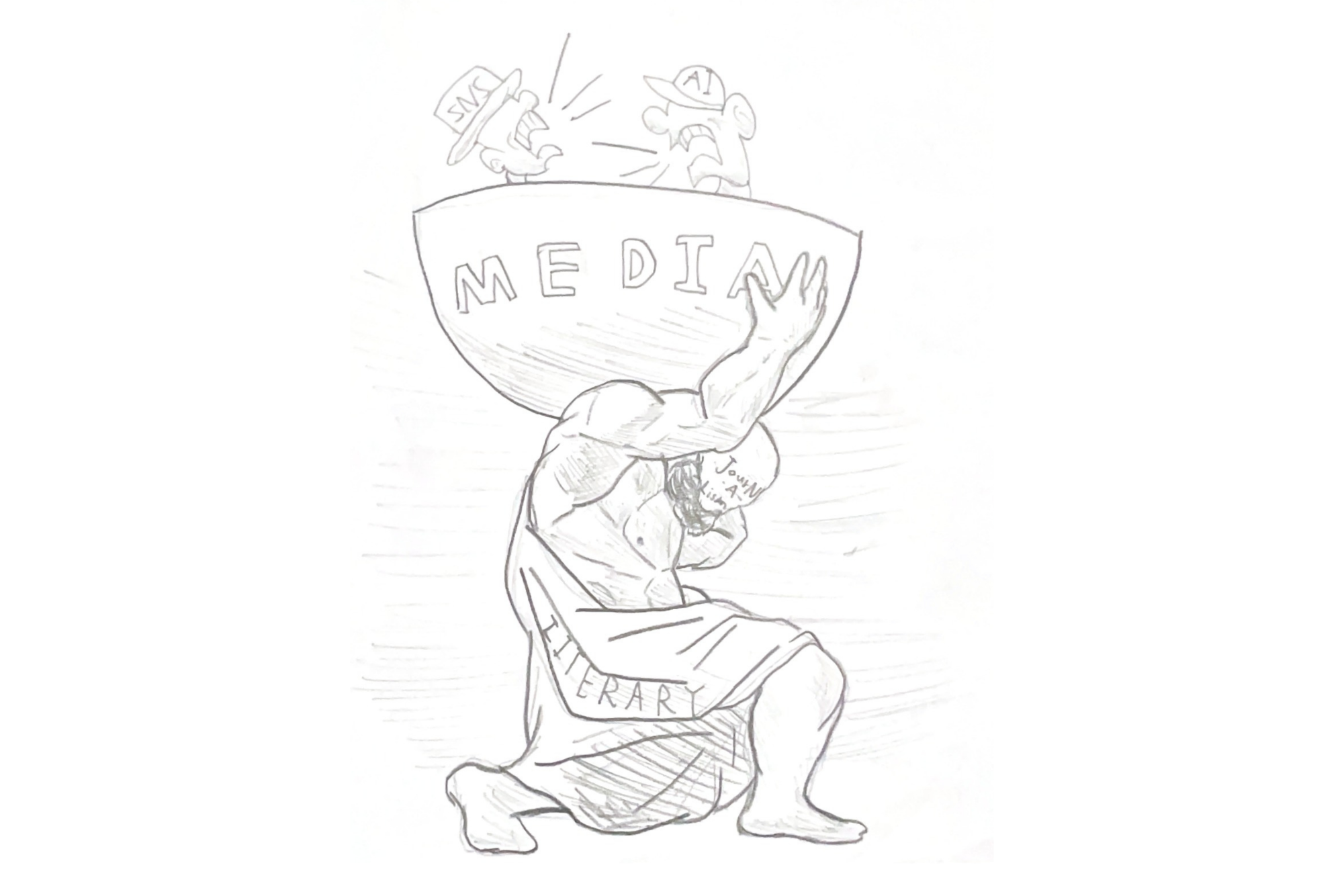
From current events to brainrot, we are constantly absorbing information. Social media platforms feed users endless piles of content that get read, commented on and shared each day. Oftentimes, content includes false information about our world, continuously manipulating or misleading viewers. With technological advances like artificial intelligence (AI), almost anything can be perceived as true by passive viewers, which many believe interferes with journalism, as writing and photos can be disguised as real events when they are not.
With so much going on in the world, journalists exist as the backbone of information for society. They play fundamental roles in pushing people to understand the environment they are in, which helps them make more reasonable decisions for their own lives. With such fast-moving digital news content from AI production, society is beginning to question the credibility of journalism today; so, it has become essential for people to become proficient in media literacy.
In the age of AI, journalism is often denoted as a “dying career” or a “regretted career” because of technology’s potential threat to spread misinformation and replace what some consider “tedious jobs. But journalism is in no way a dying art, even though the population is struggling with shorter attention spans and decreasing media literacy. Journalism is simply adapting to a rapidly digitalizing world.
Even with AI, journalism will never go away because it is an active industry that provides information about the world we live in. With the current digital world, people prioritize entertainment over actual information, creating a disconnect between the value that journalism still holds. Journalists are still trying to produce news to the public through all platforms (papers, websites, television), but it is digital platforms that are changing the demand for what gets engagement.
The real problem behind digital overflow is the lack of media literacy we as humans are ingesting. Since media is being produced on such a quicker scale, it is harder to know the reality of what is being explained. Unlike what people think, credible journalists mostly use AI intentionally as a tool, never heavily relying on it. AI should be used as a tool when it is used to fact-check, data analysis and translations. However, since 50% of articles today are written by AI, along with its frequent tendency to write inaccuracies, it has a high potential of spreading misinformation.
When people read AI-written articles that are inaccurate and believe it as the truth, it represents the societal issue of a lack of media literacy. At this point, AI has the power to, and does, distort the truth of news. So, people need to push themselves to research topics they find online to assess their credibility and ensure truthfulness.
In today’s world, journalists are actively competing with other news outlets for story turnover, so they are prone to use AI to adapt to quick changes, as AI works so fast.
Over 75% of official outlets are using short-form videos as a reporting medium on social media platforms. In addition, with people now having shorter attention spans, short-form journalism is at its peak, inclining people to pay more attention.
The new change in audience preference is creating the shift of news outlets to push for a much shorter news cycle, meaning that certain stories only have so long to peak in interest before another story takes full attention. From this, viewers are evolving to be more desensitized to current events, as there is a short window of time where a news topic is deemed as “entertaining enough.”
Ever since the 24-hour news norm emerged in 1980, people have been continuously fed information at increasing paces. Therefore, it is hard to keep up with journalism and its art form since the 24-hour cycle limits the amount of information that can be covered. But this is a reality that readers can adapt to.
To combat these realities of misinformation, media literacy training should be implemented in educational spaces. This can be given in schools, discussed in English courses, and encouraged. Only 42% of Americans today have received media literacy training. If there is more sufficient access to media training in the U.S., people would be able to identify their news and whether or not it is reliable. If the greater population understood how to identify false news and steer their attention to credible sources, there would be less confusion about what’s true, focusing on actual current issues and events. Digital landscapes, like AI, will fail to stop progressing because of the high intensity of growth it faces; we as humans have to adjust to this, and it is possible.
Additionally, news sites adhere to digital standards, creating social media content that feeds followers. Instagram and TikTok are some of the common places publications like “The New York Times” and “The Washington Post” use to share stories through photos and videos. This is creating news engagement at a quick pace that people can withstand.
Information will always hold value in society; it is simply about the way people receive it. Understanding that reliable news outlets are available, communally and globally, is where people need to draw their attention to, so they are given the right information.
People believe AI and shorter attention spans to be a threat to journalism, and as it can be, journalists are trying to alter their practices to make sure their work is heard against the perception of how people view it.
Journalism is not fading; it is adapting its methods so its voice can still be heard. Despite what people think, journalism remains the way voices can be heard and shared, and it is something that people still should have an interest in and pursue. To say journalism is a dying major is false, as journalists are needed more than ever to continue to produce authentic work to keep the public educated. Journalism and its industry are progressing along with current trends to ensure people are satisfied, making the college tuition worth the investment. To combat misinformation, education on media literacy not only does so, but it also reaffirms the value journalism holds, defending its worth as a career path.