
Dentists love to describe wisdom teeth removal as a “routine procedure,” which is interesting because nothing about the eight days that followed felt routine, manageable or even remotely casual. What began as a simple 10 a.m. appointment turned into a full week of pain, paranoia and the sudden realization that nearly every normal human activity, including eating, talking and drinking water correctly, can be taken away at any time.
Day 1:
I walked into my appointment calm and confident, which, looking back, feels less like bravery and more like “sending a lamb to the slaughter.” I knew I was getting all four wisdom teeth out, but I convinced myself that, because many people go through this procedure, it could not possibly be that bad. This was a comforting theory right up until 11:15 a.m., when I came out of surgery loopy, apparently funny and fully disconnected from reality. According to multiple witnesses, I said things that should not be repeated, which is uncomfortable, considering I remember none of it and now have to live with the possibility that my post-anesthesia-self revealed something deeply embarrassing.
The rest of the day was spent on the couch with ice cream, exhaustion and the strange feeling that I had just entered a completely new and terrifying stage of life: recovery. Everything felt dull and weird. My mouth was bloody, swollen and numb, even if my face never got dramatically chipmunk-level puffy. I tried sipping water and missed my mouth more times than I would like to admit, which was very humbling. I mostly stayed on the couch, half-awake, trying to grapple with the fact that this was considered the easiest day of recovery.
Day 2:
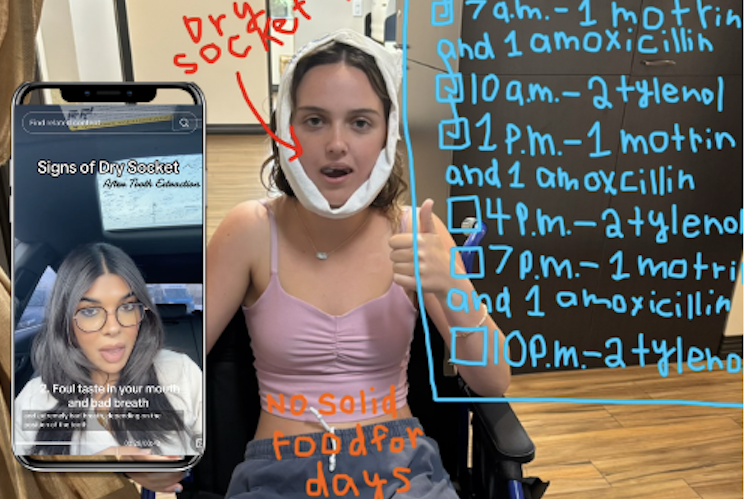
By the second day, my life lost all normal structure and became completely organized around medication. Every four hours, I rotated between Tylenol and Motrin (the 800-milligram kind). On top of that, I took amoxicillin three times and completed two antibacterial rinses a day. Recovery was no longer just “resting” to me. It was a part-time job where I was specializing in pain management and administration.
They also prescribed me narcotics, which I chose not to take. Part of it was that I did not want to be loopy again, and part of it was that I did not want to feel out of control or unable to drive or really do anything for myself. I guess I wanted to maintain some sense of dignity.
So, instead, I stayed committed to the Tylenol-Motrin system and hoped that would be enough. It mostly was — at that point.
The hardest part was that I could not really eat. That sounds minor until it becomes your entire life. Everything soft started to feel disgusting. Chicken noodle soup became unbearable. Applesauce, which should be harmless (afterall, it is a baby food staple), became one of the most depressing foods I ever ate. I was hungry, but nothing sounded good and nothing felt worth chewing. At a certain point, recovery stops feeling like a medical process and more like a karma driven personal attack.
At the same time, basic hygiene became more complicated than it should be. You are not supposed to brush your teeth normally right away, and even when you do, you have to be careful, which meant for a few days my breath was noticeably worse than usual, something I was very aware of, even if no one else said anything. It was a quite strange experience to be thinking about your breath constantly while also feeling like you cannot fully fix it.
This was also the point where I became convinced I had alveolar osteitis, or “dry socket.” My left ear was radiating pain, I had an awful headache and everything felt intense enough that I decided something must be wrong. I did what any rational person in a mild crisis would do and went to TikTok, where I watched one video, then another, then 20 more, until I was absolutely certain I had every symptom.
This is the dangerous thing about wisdom tooth recovery. Every sensation feels important. Every ache feels relevant. Every article or video starts sounding like it is specially about you. I convinced myself that the pain radiating into my left ear was not normal, that the headache meant something serious and that I had somehow entered the catastrophic branch of my recovery journey. Looking back, I think a lot of it was that I barely ate anything and was running on very little fuel, but at the time, my theory felt foolproof.
Day 3:
On Sunday, I decided to go see the movie “The Drama” at the University Town Center Mall with a friend. In theory, this sounds like progress, but in reality, I was just trying to rejoin society before I was ready. I wanted to feel normal again. I wanted to leave my house. I want evidence that I was not going to spend the rest of my teenage years lying on the couch with an ice pack, self pity and a miserable attitude. So I went.
The problem with trying to act normally during recovery is that recovery follows you everywhere. You are still thinking about your teeth (and the lack, thereof). You are still being careful of how you move your mouth. You are extremely aware of every sip, bite and every little shift in pain.
And then came the straw.
At some point in the movie, I accidentally sipped from a straw, which to a person who has not recently gotten their wisdom teeth out, sounds like nothing. But to me, it was the moment everything fell apart. You hear so much about dry socket that certain actions stop feeling like mistakes and start feeling like irreversible life events. The second I realized what I had done, I was completely convinced that if I had not already, I dislodged one of the blood clots, causing dry socket. I immediately added it to the growing pile of evidence that I was absolutely headed for disaster.
That is one of the weirdest parts of recovery. It is not just the pain. It is the constant fear of doing something wrong. No straws, no spitting, no sparkling beverages, no intense movement, no chewing in the wrong area and no brushing too hard. Every normal habit suddenly feels dangerous. Even drinking something becomes stressful.
After the movie, we tried to get food; however, since it was Easter Sunday, everything was closed. My friend got Panda Express, and as she enjoyed her crispy orange chicken and white rice, I seethed with jealousy. I wanted Panera mac and cheese since I had gotten it the night before, and it was safe enough to eat during recovery, but Panera was closed.
So instead, I got a big cup of frozen yogurt from NuYo in Solana Beach. It was good, and I was glad to have something, but there is something so incredibly bleak about realizing your dinner after oral surgery is frozen yogurt because every other option has failed you. It is even worse when you are starving and craving a “real” meal.
Day 4:
On Monday, I went back to school because I thought I could handle it. Boy, was I wrong! For about an hour I was on the right track for success. I actually thought I was proving myself right. I got through first period. I was upright. I was present. I was technically functioning. But by second period, which is Personal Fitness, it became very clear to me that I was not fine. You are not supposed to exercise for a week after surgery, and even beyond that, I just felt awful. Moving around hurt. Being at school hurt. Trying to keep up with a normal day while still being in a lot of pain was ridiculous.
So I went to the nurse and begged my parents to let me come home and rest. But apparently, since I had not learned enough, I came back for chemistry class because we were learning reduction-oxidation “redox” reactions, and I had a test the following week. That is one of the less glamorous parts of wisdom tooth recovery as a student. You are not just recovering. You are recovering while school keeps happening, assignments keep existing and people still expect you to function like a person.
Day 5:
Tuesday was worse because, by then, I was exhausted, frustrated and still convinced that something more serious was wrong. I was in English 10 Honors trying to work on my “A Raisin in the Sun” assignment, and I was in so much pain that my teacher finally told me I did not need to be doing that assignment and should go get help. That was both comforting and humiliating. Comforting because someone acknowledged that I clearly was not okay, and humiliating because it meant I looked as bad as I felt.
That was the day I called my oral surgeon’s office because I had reached the point where I could not just sit with my own theories anymore. I had a follow-up appointment coming up Friday, but Tuesday felt too far away from Friday for the amount of pain I thought I was in. I explained everything and basically tried to make my case that I should be seen immediately because, in my mind, I obviously had dry socket.
Instead, they told me to try warm salt water rinses, keep up with my medication routine and continue icing my face.
The rinses did actually make a difference, which was good news medically and bad news emotionally because I had already built a very convincing narrative around my suffering. Still, the pain was real, and the hardest part was trying to get through the school day without access to the things that actually made me feel better, like icing my face or just sitting at home and rotting on the couch.
Day 6:
By Wednesday, I had kind of reached the point of acceptance. Not acceptance in a peaceful, mature way. More in a “Fine, this is my life now” way. I went to school. I took my medications. I kept doing the amoxicillin, the rinses and the pain management routine. I did what I had to do. But I had almost no energy, mostly because I still was not eating enough.
That was one of the most exhausting parts of the week. I was not just in pain. I was tired in this heavy, unmotivated way where everything felt harder than it should. After school, I did not want to do anything. Not because I was lazy, but because recovery takes so much out of you when you are underfed, uncomfortable and constantly paying attention to what your body is doing.
Day 7:
Thursday was the first day where I started to feel like I was maybe returning to myself. It was not perfect, but it was noticeably better. I had more energy, less panic and less of that constant sense that every small pain meant something terrible. That night, I went to my hip-hop class, and it was the first time in a week that I had actually exercised. That felt huge. It made me realize how long the week had felt, because even one normal activity started to feel like a major milestone.
Day 8:
Friday was when everything finally started coming together. I ate Shake Shack, which felt like my first real meal in years. The taste of the burger and fries brought indescribable joy to my face that was still slightly swollen. After a week of soup, yogurt, applesauce, frozen yogurt and general disappointment, eating something real felt emotional. It reminded me how much of recovery revolves around food, not just physically but mentally. Being able to eat normally again makes you feel like a fully-able person again and not like a bed ridden medical patient incapable of fueling themselves properly.
In the afternoon, I went to my follow-up appointment, and this is where the plot twist happened. They told me I did not have dry socket. Everything was healing fine. The reason the bottom left side hurt the most was because that tooth had been the most impacted and tilted, so it took more work for the oral surgeon to remove. This made sense, especially because I remembered from the X-ray before the procedure that the bottom left tooth looked the worst. It was not straight. The way the tooth was tilting should have been a warning that it had no intention of leaving my mouth peacefully.
So apparently, the pain was real, but the explanation was less dramatic than I had hoped.
Final Thoughts:
One thing I still do not understand is when people ask you to rate pain on a scale of one to 10. That sounds easy until you actually have to answer it. I never know what to say because I do not want to be dramatic, but I also do not want to downplay it and make it sound like I am fine when I am clearly not. If I say eight, am I being dramatic? If I say six, am I lying? Who decides? What is the scientific difference between a seven and an eight when your ear is radiating pain, your breath is terrible, you have not eaten a real meal in days and TikTok has convinced you that your body is failing?
Three weeks later:
Now, three weeks later, I feel normal again. I can eat whatever I want. I can go through my day without thinking about my teeth every five minutes. I still use a syringe to get food out of the holes, which is both helpful and deeply unpleasant, and my left side occasionally still hurts a little, but I am so much better that the whole week feels almost unreal.
My brother is getting his four wisdom teeth out today. Let us all wish him luck and hope his recovery process goes much smoother than mine did.
Wisdom teeth removal may be routine; however, recovery does not feel that way. It feels like a full-time commitment, a paranoia experiment and a forced lesson in appreciating solid food, fresh breath and the ability to drink from a cup without fear of spillage.