

“An update has been posted to your applicant portal,” the newest email in your inbox reads. You click the website’s refresh button and log in as your stomach feels heavier with each passing second. The first sign of failure is the lack of confetti. The second is that your letter does not open with “Congratulations.” The third is the glaring six letter word: “regret.”
Class of 2030 college applications continue to be competitive as schools like Bowdoin College, Georgia Institute of Technology and Tufts University received the largest applicant pools in history. Highly-ranked, prestigious universities like the Massachusetts Institute of Technology and Ivy League schools had overall admission rates in the single digits. These statistics indicate the frequent appearance of the rejection letter.
For every congratulated student, there are far more who receive a waitlist notification or a rejection letter. The act of rejection, for people who actually read the letter and care about the institution, comes with the additional burden of processing the college’s explanation during an emotionally taxing moment. Many students say they would prefer a blunt and direct statement. However, ensuring well-written, respectful and emotionally intelligent rejection letters has never been more vital than during the modern application process.
While the contents of a rejection letter seem insignificant in the grand scheme of things, they have potential to transform the taxing atmosphere of college applications. They can encourage a more thoughtful, empathetic generation with the capability for collaborative, revolutionary achievements. In this sense, they carry more responsibility than their acceptance letter counterparts.
In the present day, most American undergraduate programs admit students using a holistic approach, in contrast with exam-based or grade-based admissions common in India and some Asian and European countries. Often, the goal of this is to select students who align with the institution’s mission and build a diverse student body. This attempts to mend the flawed aspects of only considering an exam or grades by analyzing a complete picture of an applicant, including extracurriculars, essay responses and character. However, while an institution does its best to select students who would be a “good fit” for their school, certain judgments can still feel incomplete and flawed. With this all-encompassing approach, many students react to rejection with statements along the lines of regretting working hard or feeling like time was wasted. Moreover, after pouring heart and soul into essays and activities, being rejected appears to be a denial of the student as an entire person. It is true that validation or external evaluation does not detract from the sum of a person’s accomplishments, learned lessons and experiences, a piece of comfort offered to many students in this arduous process. However, there still remains the feeling that one’s passions and ideas are “not good enough,” to the point where many students are prone to forgetting that they are still the same person and to doubting the immensity of their progress thus far.
Online and in person, students often come together for support in this shared process. Interconnection means more communication, more available advice and more camaraderie, but it also gives way to more counterproductive comparison. One’s own decision often arrives with an onslaught of many other applicants sharing theirs. This system is seen as so important that demand for counseling and advice creates lucrative careers, some exploitative in nature. Sharing grade point averages (GPAs), extracurriculars and test scores is commonplace among applicants. Such practices misconstrue college applications as a predictable process, one that is still defined by the numbers on a student’s application, when more often GPAs and scores — whether high or on the lower end — do not tell the whole story. Colleges also do their best to get to know applicants; however, factors like limited means, perspectives, time and subjective evaluation make it futile to question the results of those who may seem “less deserving.” As college becomes more and more synonymous with the word “future,” semantics of a rejection letter carry a large degree of influence.
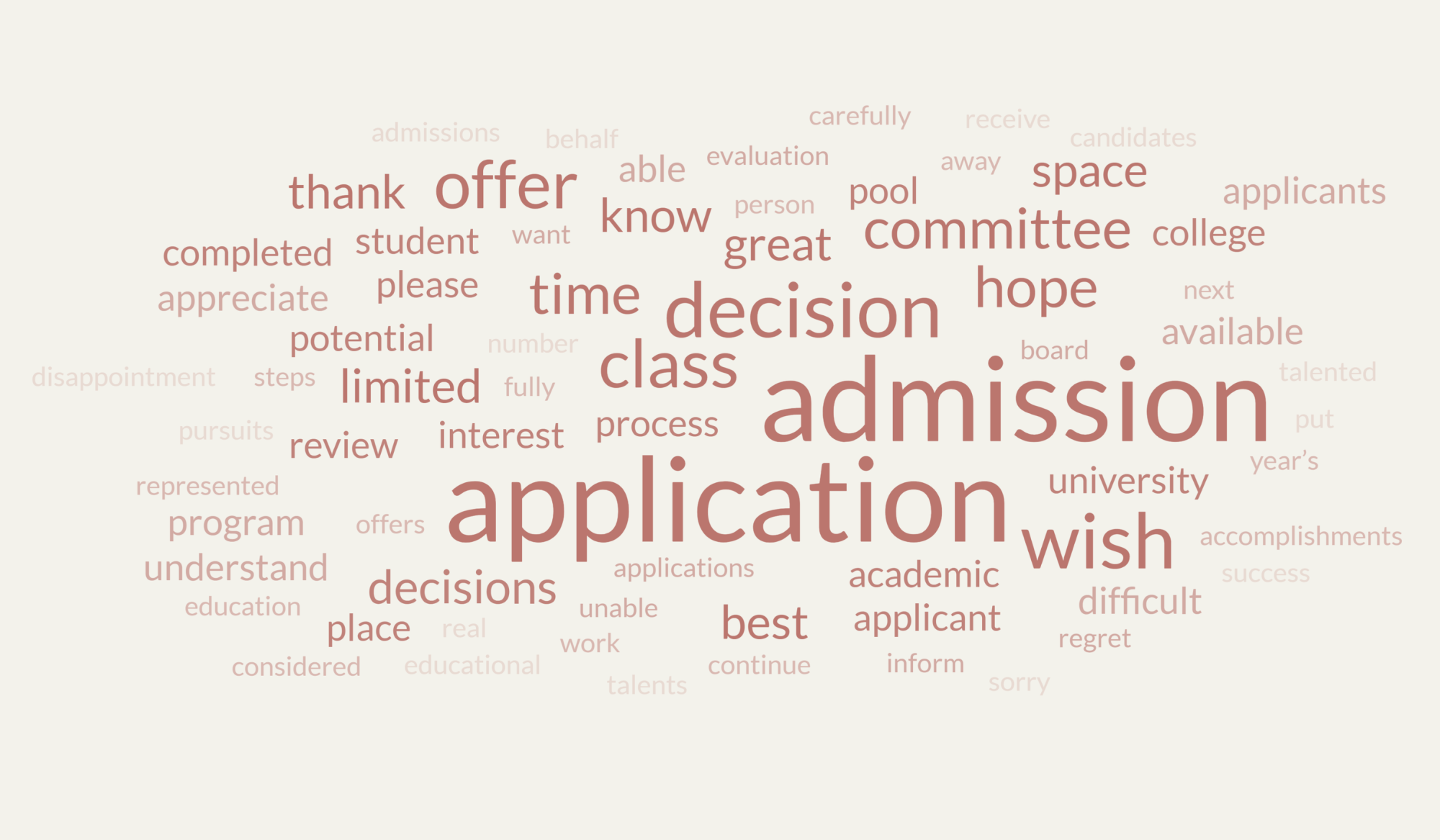
A rejection letter serves many purposes. It must announce the rejection, first and foremost. Many also emotionally stabilize the recipient, contextualize the decision with a big-picture overview of decisions (usually in terms of the applicant pool), explain the decision without being too specific, discourage or encourage the recipient from requesting personalized feedback and thank and wish the recipient well in a handful of short paragraphs. Besides quoting individual lines, applicants’ complaints often relate to the wording of the rejection announcement or the length of the letter. When a letter mentions “regret,” it is often met with pushback due to seeming disingenuous or trivializing the recipient’s emotions. Words like “denied” and “rejected” also seem to evoke negative emotions across the board, in contrast with “not offered admission” or “not accepted.”
Letters from schools including Carleton and Harvey Mudd College stood out for exhibiting the most kindness, and a humble tone, especially considering their prestigious rankings.
For Harvey Mudd, genuine appreciation and well wishes for its rejected applicants shone through.
For Carleton, it was an acknowledgement that an admission office’s judgement may never be truly fair, and encouragement that students can and should continue striving for greatness.
Within anecdotes and online conversations, some students express preferring blunt letters to those that drag on. While some letters do not feel entirely convincing — and perhaps a flat out rejection would be better than a superficially regretful one — in most cases, gentle and empathetic letters are the best approach. If a student would prefer a blunt letter, they may stop reading when the decision is clear. Having a reassuring letter for those who require it and, perhaps, sacrificing two minutes of reading time for those who do not is better than the reverse situation. For people who remove college results from a position of high standing, it is difficult to understand the weight on the shoulders of people who spend years building up a vision of a dream future or uphold immense pressure for admission to an institution due to financial aid and additional reasons. One person’s ability to tolerate and accept the process with all its instances of rejection does not detract from another person’s struggle to do the same.
In an age where visionaries are all the more necessary for solving myriad problems, encouraging students to shape the world for the better is one of society’s biggest priorities. Missions to create positive change and individual principles may become lost amid constant comparisons of numbers and extracurriculars with peers; amid the growing desire for eliteness and prestige; amid the desire to outcompete, to stand out, to achieve a learned picture of success. What this process often forgets is that life is a continuous journey, where the only endpoint is not a decision, and that it is important for young people to create impact, regardless of if it is small or large. Impact requires maintaining curiosity, independent thought, endless self discovery and altruism. As a result, the most effective rejections emphasize a detachment from the student’s future potential and a down-to-earth respect for the glimpses institutions receive into each applicant’s minds and lives. Facing rejection is just one small blip in a life as full of setbacks as it is of achievements.
A rejection letter should teach students that, no matter the wear and tear and weathering that life throws their way, they must not forget themselves; they must not stop exploring or working towards their most authentic desires, dreams and visions for the world.



Jenny Ryu • Mar 29, 2026 at 2:16 pm
What a comforting perspective! Though, the reality is that there are only a handful of students who actually continue reading to the end after they see the word “regret”
Joanne Liu • Mar 27, 2026 at 11:16 pm
last two paragraphs so beautiful I’m going to print it out and tape it on my wall