

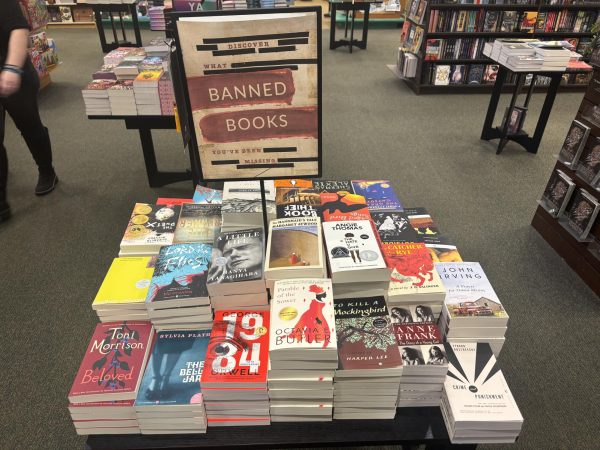
For me, a day off of school entails a stroll through Barnes & Noble. Placed in the middle of the Encinitas Barnes & Noble store, two tables that immediately catch customers’ eyes are the romance and “Banned Books” tables. Barnes & Noble clarified their “Banned Book” section to center books that have been either restricted or removed from libraries, school districts and community organizations due to political or religious reasons. Each table is diverse with subgeneres, but something is still missing.
As of Feb. 17, 21 of the 28 displayed books were written by white authors with white protagonists on the “Banned Books” table. On the romance table, 23 of the 24 displayed books narrate heterosexual relationships despite queer stories rising in popularity, with LGBTQ+ fiction stories’ sales recently rising 173% since 2019.

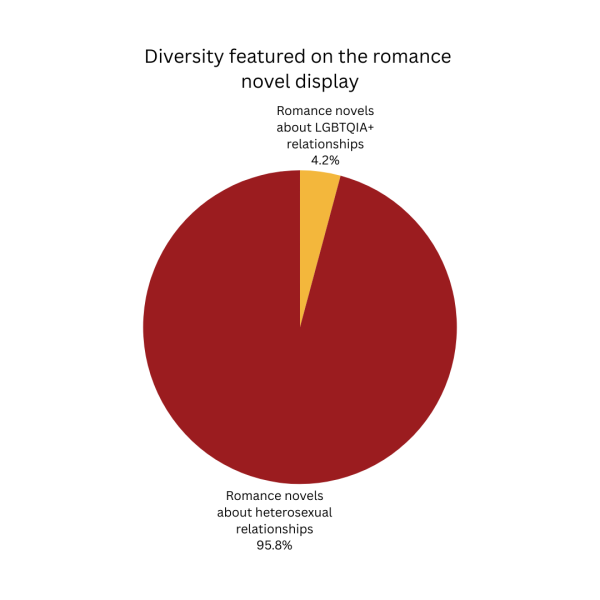
Silencing authors and storylines by only marketing books that are “acceptable” to read and sell mirrors censorship itself. Of the over 10,000 banned books, the overarching driving factor for their prohibition lies in LGBTQIA+ and racial theory concepts, and the same prejudice is apparent in the Encinitas Barnes & Noble store, even as the severity of book banning in California is far less than other states. But despite the fact that California avidly fights against bans, these books are still not receiving the same promotion and popularity as other books.
Barnes & Noble denounced book banning on their website, which reads “The Books They Don’t Want You to Read” and “They’ve been challenged, banned or censored. Read them while you can.” The company continues to sell these banned books, but this current in-store display does not connect to that sentiment. If these banned book and romance tables only want to feature white stories and lack diversity, the store continues to push exclusion. In the US, 41% of banned books feature queer themes, plots and characters. Additionally, 40% of banned books contain protagonists of color. The majority of censorship is targeting those adverse to conventional themes, and therefore propels the continuity of banning books. Although Barnes & Noble tries to spotlight these books, their marketing does not reflect those statistics. It is contradictory for a company to voice their support for an issue and criticize the current climate, but then continue to push bias and exclusion.
Some may say that these displays only serve to reflect customers’ demands. One store’s display cannot speak for an entire company. It may very well be possible that the reason for these rather limited book displays; it simply shows what is more popular at the moment, not what the company stands for.
However, these displays are crafted from corporate decisions, not just sales numbers. They are not random; rather, they reflect what the company is trying to push. As in-store displays inevitably vary, there is still a framework that should be followed and implemented to each store. In a space where storylines are continuously censored, there is thus a growing bias for a marketed storyline. If standing with banned books pushes for representation, then why are censored stories about minorities or queer characters not given the same marketing attention as traditional stories? There is not an equal highlight between diversity throughout these novels.
When a corporation as large and influential as Barnes & Noble pushes a single narrative of what banned books are while claiming to do the opposite, it sidelines the movement against censorship by, paradoxically, silencing the many stories about queer, minority and other oppressed peoples’ perspectives. What the corporation should move toward is trying to even out how they are actually showcasing the books so it is fair and actually diverse, living up to their claims.
The support of banned books is not simply to defy rules; it is to raise awareness about the oppressed and learn from different narratives that were continuously silenced in history. In the early 1980s, a high profile Christian evangelical preacher televangelist called the book “Our Bodies, Ourselves,” a sex-ed book that included queer topics, “obscene trash” and pushed for it to be banned. Similarly, “The Autobiography of Malcolm X” was banned in multiple school districts through 1965 to the 1990s.
There were over 22,000 efforts to ban books with queer stories and racial diversity since 2021. Unfortunately, these bans were successful in select states across libraries and school districts. There are currently 76 legislative stories to un-ban books with only 14 bills accepted, while more titles are being banned. There is continued defense to un-ban books, yet no formal action to cease bans in general. Protests like the “Books Unbanned” project in certain libraries are examples of counter efforts but remain to be the only form of truly un-banning books.
The entire purpose of these displays is to showcase a diverse catalog of books that people can read and learn something different about then what they already know. If Barnes & Noble can write online their support for the cause, but cannot physically display their support in stores, then they are contributing to the very censorship they condemn.