

Pro – by Joanne Liu
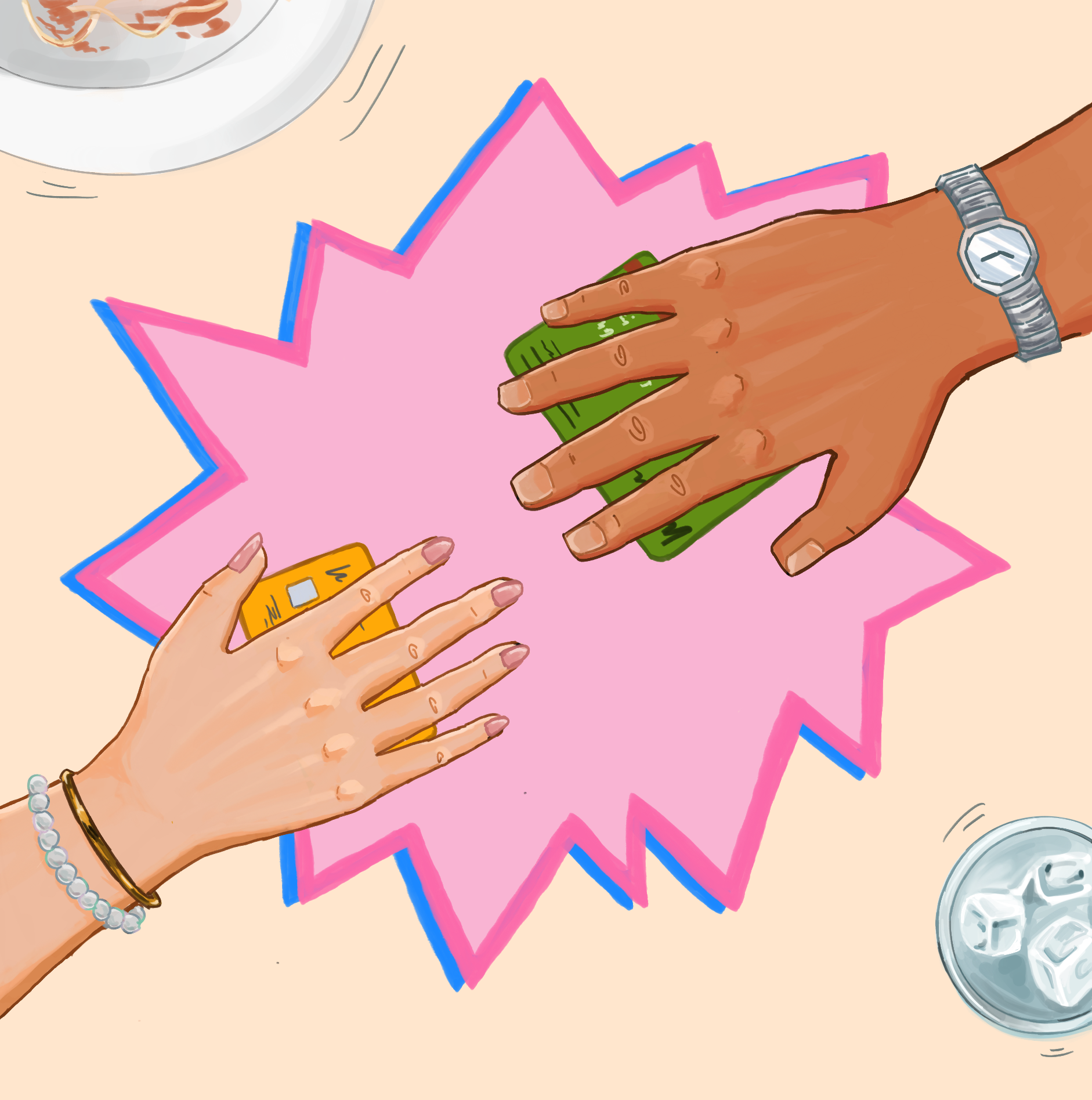
Waiters furrow their brows in disappointment at men who insist on going 50-50. Online, many conflate splitting the bill with the slow death of chivalry. For men to pay on a heterosexual date, it seems, is the natural order of things, and anyone challenging this risks upsetting the delicate balance of gender norms. Yet, this societal “rule” is representative of a larger, more complicated web of oppression at play. These standards we have normalized do not adhere with feminism, which calls for the equality of all genders. Only when we shift to each party taking half the cost or having either individual pay for their own meal, principles that do not further divide gender expectations, will we have reached true feminism.
To begin, expecting men to pay is founded on either patriarchal traditions or an inadequate attempt for compensation, while splitting the check on dates is founded on the basis of equality, just as feminism is. Just over half a century ago, women lacked financial independence. Until 1974, single women still needed male relatives to co-sign loans for them. In this rigid culture, men were “providers” and needed to prove their financial power to women, who largely depended on marriage for livelihood. Over generations, the expectation that men pay for expenses strengthened. Since then, however, countries like the United States have made monumental advancements in gender equality. There is no need to continue to perpetuate these practices, no point in letting the bitter aftertaste of a custom founded on oppression linger. If we have truly progressed towards feminism, it should be evident in all aspects of society, even a dinner date.
The prominent reason society still upholds this custom is due to we have internalized biased social rules based on gender: many women expect men to be forward and some men are offended by offers to split. The notion that men wield authority over money and that they must chase, while women passively await men’s “favors,” stems from inequalities that we have regularized.
It is true, however, that the patriarchy still dictates every aspect of our lives, suppressing the freedom of women and harming men in many instances. For example, in 2024, women earned an average of 85% of their male counterparts. Prejudices deeply entrenched within society constrain women, barring them from opportunities more accessible to men. Thus, some critics of splitting the bill argue that men should pay for dates as a form of reparation.
In theory, this sounds plausible. It holds equity over equality, essentially leveling the playing ground. However, equity is often messier in practice. Though the general societal trend indicates that women are at a financial disadvantage, it is not applicable to individual cases. Beyond gender inequities, other systems of oppression are also important factors in one’s financial situation. For example, there is also a race wage gap. Studies in recent years found that, on average, a black person makes 76 cents for each dollar a white person makes. Yet, it would be strange to take race into account when paying on a date. Are we to sit down before every first date and list our grievances in order to determine who should pay? Attempting to calculate the impact of systemic oppressions to properly issue compensations is an impossible task. Injustices should be addressed, but compensating for them on an individualistic basis is both inefficient and inaccurate.
Other critics of bill splitting point more directly towards the fact that women are expected to uphold higher beauty standards, leading many girls to invest far more time and money into getting ready for events like dates than guys. While this is the unfortunate reality, it does not make sense to encourage this “deal” that women should be dressing up and doing their makeup in return for a free meal. The “reward” of free dinner insinuates that physical appearance has a price tag, that a woman’s beauty should be bought. Instead of having men pay the full check, which would only reinforce this idea, we should be aiming to even the beauty standards for men and women (or shift away from obsession with beauty). Women should not feel obligated to achieve beauty in the eyes of a male gaze. In a truly feminist society, both parties should spend, on average, similar amounts of time preparing for the date, showing up in what they feel is fitting and comfortable, and then splitting the bill; neither party is paying for the other’s beauty. They should just pay for food.
As we navigate this controversial space where each person has a different take on how dates should be paid for, normalizing splitting the bill can avoid that stretch of awkwardness for either individual on a first date when the check arrives, preventing both parties from frantically trying to guess what might be best. Expecting the other person to handle the bill or assuming full control of it for yourself can both get messy and complicated. If we all practice splitting the bill, dates would sail more smoothly, allowing for peace of mind and an even starting ground for both parties.
Even more important, splitting the check on a date is a small act that propels us to progress past thousands of years of patriarchal tyranny. It is time we realize that financial responsibility is both a burden and a power. Gaining this power is a step to help women finally reach social equality. Breaking the binds of unfair societal norms is difficult; it is hard to fight against our internalized biases. We must slowly unravel our chains, unshackle those heavy cuffs limiting us from reaching the most logical solutions, until we reach equality, one check at a time.
Con – by Riley Gunn
There is something quietly symbolic about the moment the check arrives on a date. Your glass sits half empty, laughter softens and the check is an invisible line of uncomfortability. It is about the impression and who you want to be to this person. A date is not a business meeting, or a place for dividing expenses and calculating transactions. As a meeting born from invitation, paying on a date is a gesture that carries the words, “I want to see you again.”
A date is meant to be about conversation, connection and getting to know another. The moment your date turns into a transaction is the moment the mood dies; both people start calculating who owes what, discussing totals and awaiting separate checks. The energy dips and the spark dulls. A once-romantic invitation suddenly flattens to a mere transaction. The atmosphere shifts from romantic and inviting to arithmetic.
Stepping away from the money alone, the gesture of buying someone dinner is representative in itself. When paying for someone, you show effort and that you really care. Splitting makes dating seem too calculated, and dating is supposed to be anything but calculated. In fact, there is nothing rational about the buzz in your head, in your chest when you meet someone new, nothing rational about this inexplicable human condition of love that keeps you up at night, wakes you up in the morning. Dating is, however, meant to feel exciting.
In those first moments when impressions are fragile, he confidently picks up the check with ease and thanks the server it, keeping the mood alive. There is something so deeply attractive about this steadiness. There are no awkward pauses or wallet-fumbling, only a deliberate sign of stability and reassurance. That gesture can leave a strong and lasting impression, communicating maturity and seriousness without speaking a word. It can feel quietly affirming, like being chosen.
Chances are, paying for the date is not necessarily what your partner will remember. However, genuine confidence lingers long after plates are cleared, and that, she will remember. People naturally compare experiences, even subconsciously. A survey conducted earlier this year shows that 85% of men pay for the first date. In reality, you are not the only one who has ever taken the lead and covered the bill without making it a conversation. But the point is not that “most men do it,” and therefore you should. Rather, it is that the gesture itself has overtime become culturally associated with initiative. It sets a standard and carries meaning. Being the only one to split the check is a moment that can stand out. That pause, the hesitation, the energy shift, that detail becomes attached to that night, attached to the story they’ll tell their friends, and may factor into whether or not you get a second date.
As for generational trends, men have been paying on dates for roughly 100 years. Many assume that this societal norm might be shifting with an arising “woke” mindset, but it is doing the very opposite. The upcoming adults of our world, Generation Z, have reported that 90% of men pay for most or all of a date, while women pay only about 2% of the time and splitting occurs only around 8% of the time. Still, prevalence on its own does not indicate nor determine value. The significance lies in what the act represents within the moment. Regardless of whether one agrees with this tradition, the gesture should be understood not as an expectation, but as an illustration of intention.
In the broader scheme of things, there are five distinct ways people express love and feel loved, one of which is gift giving. Giving a thoughtful gift speaks volumes about your intentions with that person. It is beyond a price or quantity; it is an act of love. When you buy someone a gift, be it dinner or flowers, you inherently convey that you care about them. The act of gift giving is not so much about money, but about intention. Thus, when buying someone dinner, you gift them quality time and active bonding. This can make a significant impact in reaffirming a partner’s affection. In addition, they might deeply appreciate the thoughtfulness that went into every gift they receive, including the effort that is behind the gifts.
Equality is the very foundation of every romantic and healthy relationship. Both parties should feel capable, respected and equally valued. People often confuse equality with identicality, assuming that equality commands that every gesture be mirrored. There is a great difference between equal worth, followed by a natural unfolding of reciprocation, and identical action, inferring that all action revolves around doing the exact same thing for the other in pursuit of “fairness.” That is where confusion breeds. Yet, fairness is not always about that; it is about mutual respect. When the check arrives, splitting might seem like a safer option, maybe balanced. But if one person extended the invite, paying would simply be an extension of the invitation, not an act of inequality. If he asked her out, him paying is a reflection of initiative, and if she asked him out it would display the same generosity. Choosing to treat someone does not diminish either person’s independence; instead, it fosters goodwill and reciprocity. People tend to have a proordained idea that if a man chooses to pay for the first date does it makes the act unequal, her capability does not abruptly vanish because someone chose to treat her. If anything, true equality allows both people the freedom to give and receive with an absence of suspicion.
In all, a key difference in splitting or not splitting the check comes down to romantic intent. On a date with a friend is the appropriate time in which one should split the check, but in a romantic setting the bill should be paid by the man. Splitting the bill insinuates a purely platonic relationship, while a man covering is a signal of love. While splitting the check might seem like the fair choice, it causes awkwardness and kills the mood. When men step up and pay the check, it communities decisiveness and stability while simultaneously making a lasting impression.