
Another four years have flown by, heralding the arrival of the 2026 Milano Cortina Winter Olympics in Italy. From popular events like figure skating to the obscure skeleton and luge, the Winter Olympics takes on the role as the Summer Olympics’s lesser appreciated twin, standing in the shadow of its sibling’s success.
However, this year is unlike any other: it boasts the highest demographic diversity in the history of the games. Approximately 47% of competitors are female, a record-high statistic that represents growing measures to ameliorate gender disparities. This highlights major growth and achievement as it stands in stark contrast to the first Winter Olympics in 1924 when women represented 4.3% of competitors. In addition, 4 new women’s events will make their debut: freestyle skiing for dual moguls, luge doubles, ski jumping for large individual hill and ski mountaineering sprint. Furthermore, Benin, Guinea Bissau and the United Arab Emirates are making their Winter Olympics debuts and Laila Edwards, women’s hockey player, will be the first Black woman to represent the U.S. in this event.
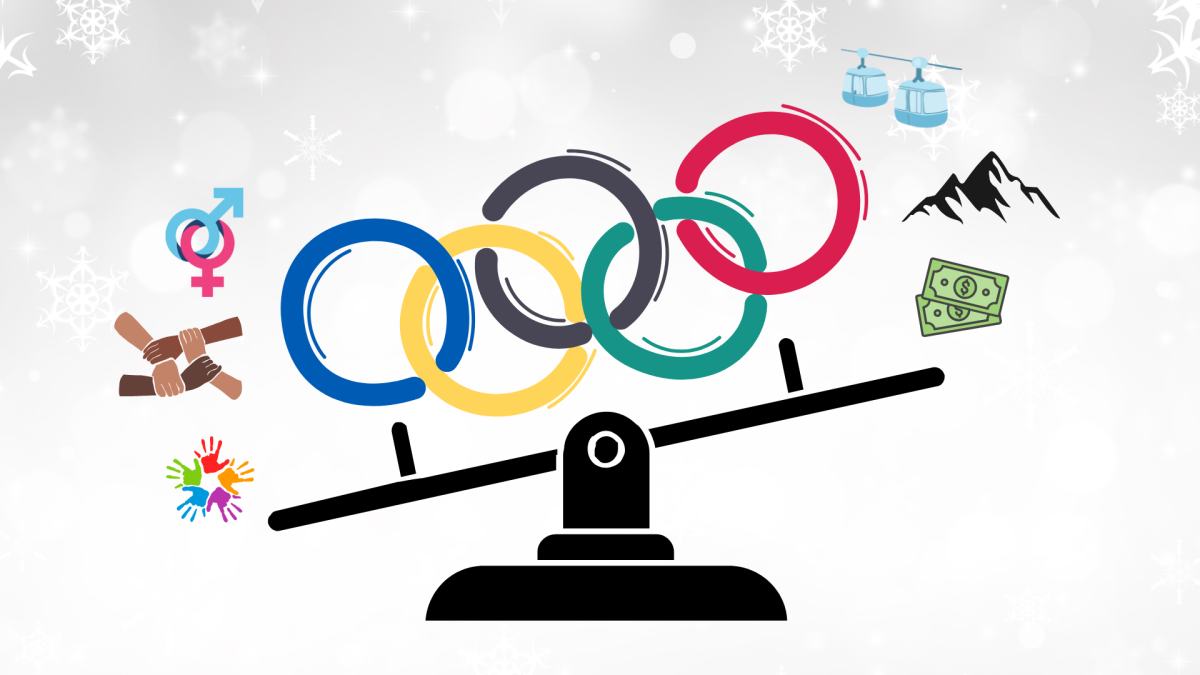
In an era that champions diversity, equity and inclusivity, it would seem probable that the Winter Olympics would be up to date with emerging inclusivity standards. It surely seems as if gender gaps are closing and the inclusion of athletes of racially diverse backgrounds is increasing, or are they?
Compared to the first Winter Olympics in 1924, context changed dramatically. Athletes were overwhelmingly Caucasian males and out of the 16 attending nations in the 1924 games, only two, the US and Canada, were not located in Europe. It was not until 1980 that the first African Americans attended the Winter Olympics. Still, more recently, a study in 2017 showed that approximately 95% of winter olympic athletes were white, indicating a strong correlation between race and qualification. Shockingly, in the Nordic combined skiing event, only men are allowed to compete. It remains the last Winter Olympic sport to exclude women. U.S. Nordic combined skier Annika Malacinski is a vocal advocate for equality in this area and won the US National Championship title in 2023 in the event. Somehow, her twin brother Niklas Malacinski is able to compete in Nordic combined, while she is not.
In order to discuss the equity of the Winter Olympics, one must first discuss the equity in winter sports, which revolves around two things: resources and location. Winter-specific sports often necessitate more gear comparatively with other sports, which then increases the cost of participation. Equipment often needs to be specialized, high quality, properly fitted and requires higher maintenance to endure cold, icy conditions. At a fundamental level, competing in a running event in track and field only requires a pair of running shoes. On the other hand, a winter sport like luge jumping requires a luge, or sled, an aerodynamic racing suit, streamlined helmet, visor, spiked gloves, booties and a weight vest. Not to mention, the specifically designed luge track and ramps necessary for appropriate training.
Quite obviously, there is also the location. A country like Norway or Canada often experiences snow as early as September and as late as May, allowing for at least a 6 month season with prime conditions. Countries closer to the equator, such as Fiji or Venezuela with no instance of recorded snow, are clearly at a disadvantage, as individuals who perhaps had the talent to be competitive skiers are forced to travel or move internationally for the right resources and conditions. Coupled with geographical disadvantage, countries that are located near the equator tend to have comparatively lower levels of economic prosperity. This means that overall populations in these areas tend to be poorer, and thus, have less financial opportunity to pay the steep cost of winter sports. However, while there is not much countries nearer to the equator can do to maximize infrastructure and create opportunities in sports like skiing or snowboarding, communities can still construct indoor ice rinks in order to expand participation in sports like figure skating or ice hockey.
It has also been shown that an “athlete’s chance of making an Olympic team increases significantly with intensive training at elite boarding schools or academies” that can cost tens of thousands of dollars. Wealth therefore impacts an athlete’s ability to progress and access opportunities at the elite level, constraining groups of lower socio-economic status, who often happen to be of racial minority. Thus, inherent inequity limits the potential for growth for disadvantaged athletes, especially in winter sports, pushing the Olympic podium further from reach.
These barriers are reflected in Winter Olympic results. At PyeongChang 2018, no athlete from Africa, Central or South America won a medal. It was not until 2022 Beijing that U.S. speedskater Erin Jackson became the first Black woman to win an individual gold medal at a Winter Olympics.
The system is quite obviously positioned against minority groups and must be reframed to better encourage demographically diverse athlete participation. Organized effort by the International Olympic Committee (IOC) has not demonstrated much promise. While the IOC awarded 429 monetary scholarships to winter sport athletes ahead of the 2022 Beijing Winter Olympics, 69% of 429 scholarships awarded by the IOC were European athletes and Black athletes received no more than 4% of those 429 scholarships.
It seems that while the 2026 Milano Cortina Winter Olympics is expected to be the most demographically diverse yet, it still is not enough. Our standard for equality in the sport needs to be higher, and the first step is rectifying scholarship programs like the IOC’s to better support minority groups. Statistics monitoring diversity in winter sports are rising — just not fast enough.