

Over a “No Kings” protest condemning President Donald Trump, a military fighter jet deploys manure on protesters. The pilot is the president himself. This generative video was one of many that Trump posted on his social media platforms to ridicule his opponents, all of which received extensive public backlash.
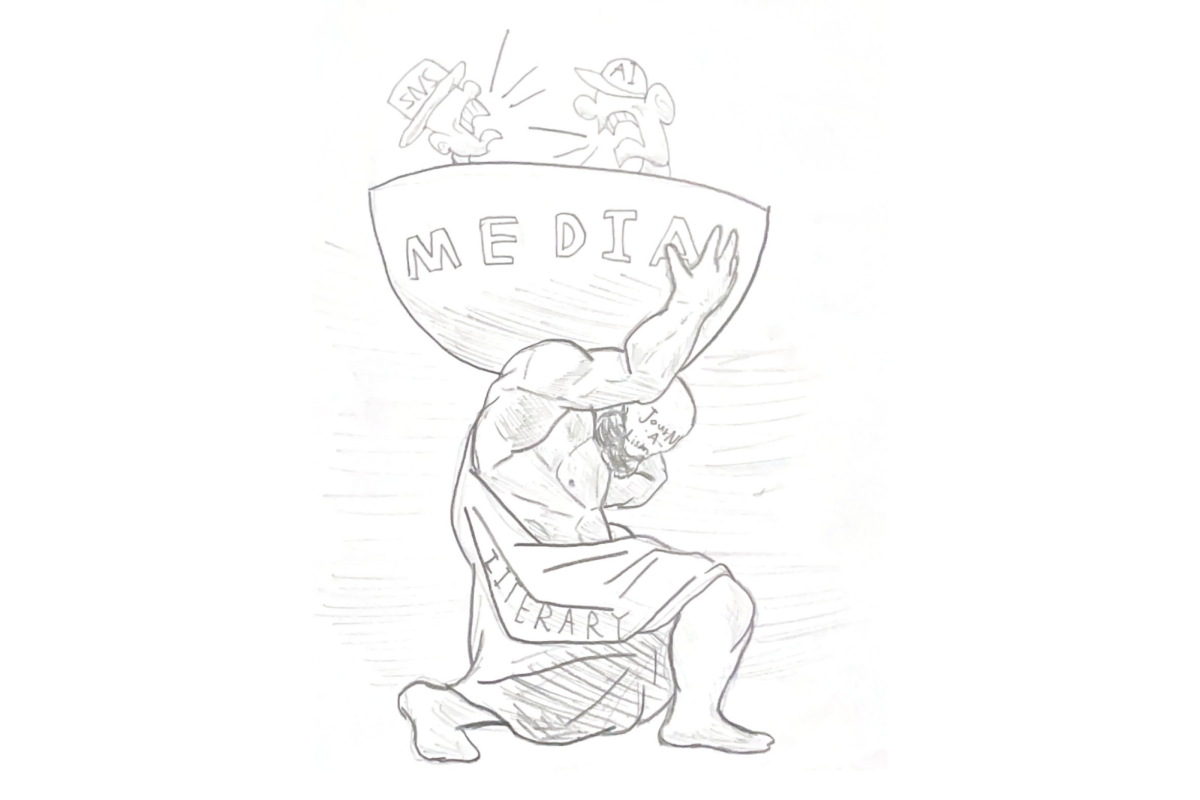
As political tensions rise, so has the use of artificial intelligence (AI), with politicians using it to create social media content. Fake videos and images should never be exploited for political reasons. Doing so is not only immature, it is immoral. The use of AI in politics erodes political trust and security, morphing government matters into a manipulative and abusive distortion of power.
The promotion of AI-generated online messages is blatantly inauthentic; the media coverage of politicians’ views on political matters should only be created through conventional means. It is far simpler and more convenient to type a prompt into ChatGPT than to produce media organically. However, a politician’s job is not to be as efficient as possible, but rather to be as effective as possible. This lack of effort is not only on the part of the politician but also their promotional team, revealing a shameful lack of interest in both their political agendas and the citizens they work for.
Moreover, the use of AI for harmful defamation of groups of people further divides our nation, a slope that we cannot afford to stumble down. For instance, Gov. Gavin Newsom slandered Trump on X following a string of Democratic wins, mocking Trump’s social media style on Nov. 5 by posting several AI-generated images showing the president as a crying baby in a stroller, sucking on a pacifier, crying over spaghetti and another where Newsom feeds Trump a pacifier. Newsom also posted another video of Trump crying while wearing a red “Newsom was right about everything” hat instead of his signature Make America Great Again cap.
Furthermore, in the New York City mayoral race, contestant Andrew Cuomo used an AI-generated ad to attack frontrunner Zohran Mamdani. According to Politico, “the ad depicts Mamdani as a demonic trick-or-treater with cartoonishly exaggerated expressions … [he then] peels off his skin to reveal that he’s actually Republican candidate Curtis Sliwa in disguise.” His campaign videos received criticism, as the use of AI instead of hiring actors conflicts with his promises for New York City: economically supporting people by creating jobs.
Regardless of purpose, the production of material through AI distorts genuine messages into unrealistic scenes of ridicule. Deepfakes, synthetic interpretations of a person doing something they didn’t actually do, further the normalization of ad hominem means of critique. These posts focus on evoking emotions rather than being factual, aiming to influence public opinion in favor of or against a certain political figure. Political figureheads need to prioritize factual and real promotion of their own campaigns rather than mocking and exaggerating opponents’ flaws.
Additionally, AI poses drastic environmental consequences, producing electronic waste and leaving a significant carbon footprint. ChatGPT, for example, is estimated to emit about 8.4 tons of carbon dioxide per year, more than double the amount emitted by the average human. Using such a platform as a political leader demonstrates a disregard for urgent climate issues plaguing humanity, and as a result, for the individuals they are supposed to advocate for.
Most importantly, AI is a direct threat to the democracy of our country. Countless revolutionaries worked to establish the basis of an egalitarian republic in which the opinions of all have equal influence. Our Constitution is the backbone of this nation, its preamble clearly stating the intrinsic rights that “We the People” have. Politicians serve to protect these universal liberties. They must embody their fellow Americans’ needs, working relentlessly to ensure their opinions are heard. AI is incapable of encapsulating the human essence.
It is no longer a government “of the people, by the people, for the people” if we are not being represented by people at all.
Disregarding AI, it is true that marketing and exposure through media are a crucial part of a politician’s administration, as it keeps citizens aware of what is occurring under their influence.
“Politicians are just celebrities to a degree, and so they’re in the limelight,” John Milner, AP World History and Sociology teacher, said. “They’re just using a tool to get likes and votes.”
The media we consume changes alongside developments in technology, so politicians’ pivot to AI platforms is rationally parallel to said innovations. Nevertheless, generative technologies have been increasingly used for mockery and defamation. A politician’s role is never to be a societal superstar, but rather an upholder and protector of American livelihoods.
“I want my politicians to be able to read really well and know a thing or two, and not stoop to [the] kind of crude, silly shock value pop culture type [ways of AI],” Milner said.
AI is currently still a paradigm of moral muddiness, and its generative powers should not be leveraged for political gain. Those in the upper echelons of our society and government are choosing to embrace the unethical power provided by AI over their civic duty. We must restrict its use to preserve the rectitude of our nation and its core values.