



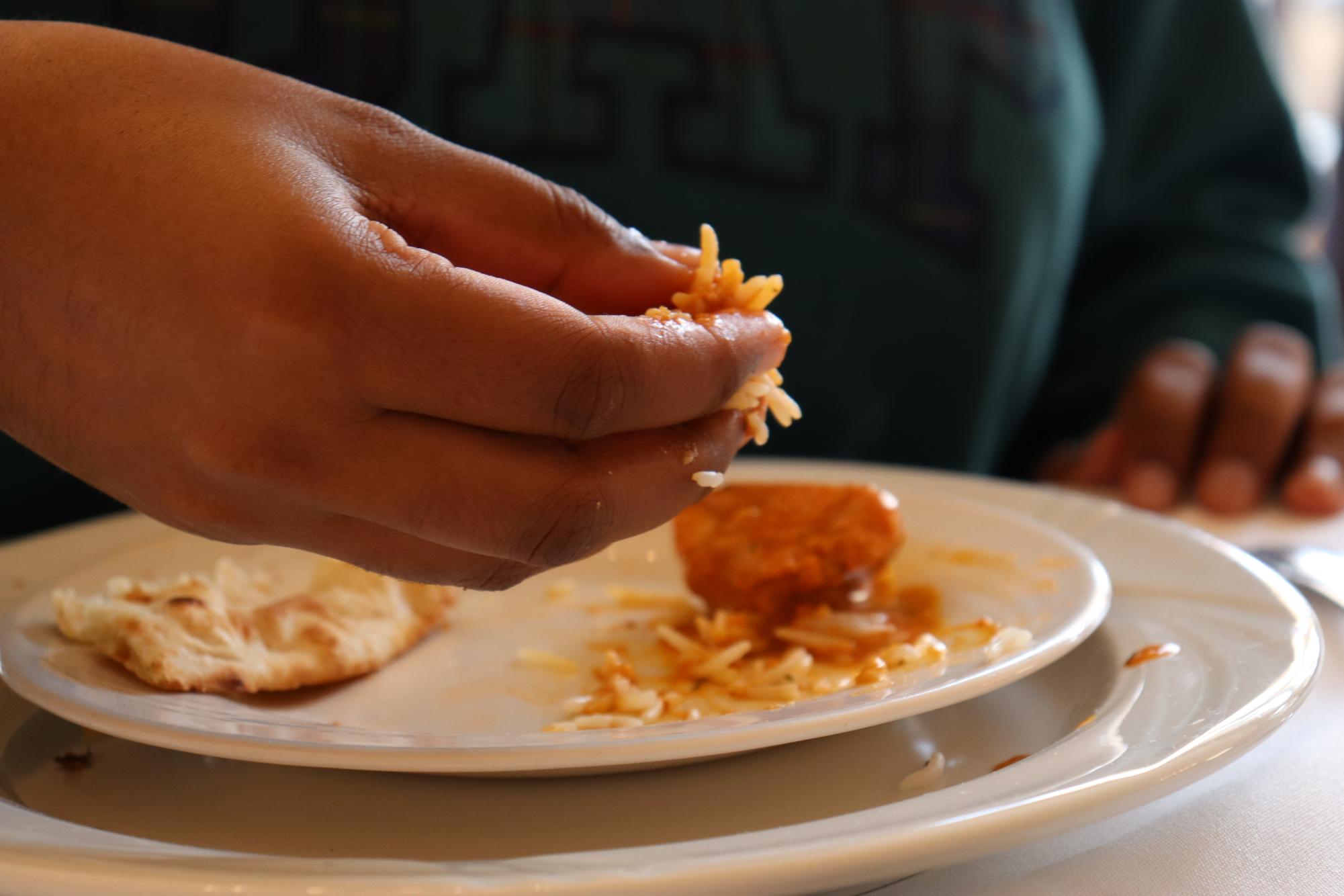
Dinner begins with warm flatbreads pressed in palms. Cumin, pepper and nutmeg wafts from dishes at the center of the table into low light, drifting around the family. Between bites, grandparents lean toward children, asking about their day or if they ate enough among snippets of small, unhurried exchanges. Parents listen as voices overlap gently, hands returning to the center for another helping.
Armenia
In Armenian kitchens, hands often remember the stories that history erases: survival, home and resilience.
Armenian Club president Mari Kradjian’s (11) family has roots in Marash, Hadjin, Digrankert and Kharpert, regions which were originally part of Armenia prior to World War I and the Armenian Genocide in 1915, but are currently parts of Turkey. After her great-grandparents fled, Kradjian’s grandparents were born in Lebanon.

“My great-grandma on my mom’s side came to America when she was an infant because her mother sensed danger coming and decided to leave Armenia and come to America,” Kradjian said. “Her family called her crazy and said, ‘What the hell are you doing? Why are you leaving?’ and then the genocide broke out, so she kind of predicted it, which is pretty crazy.”
Her maternal grandfather was then born in America. Kradjian’s maternal grandmother, though, was born in Lebanon, but is “100% Armenian.” She immigrated to New Jersey in 1959 with her brother, then the Archbishop of the Western Diocese of the Armenian Church. She was a Sunday School teacher, he was a priest. Eventually, she moved to the Armenian community in San Diego.
Throughout Armenian lineage, Kradjian notes that using hands was born from a “challenged history,” but became a symbol of resilience.
“There were Azerbaijan attacks in Armenia, and then in 2020 and then 2022 and then 2023, there were more recent attacks [on] a region of Armenia called Republic of Artsakh, or Nagorno Karabakh,” Kradjian said. “They set a blockade from Republic of Artsakh to the rest of Armenia and starved people, attacked people, raped people, killed people and stopped medicine and aid from coming. So starvation and stopping medicine was a big thing because, you know, it was very hard for them to survive. So they really relied on their own sustenance.”
Refugees did not have means to use silverware, but they did have hands, and the blockade reinforced the ancient custom.
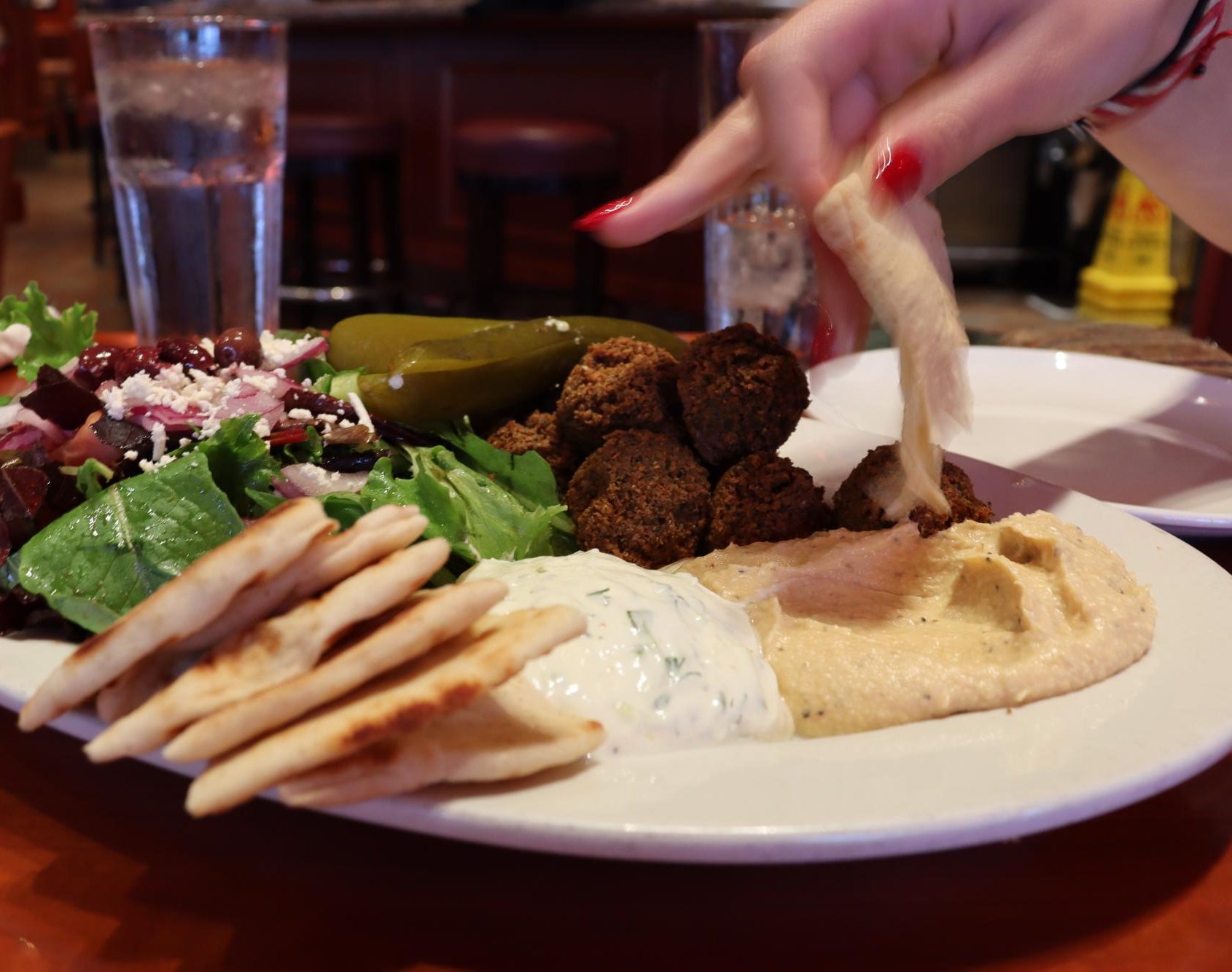
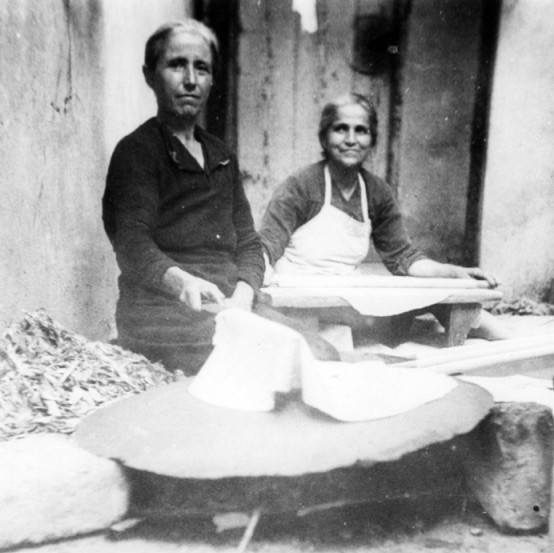
Today, at her dinner table, Kradjian is accustomed to lavash, a large, thin flatbread resembling Iraqi Pita. It is baked in the hot clay oven walls of tonir and often ripped with hands, then used to scoop or spread Middle Eastern salads, tzatziki or hummus.
“You rip pieces of [lavash] and you make little rolls,” Kradjian said. “Oftentimes you use cheese and greens. On the table during every meal, we always have a plate of greens. It’s cucumbers or dill or green onion, sometimes tomatoes too, and you make little wraps with the greens and cheese with the lavash.”
At her last club meeting, Kradjian shared lavash and Armenian cheese with members.
“My grandma makes tourshi a lot,” Kradjian said. “It’s usually pickled cabbage, carrots, parsley, garlic, really anything … Sometimes we make Tabbouleh salad, which is cut up parsley and cracked barley … and we take big grape leaves and put the Tabbouleh in it and wrap it like a taco.”
When food became scarce throughout Armenian history, pomegranates evolved into another method of survival.
“Pomegranates, which in Armenian is noor, was a big source of food in the genocide,” Kradjian said. “Mothers would peel the noor and give one little seed, little amounts of the pomegranates to their kids, just enough to, you know, sustain because they would have no access [to food] otherwise. [They fed] just one little seed there, one little seed here, and that was a big thing for sustaining during that time. Now, pomegranates are a huge thing in Armenian culture. I mean, it’s in everything or on everything … I have a pomegranate tree in my yard. I’d say the pomegranate’s role in the genocide is definitely the result of why it’s so prevalent now.”
But the Armenian community’s connection to hands and food is also reminiscent of love for family.
“Culturally, Armenian mothers cooking the food is a big thing and nurturing,” Kradjian said. “So I’d say the hand symbolizes that.”
Much of the culture’s practices are done by hand, such as aunties kneading bread. Using hands to eat food also emulates the “idea of everything being made with love and tradition.” In Armenian art, too, religious figures hold their hands up to the sky in a cupping shape, a metaphor for the phrase, “up to God.”
“It’s like holding the history of past ancestors, especially within a culture that has had a challenged history,” Kradjian said. “It’s definitely a special thing when food is made by hand in the traditional way.”
Seeking better opportunities in the United States, Iniya Sivakumar’s (11) parents immigrated from southern India in the late ‘90s.
“It definitely took them a while to get used to eating with utensils, because they weren’t used to [it],” Sivakumar said.
Even while assimilating by learning American dining customs, Sivakumar’s parents preserved traditional customs like Indian recipes and way of life.
“They thought it was important to preserve their culture for the kids, so they kept eating with their hands at home,” Sivakumar said.
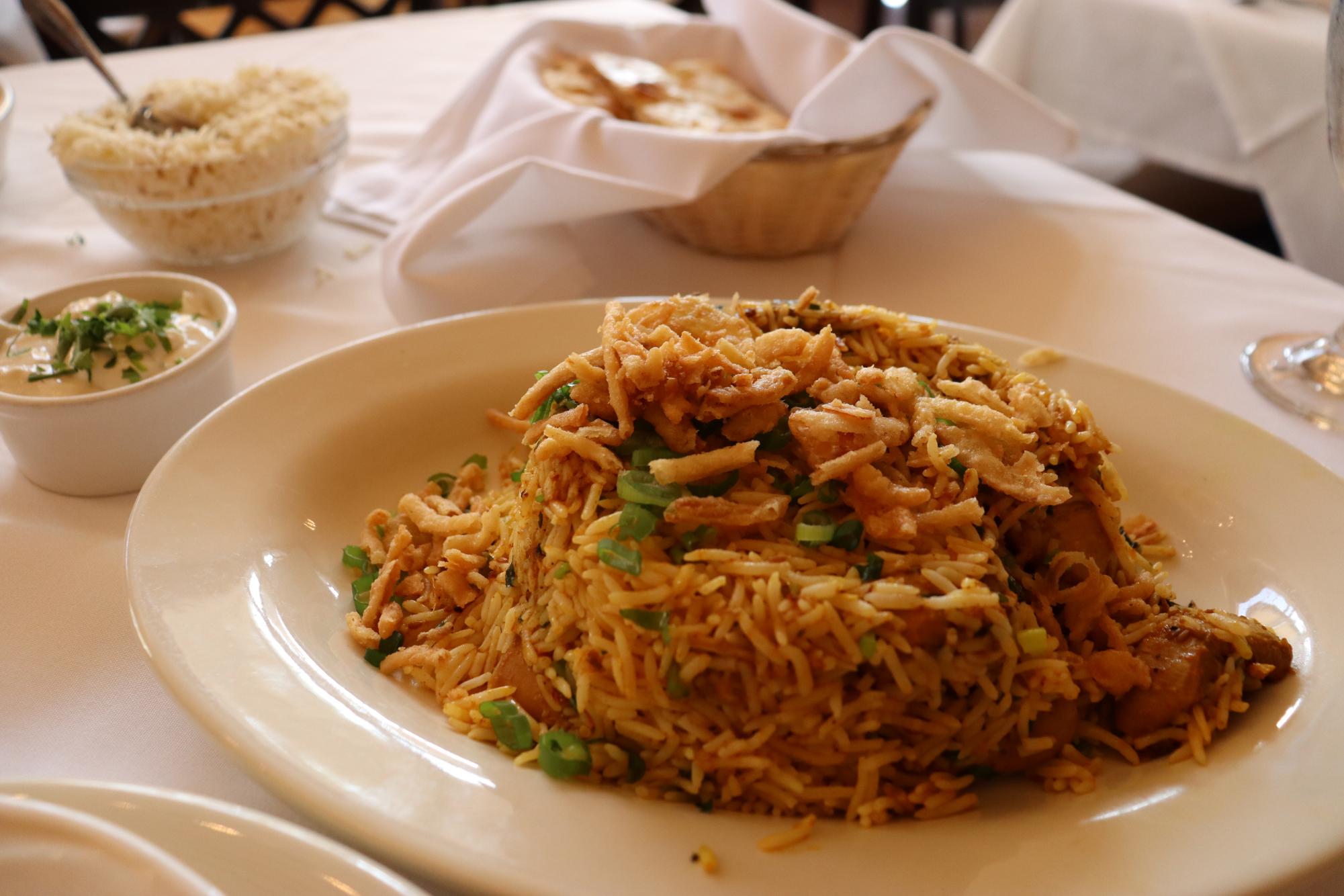
Growing up, Sivakumar ate a variety of Indian curries. Her family cooks homemade dosas, or crispy lentil crepes, which are then dipped in chutneys and curries. Oftentimes, the kitchen is filled with the scents of cloves, turmeric, garlic, saffron and other spices sauteed with rice, vegetables and marinated chicken for one of her parents’ favorite dishes: steaming, golden biryani.
“At home, I cook and my parents also cook,” Sivakumar said. “They’ll make biryani maybe once every other week, because it takes longer to make. They cook a lot of Indian food at home.”
During meals, a family shares a couple dishes, like a biryani, a curry, a yogurt rice and a dessert. Then, these dishes are passed around so “everyone [can] have a little bit.”
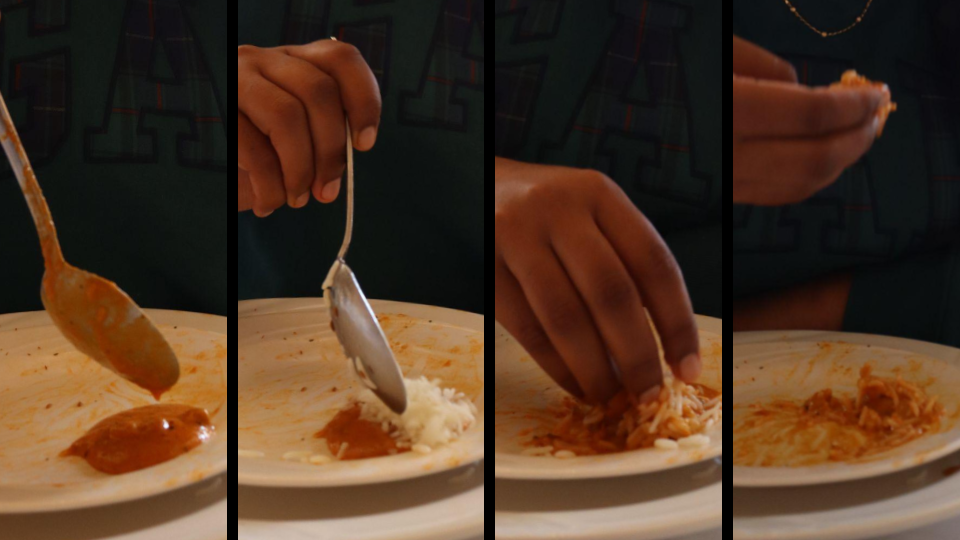
While the left hand is traditionally used for sanitation, the right hand is oftentimes used to spoon food.
Sivakumar begins by spooning rice into her bowl, then adding curry over the rice.
“So you mix it up, and then you scoop it up with all of your fingers,” Sivakumar said. “Then you use your thumb to kind of push it into your mouth.”
Sometimes, naan is used to soak the curry in place of rice.
-
While the left hand is traditionally used for sanitation, the right hand is oftentimes used to spoon food. Sivakumar began by spooning rice into her bowl, then adding curry over the rice.
It is believed that each of the five fingers conducts a different element: the thumb conducts fire; the pointer finger conducts air; the middle is space; ring, earth; and pinky, water. According to Hindu legend, many gods ate with their hands because they did not have utensils, “so a lot of people eat with their hands because of that.”
“Especially in more poverty stricken places, [people] can’t afford utensils, so they eat with their hands,” Sivakumar said. It promotes cleanliness … because you have to wash your hands before and after eating. A lot of people believe that it helps digestion, because you’re more connected to the food, and if you’re more connected to the food, it helps it go down easier, and it’s more nutritious for you.”
After meals, many also savor the leftovers on their fingers.
“You’ll see a lot of people licking their hands after they’re done eating [to not] waste any of the food, but also because the food was delicious,” Sivakumar said.
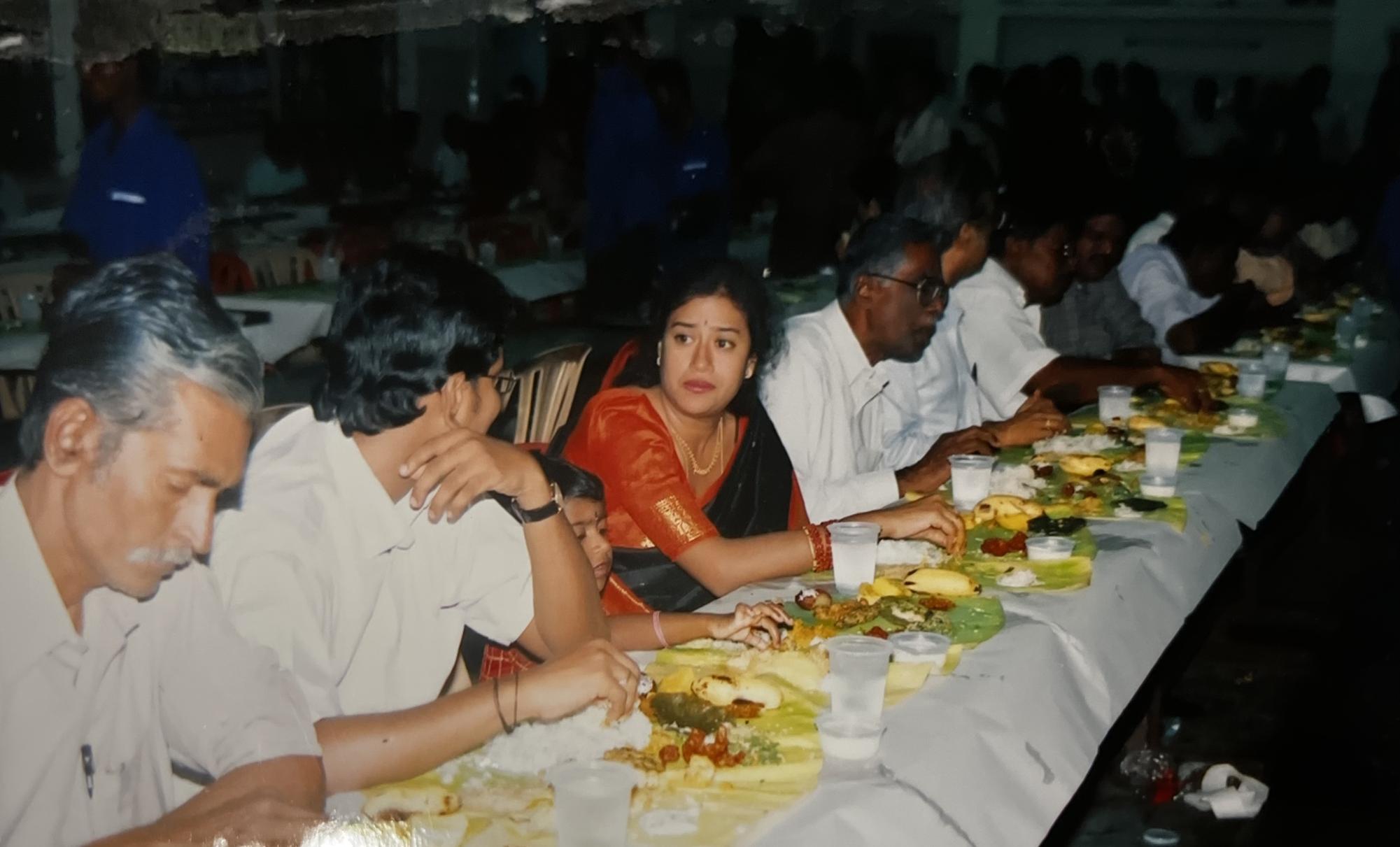
In India, many also substitute banana leaves for plates because they do not need to be washed and naturally compost into nature.
“It’s like a fertilizer for the plants, and then you also absorb some of the nutrients from the banana leaf while you’re eating,” Sivakumar said. “So a lot of people do it if they can’t afford plates or the water to wash the plates.”
During the buildup of the New York Mayoral election, Democratic socialist candidate Zohran Mamdani sparked debate when he was spotted eating biryani with his hands. Historically, British colonialists looked down upon their Indian subjects’ finger-eating, deeming it uncivilized.
“[People are] only saying it’s uncivilized because of the color of [Mamdani’s] skin or what he’s eating,” Sivakumar said. “When you see people eating burgers or pizza or tacos with their hands, you don’t say, ‘Oh, that’s uncivilized.’ You just say, ‘Oh, that’s how you usually eat it.’ Rice or a lot of Indian food, traditionally, you eat it with your hands, so it is civilized.”
Just as Sivakumar’s parents were initially unaccustomed to using Western utensils, eating with hands can be a learning process for those who are foreign to it.
“Eating with your hands is not something you can learn overnight,” Sivakumar said. “It’s like a language. It takes time and practice to fully appreciate … and it’s not something you should take for granted.”
A fingerful of smooth, thick sadza is sculpted to scoop steamy beef stew. Made from finely ground maize and mixed with water to become a highly viscous porridge, sadza is the staple food of Zimbabwe. For campus supervisor Martha Whyte, sadza lies at the heart of childhood meals growing up in Zimbabwe.
“You can eat it with a chicken stew, beef stew, fish — any side dishes [that] you normally have with your food, except you’re using your hands,” Whyte said.
Some other common Zimbabwean dishes eaten with sadza include beetroot, lentils, cabbage and stews made of beans and chickpeas. Each dish is packed together on one platter, forming a colorful array of options to accompany every piece of sadza.
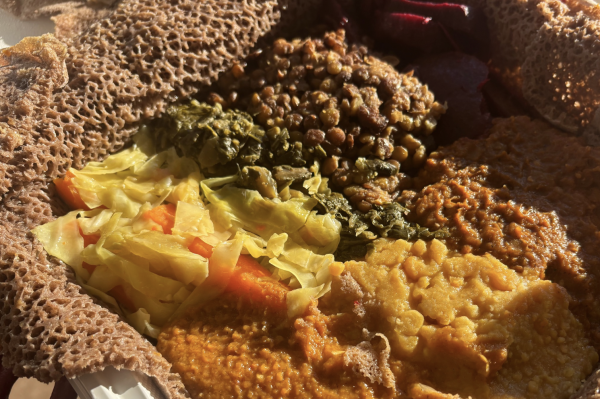
“You just mold it with your hands, and [then] you make a hole, and then you scoop the food.” Whyte said. “But other than that, it is not too specific as to ‘Oh, you have to eat it like this.’”
Whyte was born in the small town of Shurugwi, Zimbabwe, where she lived until she left for the United States on a student visa at the age of 21. Of the two primary ethnic groups in Zimbabwe, Shona and Ndebele, Whyte is Shona. As a child, Whyte ate a variety of homemade Zimbabwean food.
“Do not laugh at me, but my favorite food is caterpillars,” Whyte said.
Whyte is referring to a specific species of caterpillar native to Zimbabwe: the Mopane worm. A specialty dish in Southern African countries, Mopane worms are cooked into a stew with tomatoes, onions, salt and pepper, then served with sadza and vegetables.
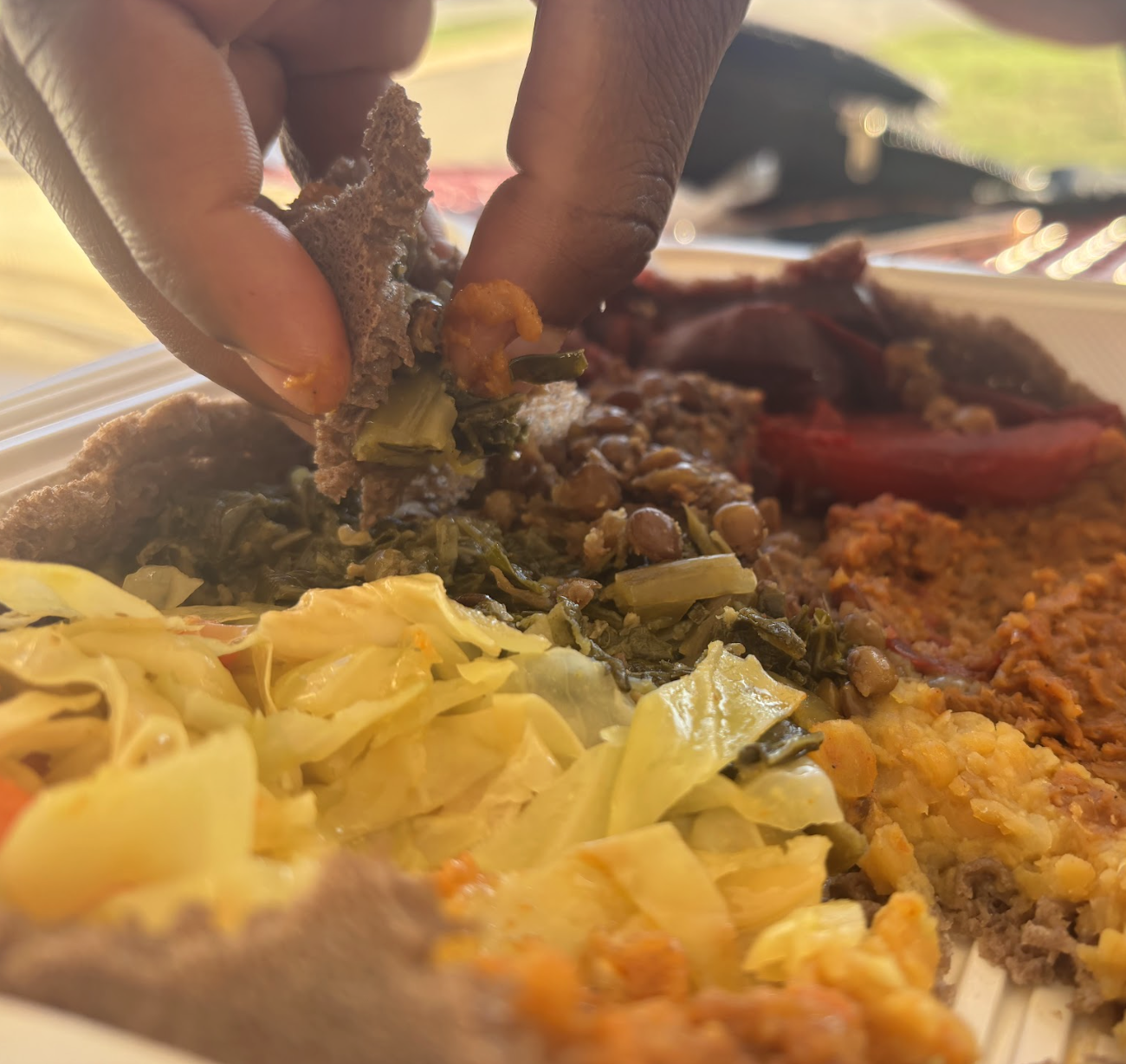
“They are delicious,” Whyte said. “They look weird, [but] they are very crunchy.”
After immigrating to the United States, Whyte has struggled to find Zimbabwean ingredients in local markets.
“Those caterpillars, I can never find them here,” Whyte said. “Somebody would have to come bring them from home. They are native [to southern Africa], but I’ve never seen them in the stores here. I don’t know if I can order them online, but I know for a fact my siblings in London can easily get stuff over there. So sometimes they mail me stuff that I need, but it’s very hard to find very specific ingredients here.”
Nonetheless, Whyte still continues to cook Zimbabwean dishes despite being thousands of miles from home. When she does, she instinctively uses her hands.
“It’s just so weird to eat it with a fork, almost like it takes away the whole experience,” Whyte said. “I will never, ever eat my African food with a fork and spoon. But when I’m eating Chipotle, I use a fork … But whenever I make [an] African dish, I automatically just use my hands. Even my kids, [who] were born here, they automatically use their hands.”
These eating habits are rooted deep in African culture. For those like Whyte, to savor the true, authentic experience of Zimbabwean cuisine means to use their hands. Only then, for Whyte, is the experience complete.
“It just wouldn’t be the same [with a fork],” Whyte said. “It wouldn’t taste the same. It’s almost like it’s engraved that as long as I see African food, it’s natural to want to use my hands. It’s like an innate thing. I have never even ever thought of ever taking a fork to eat [African food] … I don’t know, it’s just so weird … I wouldn’t even want to. I just feel like it takes away the whole, ‘I’m eating African food today.’”
Whyte believes that all cultures used their hands to eat before the invention of utensils, but for some cultures, “it just kind of stayed.”
“I think it’s just how God created us,” Whyte said. “We use our hands. I don’t know if there’s more to it than that. I just assume, you know, we see with our eyes, we use our hands to eat.”
When Whyte visits family in Zimbabwe, she finds that “the food always tastes so much better” and cuisine becomes a highlight of her trips. There, the family gathers around a large platter to eat together directly from the center plate. Growing up, Whyte ate with the women of her family, including her three sisters. They sat on mats made of cow or goat skin while all the men and boys sat on homemade stools in another circle nearby.
“Eating together is more connection,” Whyte said. “Number one, when you eat like that, you’re never on your phone. If you’re on your phone, the food is going to be gone. Number two, we didn’t even have phones, so I would say people are more connected. This is when people talk about their day.”
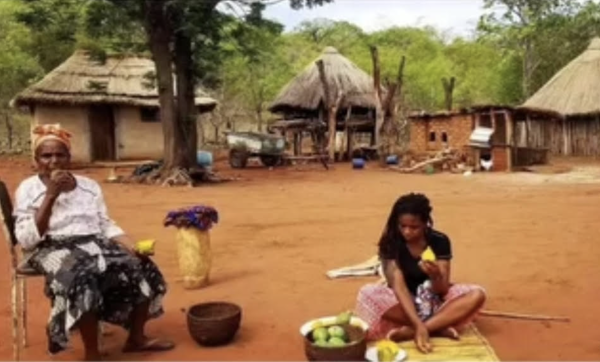
Communal eating can also foster valuable connections.
“You learn to share,” Whyte said. “Mothers, they feed the little ones, and older ones know that, [so] let’s say there’s one piece left, you normally leave it for the youngest one, or you break it up and share with everyone. I think eating together is just so much more intimate.”
For Whyte, shared meals are a symbol of bonding.
“Now we are family,” Whyte said. “We have shared food.”
Your donation will support the student journalists of Torrey Pines High School. Your contribution will allow us to purchase equipment and cover our annual website hosting costs.







Viktoria Kiss • Dec 19, 2025 at 10:01 pm
This is such an amazing piece. Great job Claire and Joanne!
Lisa Kirazian • Dec 19, 2025 at 12:03 am
Beautiful article and shared histories, traditions and dishes. Thank you for writing such a thorough, insightful piece!