
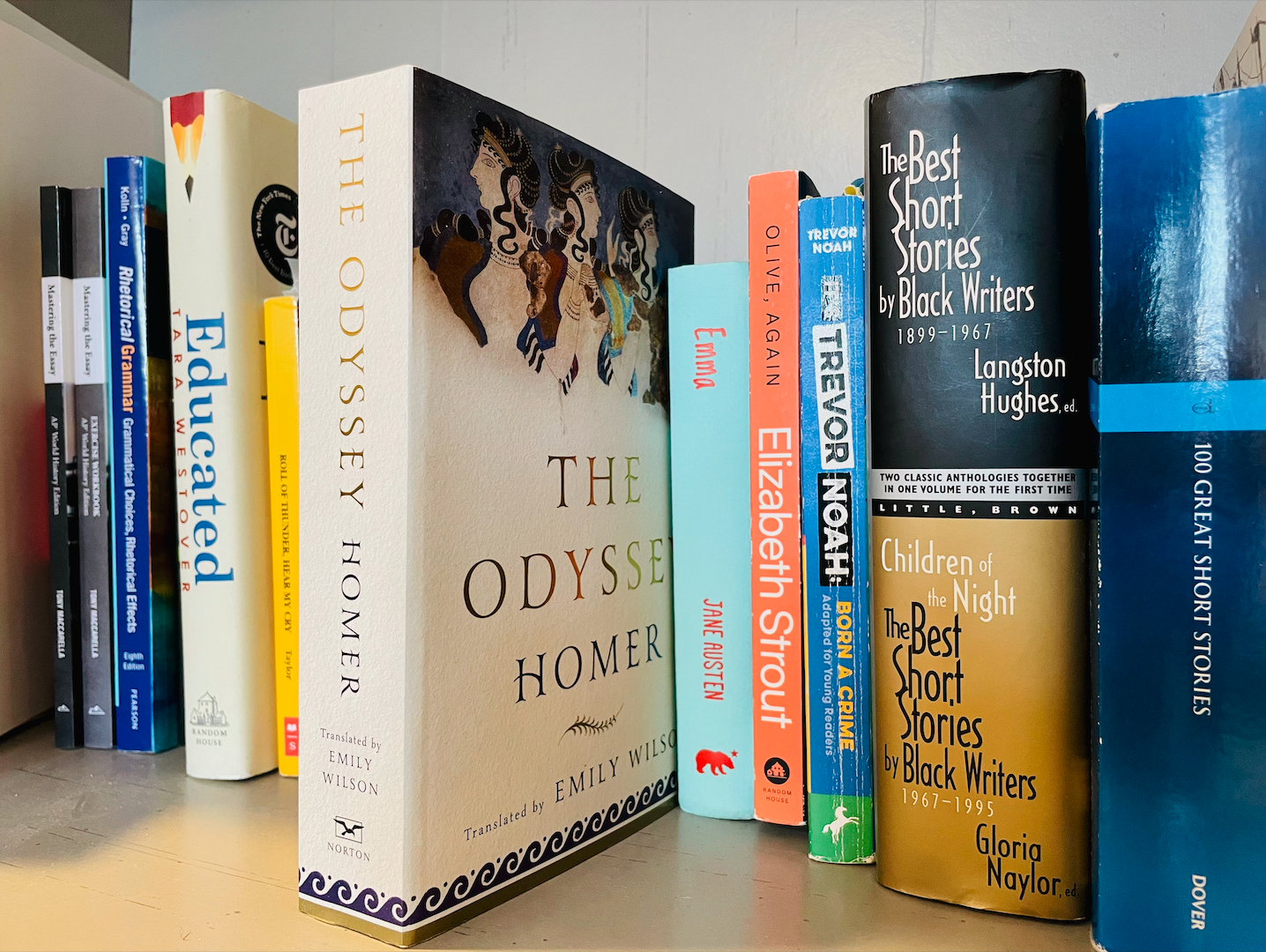
A foundation-funded class set of Wilson’s translation of “The Odyssey” became part of teacher Lara Haines’ English 9 Honors curriculum in early April, following “Fahrenheit 451,” “The House on Mango Street” and “Romeo and Juliet.” The class is currently about halfway through the translation, which is divided into 24 books.
“This is our last unit of the year in my honors class,” Haines said. “I received our copies right before we went away for Spring Break, and we started this unit right after we got back from Spring Break. So it was a pretty compressed timeline, but I was really grateful that we were able to get it in time.”
Haines is the first to teach this translation at the school.
“I wouldn’t say that I’m the first to have the idea of taking a more modern translation and then bringing it into the class, but I know that I’m the first one to use this specific translation,” Haines said. “I know that it’s also used on [Canyon Crest Academy] campus, but it’s a matter of being able to purchase and provide those books, and, typically, if the books are still in working condition, we’ll use books that we have, rather than spending the money to get hundreds of copies of new books. So that’s one of the benefits of us having the foundation … we’re able to bring in these resources that otherwise wouldn’t be as accessible.”
Throughout the year, teachers send applications for academic grants to the foundation, which discusses proposals then votes to approve, deny or stay.
“The way that they make decisions is based [on] how many students will be impacted positively by that decision,” Haines said. “So, typically, they’ll give more funding or funding more readily to something that will have a wider impact, and they provide a lot of services on our campus … So there’s a variety of things that they do for our campus, specifically in academics. They have helped different classes, different departments, with essentially any out-of-district, out-of-budget item that we want to implement.”
The unit, which contains an introduction to translation studies and comparing and contrasting different translations, is one of Haines’ favorites.
“We did it a little adapted with my college prep class, but the end summative for this is creating a children’s book based [on] the hero’s journey, the philosophy by Joseph Campbell, which he used a lot of inspiration [from] ‘The Odyssey’ to help develop this theory,” Haines said. “And then, my students will be picking a cultural norm or value that they think is important for people to teach or know, and they’ll try to create a story that’s appropriate and follows the level of the hero’s journey for a child.”
Haines’ students compared the first line of Pope, Fagles and Wilson’s translations as well as Book One of Fagles and Wilson’s translations, where they “definitely noticed how much longer the Fagles translation was.”
“I was just really hoping that we would get this translation because it’s easier to do in a shorter amount of time, and I think that the students [would] like it much more,” Haines said.
Many elements distinguish Wilson’s translation from the 60 others, according to Haines.
Classic literature is a staple of English curriculums at the school.
“A lot of literature from the past will talk about things that you’re experiencing and will give you a historical perspective that can help you get through some of the struggles that you’re going through,” Haines said. “For example, ‘Fahrenheit 451’ is one of those books that tells you some of the incredibly present warning signs of a dystopia, and things that are mentioned in that book are things that we see every day. So being able to, as the main character in that book eventually does, start to recognize the way in which technology is shaping our lives … can help empower us to take back that power.”
While Haines believes “everyone should be reading classics … the time that you read it is also important.”
“I don’t necessarily think that a freshman will have as much grasp on the complexities of ‘Frankenstein’ as a senior would, and that’s part of why we have these books in different grade levels, because there are levels of prior knowledge or information that you get through other classes that can help build your expectancy and understanding of these more complex themes,” Haines said.
Haines teaches freshmen by analyzing texts in two phases.
“I approach it by trying to figure out what questions are most important to be answered before we get in the book, and then what is useful or important to grapple with during the book, so I split it into two sections,” Haines said. “The ‘before the book’ is what prior knowledge, context and historical events will help you understand what’s going on here, and then during the book, they’re more processing questions, getting into that deeper depth of knowledge to help students figure out how this applies to their lives and how those themes are still universal.”
Haines discussed the significance of engaging with translations.
“I think it’s really important that we read works that are written in other languages, even acknowledging that translation has certain barriers [to] providing a really clear window into those cultures,” Haines said. “Even though you’re not able to experience necessarily exactly what the audiences did, I still think that the value you get from learning these stories and the cultural traditions that come with them makes us into more rounded and more prepared individuals to go into the workforce, which is incredibly diverse.”