
You are sitting outside an office, trying to remember how you should shake their hand first, smile more, talk less and somehow sound confident while feeling extremely unprepared. For many teenagers, the hardest part of an interview begins before the first question is even asked. Applying for a first job, club, college opportunity or summer program all consist of interviews. Here, students are expected to truly showcase who they are and why they are the “best fit” for the role, even while they are still figuring that out themselves. Intro to Business and Marketing teacher Teresa Barnes reminds students that interviewing is not about having a perfect personality, but preparing, communicating clearly and presenting yourself with confidence.
Why interviews matter
Interviewing is often treated as a skill students will eventually learn on their own. However, according to Barnes, it is a craft students should extensively practice before sitting across from an employer.
“It is a really great skill, not only for formal interviews, but also just talking to other people and communicating in general,” Barnes said. “It is definitely a skill that we emphasize in our business pathway, because we want our students to be prepared for any sort of interview they could encounter in their professional careers.”
Beyond helping students get hired or accepted, interviews teach students how to organize their thoughts, speak with purpose and understand how they are presenting themselves.
“I think a lot of the time we tend to use filler words, myself included, and so I think it kind of helps you practice how to communicate clearly, practice your answers ahead of time and sound professional,” Barnes said.
Before the interview
The first step to prepare for an interview is understanding that you do not have to find the perfect answer to each question, but rather being able to prepare for different forms of questions that might be asked.
For students who feel lost for where to begin, sample questions can make the process feel more familiar. Job descriptions, career websites and online tools can help students predict what an interviewer might ask.
“Using Artificial Intelligence, specifically ChatGPT, can be really helpful,” Barnes said. “You can actually put in the description for a job and say, ‘what are some questions I could be asked in an interview for this job description?’ And then it [will] actually come up with example questions that you can practice.”
Preparing for questions regarding strengths, weaknesses and past experiences provides students an opportunity to rack their brains for examples before they are expected to answer on the spot.
“You can also go on LinkedIn or Indeed and find example questions,” Barnes said.
Preparing answers, however, should not turn into memorization, whether being confident in wording. Strong answers should sound confident, not performed.
“I think a lot of the time we want you to prepare, but then there is also risk [to] over preparing, [such as] it sounding like a monologue,” Barnes said. “I would say before the interview, take some deep breaths [and] do not overthink it. You just want to think of the interview like [a] conversation. I would just say try not to be too nervous … and then just make sure you’re hitting all the points about yourself.”
First impressions
Before an interviewer hears a student’s first answer, they initially see the student’s body language and appearance. A handshake, outfit, eye contact, posture and tone can shape the first few seconds of conversation and guide the interviewer’s overall impression.
“ I actually have my students practice giving a firm handshake … I know we have all given a handshake. but going [into an interview] with a confident firm handshake is really important,” Barnes said. “It shows the interviewer that you’re prepared, you want to be there [and] you’re professional.”
Clothing should also demonstrate that the student understands the professional setting.
“How you dress is important,” Barnes said. “Dress for the role.”
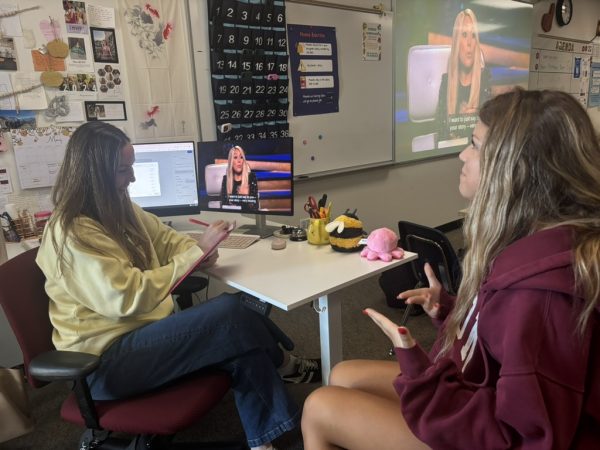
Even small details can make an interview feel more natural. Having eye contact, sitting up straight and using gestures when you speak help students demonstrate engagement without making the interaction awkward or seem forced.
“You always want eye contact [and to] be professional … [but] do not make too much eye contact,” Barnes said. “[It can also be helpful to use] hand gestures to be conversational. [Try to not] overthink it [and] just practice with a friend, parent or teacher and have them give you feedback.”
Talking about yourself: strengths and weaknesses
For many students, the hardest part of interviewing is answering questions about themselves. Unfortunately, one of the most common questions is also one of the most open-ended: “Tell me about yourself.” The answer should give the interviewer something to remember without turning into a life story. A student does not need years of work experience to show responsibility, communication or commitment.
“We teach a lot of our students to use all of [their] school experience to [their] advantage,” Barnes said. “For a lot of high school students, you are probably interviewing for your first job, and so you may not have work experience yet.”
The strongest examples students can give connect an activity to a skill. Listing a sport, club or class is not enough if the student does not explain why it matters.
“Do not just sayI do cheer,” Barnes said. You [would] want to say: I do cheer, [which] has taught me teamwork, being accountable [and having good] time management.”
Students should also be comfortable talking about their strengths without feeling like they are bragging.
“There is a way to do it humbly, of course, they want to know about you,” Barnes said. “Touch on strengths that you feel are really authentic to you, like being organized, having good time management [or] being great with people.”
Sharing weaknesses requires the same honesty, but they should also follow with self-awareness. A good answer explains not only the weakness, but what the student is doing to further develop the skill.
“I always tell students [to] give an honest weakness, [because] that’s what they want to hear, but then back it up with how you are improving on it,” Barnes said.
During the interview
Once the interview begins, students often feel pressure to prove themselves all at once. Successful answers, however, are not always long and excessive, but instead focused.
“Just think of being clear, concise and accurate,” Barnes said. “It’s better to be more concise … than to ramble on, because the more you ramble, people get a little lost.”
If a question catches a student off guard, taking a pause is better than rushing into a weak answer. Silence may feel awkward, but it can display thoughtfulness and diligence.
“If students don’t know [the answer, they can] definitely take a second to think,” Barnes said. “There’s definitely no harm in saying, ‘Can I take a few seconds to think about my answer?’”
Students should feel comfortable asking for clarification, as understanding the question matters more than pretending to know what was asked.
“You can always ask the interviewer to rephrase the question,” Barnes said. “I’ve done that before, where you think of your answer, and then halfway through, you [think], ‘Wait, when did you ask me again?’
A stumble does not need to feel like the end of the world. Students can correct themselves, restart an example or move forward.
“You could say, I did not love that example I gave,” Barnes said. “Let me rephrase that and start with a new one.”
If students are asked about a challenge, they can still be honest, but the answer should remain professional and constructive. Students should avoid speaking negatively about past experiences. Even if they had a difficult job, a teacher, coach or manager, an interview is not the place to complain.
“If they ask you [to] describe a scenario where something negative happened, [it is] appropriate [to be honest here], but I would say for the most part, keep it positive [and] do not ever complain about [past] jobs,” Barnes said.
End of the interview
Although the conclusion of an interview may feel like a relief, students remain focused by the time the interviewer asks if they have any questions. Well-formulated questions can show if a student researched the position and is genuinely interested.
A strong question often relates to a specific aspect of the company, such as its website, social media, schedule or workplace culture.
“Depending on the job, [I would] ask a question [that starts with something like] ‘when I was looking at your website, I noticed that you don’t have a lot of social media,” Barnes said. “Is that something you’d be interested in me helping you with?”
Asking questions can also help students decide whether the job is the right fit for them. An interview is not only a chance for the employer to evaluate the student, but also for the student to get to know the workplace.
“Asking a question about company culture is really important because you want to make sure you are working for a company that aligns with your values,” Barnes said.
After the interview
Contrary to popular belief, leaving the room does not mean the interview process is over. A follow-up message can show gratitude and professionalism after the conversation ends.
“[You] should always thank the interviewer,” Barnes said. “I send a thank you email if you have their email … you can [reach out to] Human Resources for that depending on the job.”
Afterward, students can use their experience to prepare for the next interview. Writing down questions that were asked while they are still fresh can help turn one uncomfortable moment into valuable practice.
Interviewing may never feel completely natural, especially for students doing it for the first time. But each interview provides students a better understanding of how they communicate, what they want to improve and how they can present themselves with more confidence next time.
“I would always just say something that I like to do is keep a running Google Doc of all the questions I was asked, because those are really good example ones I can practice with in the future if I do not [get the job],” Barnes said. “I would … keep a running list of what you were asked, [how] you responded and then next time just make it better.”