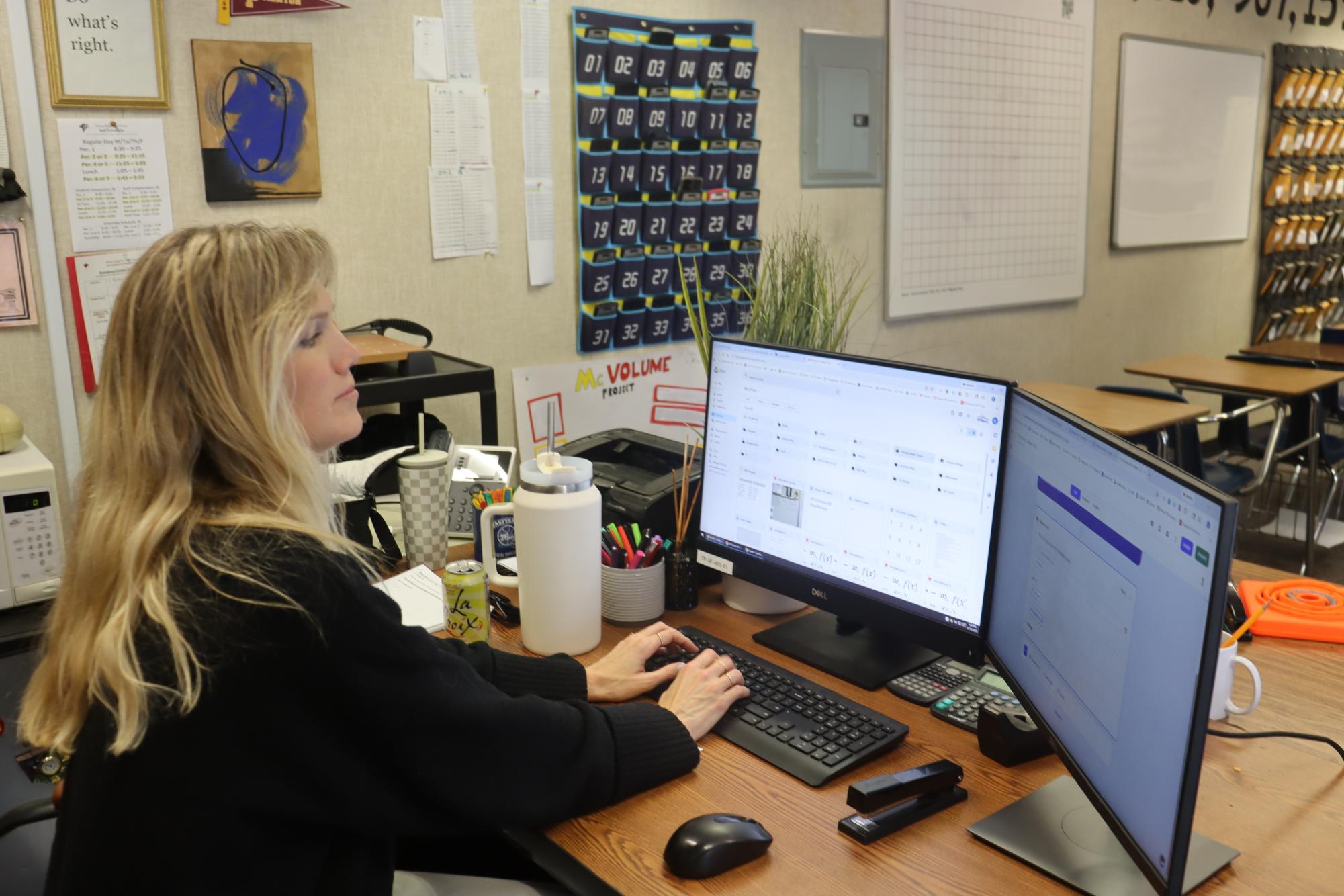

School is full of opportunities, but many students sit in classes like Advanced Placement Calculus or Advanced Placement World History wondering, “How will this help me in the real world?” Feeling unprepared for the “adult world” is not rare, and not every teen feels that what they are learning is useful to them. One class that contradicts this feeling is Personal Finance, taught by Katlin Hildebrand, who also teaches Advanced Placement Calculus AB. This hands-on course equips students with the skills to manage money, ensuring they are financially prepared.
Hildebrand started teaching at the school 11 years ago, mainly teaching AP Calculus BC and Personal Finance, and she also spent two years in between teaching at Pacific Trails Middle School and Earl Warren Middle School. The Personal Finance course is meant to enforce the key components of financial literacy: budgeting, investing and saving.
Budgeting and saving
“An easy place to start is the 50-30-20 rule,” Hildebrand said. “Twenty percent of your take-home pay goes to savings. It is an easy way to start if you don’t know how much to save. The 50% goes to necessities, and the 30% goes to wants.”
Another beginner budgeting strategy is the concept of “pay yourself first,” which prioritizes saving before paying bills or buying wants.
“The idea is whenever you get your paycheck, the first thing you do is deposit a percentage that works for your financial situation into your savings or retirement or investment account,” Hildebrand said. “Then [use]the rest of your money for your everyday expenses.”
For smart budgeting, structure is key.
“With budgeting, there are apps and spreadsheets you can utilize to help organize all of your expenses and stay on top of them,” Hildebrand said.
Budgeting and saving require planning, and even with strained funds, it is important to budget your paycheck.
“With limited funds, you should set aside even a small percentage of your paycheck each month towards your savings or investing,” Hildebrand said. “You should have a savings account with an emergency fund, roughly three to six months of expenses, but also start investing money for long-term growth.”
Investing
“One of my biggest tips is to start when you’re young,” Hildebrand said. “If you start saving for retirement and investing at 18, you can make exponentially more money than you would if you started in your 30s. Even if you are saving a small amount per month, it can still make an impact in the long run.”
Taking calculated risks is important as well..
“You can always invest in an index fund, like the S&P 500, because it is less risky,” Hildebrand said. “As young people, you have a lot of time left to go through the ups and downs of the market, but historically speaking, the market will go up over a 30-50 year period, meaning you have the potential to make a lot of money.”
Hildebrand strongly recommends starting a retirement fund.
“I encourage opening a retirement account early and contributing as much money as you can when you are young because with compound interest, that money will grow and increase much quicker than if you start later in life,” Hildebrand said.
Taxes and credit
“Everyone with an income pays taxes each year,” Hildebrand said. “Depending on your income, you will be placed into a tax bracket, which tells you how much you owe.”
Depending on your job, taxes may be deducted from your paycheck before you receive it.
Many jobs take taxes out of your paycheck for you,” Hildebrand said. “Such as teaching, or any job with a salary. But, jobs like an independent contractor or freelance [means] you’re self-employed, so you need to set aside money for taxes yourself.”
Filing taxes has turned from an all-day affair to a simple click of a button with online programs.
“You can always use a program like TurboTax, which is relatively cheap and super intuitive, and files everything for you once you fill out all the needed information,” Hildebrand said.
Not paying your taxes can impact credit score, which Hildebrand explains as similar to a loan.
“Credit is like a loan,” Hildebrand said. “You spend money, and then every month you pay off your loan.”
A credit score is a calculation that represents how likely you are to repay borrowed money, like a loan. Having a high credit score in the long term increases your chances of approval for things like a mortgage, car loans and opening new credit cards. This means you have to build your credit score.
“The biggest key to building and maintaining a good credit score is to always pay your full monthly balance on time,” Hildebrand said. “There are other factors as well, such as not opening too many lines of credit in a quick period of time, having multiple forms of credit, not spending too much on your credit cards to where you approach your credit limit and more.”
Hildebrand’s biggest credit recommendation is to start as soon as you can.
“I highly recommend starting a line of credit now, such as opening a credit card, because then you can start building credit,” Hildebrand said. “With credit cards, it is important to only spend money that you have, so you can pay your bills on time and in full every month. If you treat your credit card as if it were cash that you have, then you can build credit and earn rewards as well, like cash back or airline miles.”
Overall, financial literacy is something valuable that everyone should learn.
“Everything you will do in the future involves money,” Hildebrand said. “Understanding these concepts is crucial for setting yourself up for financial success in the future.”