
The caterpillar from Eric Carle’s picture book eats various foods in order to become a butterfly. This childhood classic is the name inspiration behind the Caterpillar Project, an initiative that raises awareness surrounding balanced approaches to nutrition for young individuals, fostering healthy relationships with food and rejecting the toxicity of diet culture.
The club began as the Torrey Pines Service Squad, which promoted nonprofit events as its members tried to “find a focus.” When President Portia Perry started her Girl Scouts Gold Award, she came up with the idea for the Caterpillar Project.
“Just being a student at Torrey Pines being, you know, number one in California for athletics, … the culture around food at Torrey Pines can sometimes be a little negative, and as athletes, we need that to be positive, because food is fuel,” Perry said. “Just kind of the way, not necessarily just diet culture, but also in recent years, wellness culture has really taken all these weird rules around food that are very destructive to athletes. It personally impacted my athletic performance extremely, and, as I’ve been working with dietitians across the country, I’m able to see how other conditions, like Relative Energy Deficiency in Sport (REDs), have impacted kids.”
Perry blended the service club and her Girl Scouts Gold Award to create the Caterpillar Project. While REDs is not an eating disorder itself, it is common in individuals with eating disorders.
“There’s a lot of this thing in elite athletics where you think that being thinner will make you go faster,” Perry said. “It’s a big problem, especially at the elite level, and a lot of Torrey Pines students are at the elite level.”
Perry noted that, due to societal norms and the relationship between appetite and exercise, REDs and eating disorders in general may go unnoticed.
“I think that’s the biggest thing,” Perry said. “… When I was underweight, no one made a comment about it. I didn’t have any coach approach me even when my decline in weight was visible. And I’m not saying that this is bad on them. They probably just didn’t notice. But I hope to create an environment at Torrey Pines where you do notice, and you’re able to help and realize when something is wrong.”

Underfueling often manifests in the form of physical symptoms, like slower metabolism and gastrointestinal discomfort.
“The thing is, a lot of these symptoms are very easy to just, like, ignore, because you can think, ‘Oh, I’m just not feeling very good,’” Perry said. “But … you need to be aware of the symptoms, because then once you know that it’s wrong, then you know it’s serious … your body’s not running as efficiently, and thus, you know you’re not as healthy. And then, it has a bunch of immune effects, like your immune system goes down [and] your cardiovascular system is impacted.”
These long-term physical consequences also include osteoporosis, which is “very hard to reverse,” and disruptions in endocrine and menstrual function — like missing periods — which Perry notes is frequently normalized and treated as a taboo subject.
“Especially for kids and teenagers, … we keep growing until 25 so even until your prefrontal cortex is developed, you’re still constantly growing,” Perry said. “Having a condition like this is exceptionally detrimental as a kid and teenager because you’re stunting your growth and your development, and this is a key time in your life [so]it’s going to impact you forever. You’re going to work really hard, but you’re not going to get out as much of it as if you ate more. You’re going to be irritable. … Your body isn’t meant to be running on empty.”
Mentally, underfueling puts individuals in “caveman brain style,” as described by Jennifer Gaudiani, author of “Sick Enough” who helped put Perry in contact with dieticians.
“You’re thinking [of] survival, so that’s not an ideal way to live,” Perry said. “You don’t have mental room for the things you love and enjoy, and you’re just not going to be working as efficiently.”
Perry believes credible sources are especially important since the project is educating others on topics like nutrition and fueling. Her team of dieticians include Rebecca McConville, who has her own program for clinicians on REDs; Lauren Anton, who frequently gives talks about fueling for athletics; Kate Daley, who spoke at REDs seminars and was trained by McConville and Theresa Gwinnett, who is locally based at the University of California San Diego. She hopes to include more diverse groups when making the video series for more perspectives and relatability.
Gwinnett serves as an adviser for the project by reviewing materials and expertise. According to both Perry and Gwinnett, oversimplifications can misrepresent the nature of nutrition requirements.
“I think that’s really the heart of it: just spreading information, really getting at the fact that your body is so, so complex,” Perry said. “We often associate food with, like, very specific numbers, like regiments and rules which can end up hurting us more than helping us. But really, how our body processes food, it doesn’t really care about numbers and the way we as a society view food. And it took me a really long time to be able to realize that food is just food, and [it’s] just a mixture of different components, different molecules.”
Gwinnett agreed, noting the adverse effects of a numbers-based mindset.
“I think one of the biggest misconceptions is that there’s a very simple equation, calorie in and calorie out, to determine how much the body needs, and the truth is that our bodies aren’t really machines like that,” Gwinnett said. “We’re dynamic beings that have so many different factors that play into how much food we need to eat for the day … Those vary based on hormones, the sleep that you got, your stress level, the time of the day. When we try to get rigid with our eating by using some of these apps and tracking calories, sometimes that can backfire, because then we end up ignoring our own internal physiological cues.”
The variability of nutrition requirements and the dynamic nature of the field itself drew Gwinnett to pursue it. Nutrition requirements differ from person to person, but also from day to day within the same individual, resulting in the need to “ask ourselves every day, ‘Okay, what do I need in this moment?’”
“It definitely helps to get a dietitian because then someone can be there to look at your specific food intake and your energy output, and tell you what an individual meal plan might look like for you,” Gwinnett said. “And I say meal plan loosely because sometimes meal plan implies that you’re going to be following exact measurements of food for every meal, and that’s not really what I like to do, but I do want to give a very general amount of macronutrient intake and energy intake per person based on what they need. I look at the person’s age, their height, their weight, their activity level … It varies really widely in each individual, and that’s what I love so much about nutrition, is that it’s not just a simple black and white answer.”
Scientific knowledge continues to evolve in the field.
“A perfect example of that is when I was studying nutrition, and I was in [graduate] school, we were taught that foods that are too high in cholesterol are unhealthy, and that you should only eat so many eggs in a day,” Gwinnett said. “And then, you know, suddenly eggs are okay. It’s a good thing, though, that we’re constantly questioning prior research and beliefs about nutrition … I’m sure you see all the time, people that will eat in one way and then have really good vital signs or lab serum blood levels, and another person eat in another way that you would expect those blood levels to be different, and they’re not.”
Perry aims to account for this when designing fueling guides for students.
“It’s literally so individual and specific,” Perry said. “Everyone has different schedules, everyone has different families … The wrestling team is obviously going to have different needs than say the cross country team or golf team. The heart of it is to be able to teach yourself the skills to efficiently fuel your life, your body and your sport.”
Additionally, Perry noted that one can eat enough but still be undernourished.
“So the way I want to approach nutrition and fueling is very, like, how can you build the skills in your own life kind of thing, and not just necessarily, like, you need to eat 50% carb and 30% protein,” Perry said. “I think the biggest approach I want to take for the project and all its resources is just being like this is why fueling is important. You should be fueling consistently. This is important because that’s something that’s not just the athlete level, but also a human level. Like, you need to be consistently eating throughout the day. It’s not normal for modern humans to just eat one big meal in the day … If you want your body to be properly fueled, that’s not going to work.”
Gwinnett sees the internet and peer influence as playing large roles in how nutrition information spreads.

“Access to information can be a really good tool … but then the flip side of the internet is that anybody can write any article or make a website when they don’t have any of the education or the experience,” Gwinnett said. “What I see nowadays is sometimes, you know, fitness influencers and podcasts where people will talk about nutrition, and some of the advice that they give is not a healthy, well-rounded diet. There’s a lot of information out there about low-carb … I see a lot of patients in my own practice that try to follow low-carb diets.”
Most of Gwinnett’s patients follow advice “always with good intention.”
“I don’t think that anybody wants to harm themselves,” Gwinnett said. “I think that they are trying to do their best, and they’ve seen these podcasts of people who supposedly are experts, and they are saying don’t eat carbohydrates, and then that could be harmful in the long run,” Gwinnett said. “So the internet would probably be the biggest factor that’s influenced people nowadays, and then, of course, your peers, but that’s always been the case since the beginning of time. I think that every high school, from the beginning of time, has had people that you know have tried to make an, you know, your peers will make an influence on you, no matter, but that’s just a part of growing up.”
Both Perry and Gwinnett note that professional medical environments can validate biases. Perry pointed out that, in healthcare, weight bias means that individuals may be praised for “habits that make them skinner” but can be “destructive” and “not sustainable.”
“You’re going to have all these bone issues, going to have these cardiovascular issues, and you’re going to get injuries for the rest of your life because your body’s weakened,” Perry said. “And then the biggest part … especially for athletes [is] the effects it has on your performance. So when you’re training, you’re going to have decreased endurance … It’s going to give you an increased risk of injury.”
Gwinnett believes that “our healthcare system is still catching up a little bit to modern times.”
“I have worked with some doctors who still use BMI as a measurement,” Gwinnett said. “I think that measurement is starting to go away, but it has not completely yet, and that’s why it’s helpful to have an interdisciplinary team … I have doctors, nurses, dietitians, social workers, and so we all have a meeting after we’ve seen the patient and we discuss that patient’s care … I might speak up and say hey, even though this person has a BMI that might put them into the overweight category, let’s look at all of their different, you know, components playing into this … So we have these tools, same thing with the calorie predictive equations. We have equations that will, if we input their age and their height and weight, it’ll tell us how many calories that person might need, but that also is just a tool that I use in conjunction with everything, and ultimately it’s important for the human being to make an accurate assessment of to help someone with their health, rather than just using these tools alone.”
The nature of the nutrition industry creates openings for student advocacy.
“The industry is often just going by scholarly research,” Gwinnett said. “We work in a scientific environment, and so we need to use evidence-based science in order to make any kind of interventions … I’m not really allowed to say something to the patient unless that’s backed up by clinical research. Sometimes the industry lags a little bit in changing. But it’s still incredibly important that there are those grassroots movements, because that leads to then more focus on those topics, and the more people that focus on it, the more you’re going to get research and anecdotal evidence as well, which will then lead to change in practice.”
Overall, the project’s mission is to “help youth, especially athletes, develop a positive and healthy relationship with food based on scientific evidence and information from accredited dietitians.”
“We’ve hosted events to help students have a healthy relationship with food,” Perry said. “That’s really at the heart of it, helping students gain a better relationship with food so they can thrive in all areas of life because under-fueling in your sport doesn’t just affect your sport. It affects your personal relationships as well. It affects your school. It affects every single aspect of your life.”
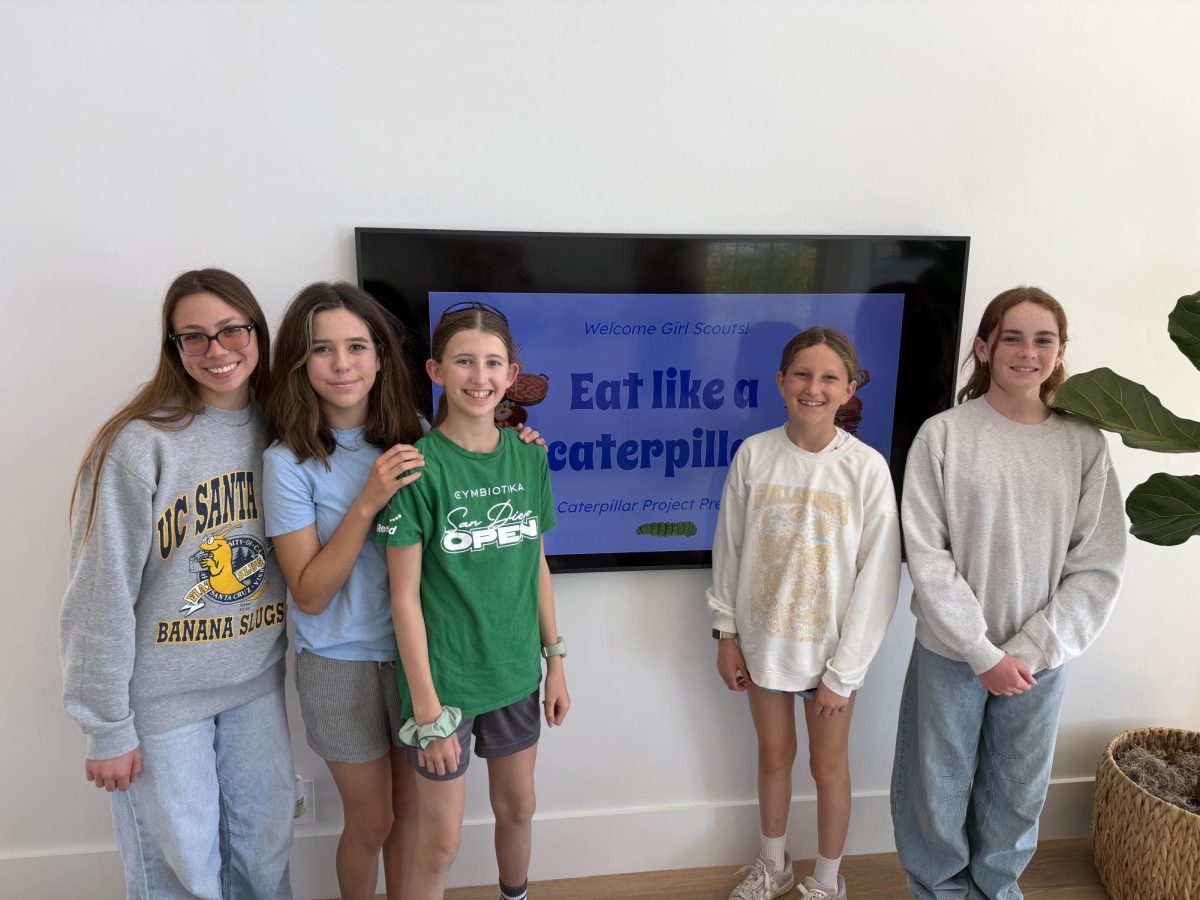
The project’s events included a trick-or-treating activity during Halloween with food-related myth busters at six stations. Fifty students attended and over 200 myth-busting flyers were distributed across the stations. They also partnered with the EDucate club for an eating disorder awareness talk with specialist Megan Freundlich. Perry and the Caterpillar Project are focused on “having the biggest impact outside of school,” through presentations with Girl Scout troops and local sports teams, and a fueling guide for the Blue Angel Snow ski camps.
“What we really want, and will probably not fully get this until next year, is to have a nutrition, kind of fueling program for all Torrey Pines sports,” Perry said. “I’m currently making a five to seven part video series. So using the video skills I’ve learned as part of Falcon Vision, I’m blending that love with also my love for athletics. And I’m gonna be recording a bunch of the dietitians I’ve been working with and creating a fun, engaging, well-developed video series for San Diego athletes, which I hope we can integrate into Torrey athletics next year.”
In engaging with sports teams and Girl Scouts troops, Perry hopes to create a conversation around nutrition by “asking [their] audience what they know and what their perspective is, and then also being … guideline level on how people can build their own healthy habits.”
Perry said that in her recovery journey, seeing others’ stories helped the most. Now, she is launching the Consumed Film Festival, which is scheduled to premiere next February, and is in the process of creating two community-based apps. The first, with a target audience of teens, creates a community for individuals recovering from eating disorders with features like miniature games. The second app is for athletes interested in learning more about nutrition and the issues surrounding it.
In times when Perry feels unmotivated, she is reminded of the widespread problems that underfueling creates.
“It seems like every single day a friend will say something to me, and I’m like, ‘Okay, no, this is exactly why I’m doing this,’” Perry said.
Club member Danika Balden (9) said that in her time playing sports on a school team, “there was nothing really focused on the mental health and well being of athletes.”
“It was all like, oh, make two practices every week and one game every week,” Balden said. “You need to meet these quotas. You need to do this and this to improve your game, and that was really all and it wasn’t like, well, ‘How are you doing?’ [or] ‘Are you actually eating enough?’”
Balden said that teammates would skip their lunches before games because “they didn’t have enough time.” While Balden said she personally “never really struggled with eating,” she appreciates the different perspectives she learns from Perry and the Caterpillar Project.
“I really like what Portia does is she keeps saying food is often used in cultural celebrations,” Balden said. “You can eat for fun to make you feel happy or when you’re sad, because it is a comfort food, and that’s what links us together. She has really cool studies on that, but I like how she’s not just focusing … on the aspects of it being like, ‘Oh, you can only eat this.’ … I like how she’s really looking at a big picture.”
Perry noted that influence from figures like coaches and famous athletes are especially large during a young individual’s formative years.
“In high school, we’re at this kind of point in our life where we want to be an individual, and we’re kind of learning what it’s like to be our own person, like detaching from our parents, [that] kind of thing,” Perry said. “So naturally, we start to [think], ‘Oh, what am I eating?’ And like, you go out to eat food with friends, so it becomes kind of more than just food, but you develop your own relationship with it. So it’s important, especially for teenagers, to learn how to properly feel themselves, because if they have this diet culture noise, then they’re going to start out with an unhealthy relationship with food, and then that’s going to grow for a really long time.”
Peer-to-peer connections have the potential to drive change, according to Gwinnett.

“I actually think that it’s incredibly important because to some degree people expect me to go with the grain and say what’s in the textbooks, and what the Academy of Nutrition and Dietetics has taught, and you know you can look up, you know, anything about nutrition online and find answers,” Gwinnett said. “But when information is coming from one of your peers who’s maybe experienced things for themselves and has lived it and is telling their story [about] the things that they’ve learned, then it’s much more impactful, because it’s somebody who you align with, rather than, you know, someone like me. Yes, I have the credentials, but I might not be as impactful to somebody who is in high school.”
Gwinnett described Perry’s work on the Caterpillar Project as “amazing.”
“I’m so in awe of all that she’s accomplished with this project,” Gwinnett said. “Not everybody is searching for a dietitian online and going to spend money to get individual advice, and so she’s doing something where she’s going to reach a lot of people. Even if they don’t, in that moment, seem to agree with whatever she’s saying, it’s planting that seed. That’s the most important thing, just to stimulate the conversation about these things, so that we’re all aware, so that we’re moving in a direction where people are becoming healthier [and] not doing things that are potentially detrimental to their health. I’m just really proud of her. She’s doing a great job on the project.”
While Perry knows that changing specific habits is up to the individual, she focuses on the act of planting.
“I like to think of myself as a gardener — it’s really helped me go to bed at the end of the night too,” Perry said. “Because it’s like, ‘Well, am I doing all this work for nothing? Is this really going to help people?’ But I’m like, no, because in my own life, I know you think, ‘Oh, well, I remember when blank said that.’ It’ll pop up in the back of your mind. I want to be that person to pop up in the back of your mind and be like, ‘Wait, maybe this isn’t okay? Wait, is that really true?’ I just want people to be able to have that voice, and I want to be that little voice in the back of their head, and hopefully then they can create their own voice.”