
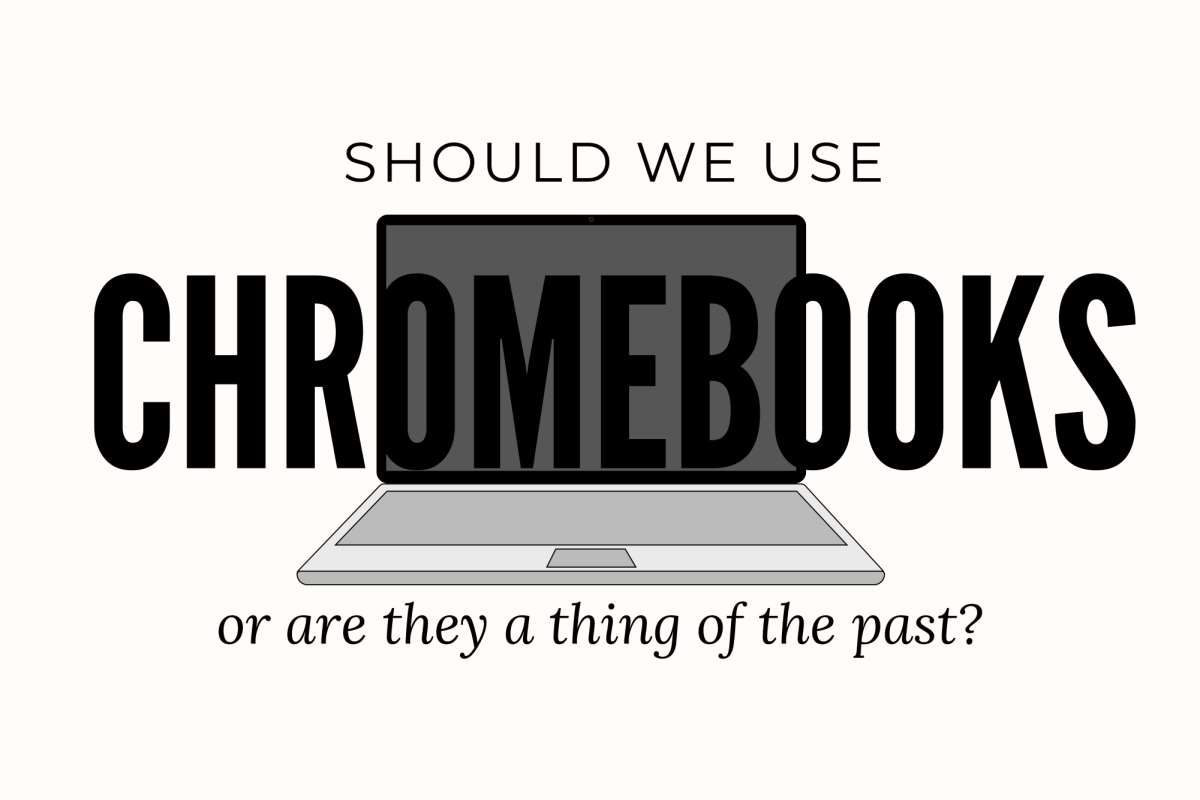
With continuous technological advances in the education field, it becomes difficult to discern whether a new device does more harm than good for students. While many teachers rely on Chromebooks to teach their respective curriculums, they encounter new challenges every year.
Integrated Math 2 and Personal Finance teacher Stephanie Pearson witnesses how technology use changed within the math department over the last 16 years of her career.
“The biggest advantages would be when [students] are taking notes, it’s so much easier to highlight and use different colors and erase,” Pearson said.
On Formative, a platform that many teachers use to assign tests, homework and other class assignments, students found new ways to cheat. This caused many teachers to shift their testing strategies.
“This year, we’ve had so many more issues with students being able to cheat on Formative assessments to the point where I’ve just given up, and I just do my assessments on paper now,” Pearson said.
Pearson also sees the struggles that come with using Chromebooks for an entire lesson.
“I feel like a lot of us teachers have swung so far to the technology side, including myself,” Pearson said. “At the beginning of the year, everything was on Chromebook, nothing on paper. I feel like I’m swinging back to wanting a lot of things on paper.”
Pearson also realized she had to find different solutions to get students engaged. Pearson introduced short lessons on whiteboards that she has placed across her room. Students do small group problems on the whiteboards.
“Physiologically, it gets the blood moving when you’re standing up, it allows students to be engaged more in the content as opposed to sitting and mimicking me in front of the classroom,” Pearson said.
Teachers see the same effects on students across all grades. Biology: The Living Earth teacher Matthew Livingston, who began teaching at the school 25 years ago, also saw that learning tools changed in classrooms.
“In the old days, if a kid was absent, they had to have their brother, sister or friend pick up some sort of hard copy, and then you had this constant shuffling of papers and kids were losing things,” Livingston said.
When teaching ninth graders, Livingston takes into account that he is teaching them how to be successful learners throughout high school and beyond.
“I’m dealing mostly with freshmen, so they struggle with motivation, rigor, trying to keep up, and it can be overwhelming,” Livingston said. “A lot of us use our electronics as an outlet, so I would regularly have students doing something non-class related on their Chromebook.”
For Livingston, the unrestricted access that Chromebooks present leads to challenges within the classroom.
“It was almost like a [television] show, kids right in front of me and [when] we’re doing notes or we’re doing a lab, something [I consider] serious,” Livingston said. ” The kids look at me, and they’re nodding and I just get slightly around them, and [see] they’re driving a car game or they’re watching basketball.”
“[There’s] a drastic disconnect because [in class where we] did a whole lesson on maybe one or two concepts, and then you just had a conversation with the student, and they just completed this big document about it, and they don’t even know what they’re talking about,” Livingston said. “In my … view it is a disservice to the student because they can get through the class without the class ever getting through them.”
Livingston has also recognized a decline in foundational skills.
“Kids used to be much better at reading content, critical reading and their writing was better,” Livingston said. “Their verbal skills were better for reading and writing, even their vocabulary was better. Now, a lot of my students struggle [with] writing a sentence to explain something.”
This year, Livingston made changes to better support his students’ learning.
“I’ve totally eliminated [Chromebooks] in class, we’re back to paper and pencil labs because it’s more authentic,” Livingston said. “I’ve got this bin system where they just put their backpacks and their electronics in there… and then [in class I ask the question of] how far can [a student] get in this 100 minutes with a paper and pencil?”
Olivia Sedano (9) is a student in Livingston’s freshman biology class and enjoys the break from technology-based learning.
“Doing everything without Chromebooks is beneficial to me because it reduces distractions, and we spend a lot of time at school using Chromebooks, so it’s nice to have a class where I don’t use it,” Sedano said.
Without technology, her learning is now more independent.
“I think it’s easier to learn with his teaching style because he guides you through [the lesson], but we also do a lot of work independently, which has helped me … learn how to answer my own questions without just copying,” Sedano said.
John Milner, Sociology and Advanced Placement World History teacher, noticed how Chromebooks impact the way information is delivered to students.
“I think it’s become way less about [the] delivery of facts to [students] because all of the information is just at a click of a button [away],” Millner said.
GoGuardian is a district-purchased digital platform that ensures safety, security and classroom management tools. Almost all teachers at our school have implemented this as a tool. Milner has claimed the term “GoGuarding” students
“It takes one person to hack into it and then the word spreads, and with the surveillance, it makes me feel kind of weird,” Milner said. “I’ll be [on GoGuardian] and I’ll be watching their screens on my computer and [see them] playing a game [by] bypassing … whatever the district puts out. It just proves that [students] are ahead of adults when it comes to technology.”
Overall, Livingston is seeing all of the effects of digital learning doing more harm than good.
“[There’s] a drastic disconnect because [in class where we] did a whole lesson on maybe one or two concepts, and then you just had a conversation with the student, and they just completed this big document about it, and they don’t even know what they’re talking about,” Livingston said. “In my … view it is a disservice to the student because they can get through the class without the class ever getting through them.”