Skip to Content
Categories:

Six years after COVID-19: Students, staff discuss the pandemic’s impact on education

Students and staff discuss the impacts the COVID-19 pandemic had on education. They reflected on topics from online school to exploring new hobbies.
Joanne Liu
COVID-19, or the coronavirus disease 2019, spread to San Diego in early 2020. Exactly six years ago, local public schools began to shut down. (Joanne Liu)

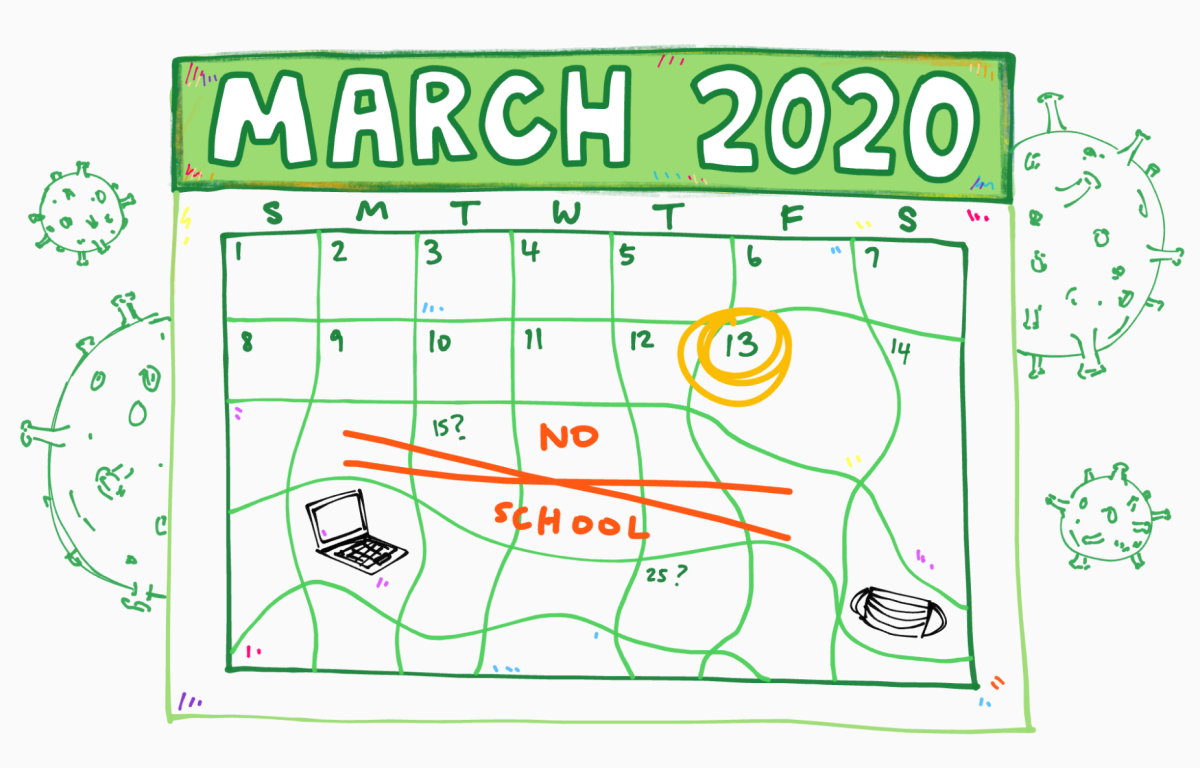
Exactly six years ago, it was another Friday, March 13.

During the early months of 2020, school hallways filled with talk of a new virus spreading fast and inching closer, but students and staff attended class like usual. Advanced Placement (AP) World History, Social Political History of Rock and Roll, Surf PE and College Prep United States History teacher Austin Wade, who was teaching five periods of United States History in 2020, has a “vivid memory” of this day.

“We got through the first couple periods of the day, and then I got an email saying there was a mandatory emergency teacher meeting at lunch in the lecture hall,” Wade said. “All the teachers showed up, and that’s where Principal [Rob] Coppo gave us the heads up that we would be closing down. We were a week or two away from Spring Break, so I think a lot of us just thought, ‘Oh, we’re gonna, like, have an extended Spring Break, and then we’ll come back and it’ll be back to normal.’”

Schools in San Diego County, like much of the nation, were closing to prevent the spread of the COVID-19 virus. Most expected it would take a few weeks for the disease to die down.

“We were told [to] prepare not to come back,” Math 2/3 Honors teacher Kristina DeVico said. “They didn’t say indefinitely. They didn’t say [that we would be gone] until the end of the year. But there were people in our department who suspected we wouldn’t be coming back at all. And so, as math teachers, we took home all of our lesson plans and binders expecting not to come back.”

At the time, no one knew that day would mark a turning point in students’ and teachers’ lives for, at the very least, the next two years.

“We were all kind of just celebrating,” Elle Beron (11), who was in fifth grade at Solana Pacific Elementary School at the time, said. “We’re like, ‘Oh, two weeks off of school,’ and we all just packed up our desks and we were given two really big textbooks and then just sent home. [Then] I walked home, and that was that.”
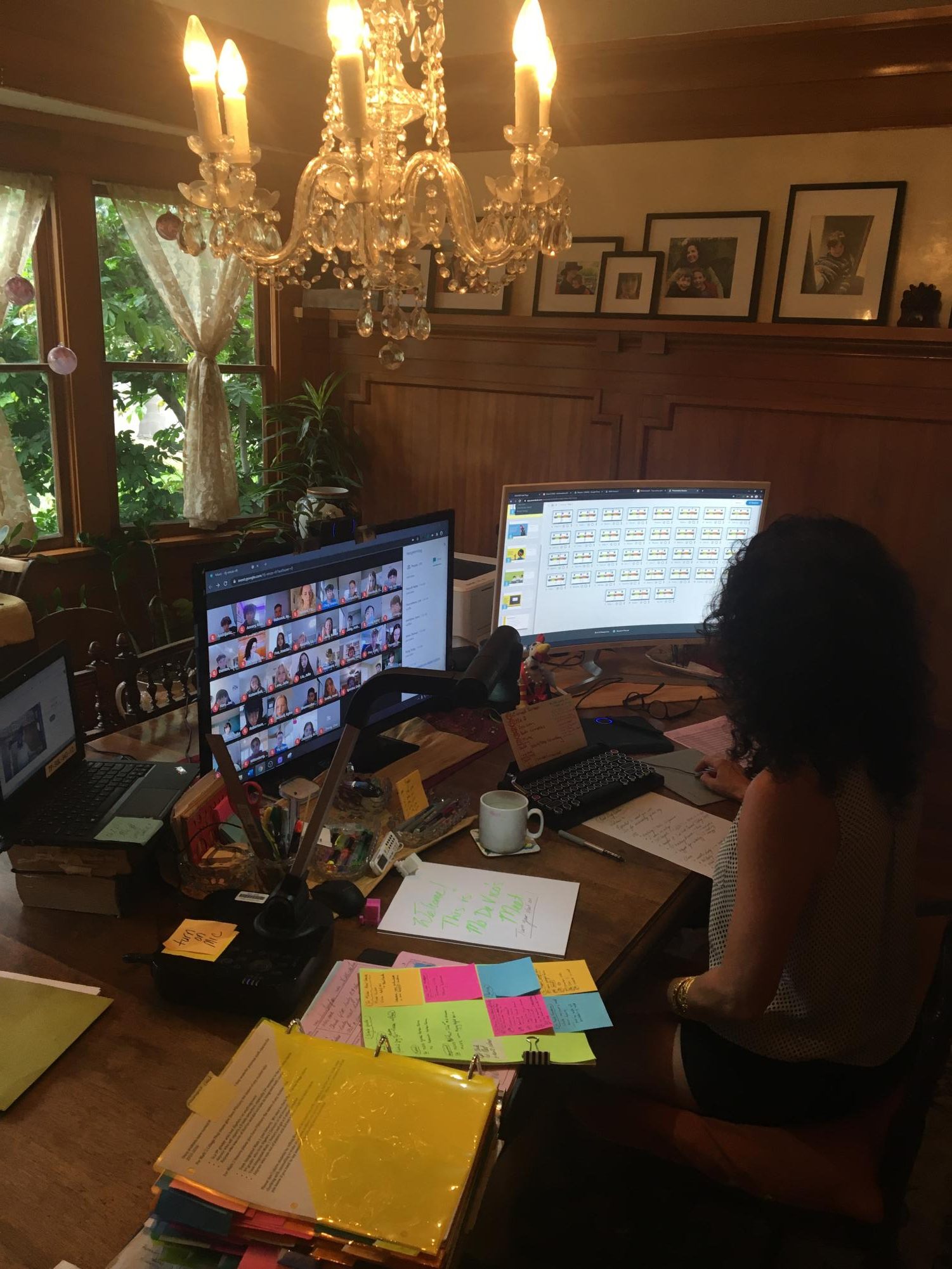
Math 2/3 Honors teacher Kristina DeVico teaches a class online in 2020. DeVico said it was difficult to regulate classes virtually. Photo courtesy of Kristina DeVico.

Plans for kids to return to campus soon crumbled as the COVID-19 pandemic spread. Teachers continued their lessons online.

“It was odd because … it took them about, I think, a few days to get all the Zoom stuff and notifications sent out to parents of how we’re going to continue the year,” Beron said. “But we’d never really properly continued the year. It’s really blurry. We just started doing online classes. I think it was once a week for a little bit until they were able to finally increase our load, but by then school was kind of over and it was summer for a little bit.”

For Lucy Huang (12), who attended Ocean Air Elementary School at the time, the following week was supposed to be sixth grade camp. Most believed that the trip would simply be postponed, but as the pandemic got worse in the weeks that followed, these prospects were squashed.

AP English Language and Composition and English 12 teacher Anna Hubbard remembered that teachers were supposed to “start back up lightly” after a week or so. She began with optional online meetings and issued practice material, but plans to fully restore learning overlapped with Spring Break. In those last few months of the 2019-20 school year, classes were shorter and less rigorous, according to DeVico.

“[Teachers] taught for less amount of time, and we as math teachers went through what absolutely needed to be taught and what were some of the topics you could eliminate,” DeVico said.

According to DeVico, the school board kept going “back and forth” between whether grades would count that year or if they would not. Many parents pushed for grades to count in order for students to have complete transcripts, but how that would be “taken care of” presented even more difficulties. Math teachers focused on teaching all essential material and continued to issue assessments.

AP exams were also altered. For the first time, College Board made every AP exam digital, despite only having eight weeks to prepare for these changes.

“It was a decision that was made, I want to say, maybe in April,” Hubbard said. “They decided that the AP [English Language and Composition] exam would just be the Rhetorical Analysis essay. That’s it. Students would have 45 minutes, and that would be their entire test score. They also moved AP exams back [to the end of May].”

Some students took advantage of the education system while it was vulnerable. The conditions left many teachers frustrated and confused, especially as “things were changing so fast in terms of what [they] could and couldn’t ask of students,” according to Hubbard.

“It was a very stressful time for teachers,” DeVico said. “Nobody knew what was going on.”
Math 2/3 Honors teacher Kristina DeVico teaches a class online in 2020. DeVico said it was difficult to regulate classes virtually. Photo courtesy of Kristina DeVico.
COVID-19 variants emerge as the pandemic spreads. During the 2020-21 school year, the virus continued to be a public health threat.

Districts, schools, staff and students were more prepared going into the 2020-21 school year. While many schools remained online, some allowed students to opt for a hybrid program.

At TPHS, teachers taught from campus classrooms since the start of the school year for accountability reasons, according to Wade. Students, on the other hand, stayed home and attended fully virtual lessons. Later in the school year, students were given the choice to attend class on site. However, few students showed up on campus.

“I had six kids that would show up in class, and then the rest were online, and so [I was] teaching simultaneously online and in person,” DeVico said.

Many teachers adjusted their curriculum. According to Hubbard, each class period was only 40 minutes of synchronous learning, or class time where students were on Google Meet with teachers. The rest was asynchronous, meaning that students would complete individual work assigned by their teachers.

“It made me a lot more efficient, and it even changed some of the things that we do now, some of the ways in which we do discussions [and] the ways in which we break apart passages,” Hubbard said.

Math teachers also had to decide what to keep versus what to omit from their lesson plans. DeVico continued to teach “everything that was fundamental” in order to properly “prepare [students] for the following year.” However, she believes that students were not taught “as in depth” as before.

Managing a class of teens virtually was a grueling task for many teachers. DeVico believes that she never worked harder than that year of at-home learning. She remembers that “for every single kid, every single day, every single period,” teachers had to report if they were present, if they were on task and if they turned in their homework. She had to fill out “massive amounts of paperwork.” On top of that, she struggled with her technology at home.

“It was twice as hard,” DeVico said. “It was a year in which so many of us were dead at the end of every single day.”

Regulating students’ behavior and grades also became difficult.

“The teacher can’t stop you from eating food because you’re probably taking the class in your kitchen,” Alex Zhang (10), who was in fifth grade at Solana Pacific Elementary school during the 2020-2021 school year, said. “If you’re going to go goof off and be off task, you just have to turn off your camera and mute yourself and the teacher is not going to notice. I literally had one time where a kid just forgot to answer a question because he was playing ‘Among Us’ with five other people in the middle of class. [Another] time, this guy’s just laying on his floor taking class.”

DeVico encountered problems with student accountability when issuing tests.

“Every test day, I would say, at least 50% of the screens were frozen for the kids,” DeVico said. “And it wasn’t that they were having technology problems. They were contacting each other on their phones and saying, ‘how do you do this problem?’ They were looking it up in their notes. So a lot of the tests turned into open note tests because of that, but they were just Googling the answers on Wolfram Alpha or whatever it took to get things done. So to me, the grades meant absolutely nothing.”

DeVico saw a lasting shift in students’ mindset when it came to education.

“Learning was more about getting it done and turning it in,” DeVico said.

Beron agrees, saying she doesn’t “remember learning anything that [she] didn’t already know.”

“This is going to sound horrible, but we didn’t really learn,” Beron said. “We more [so] looked for ways to get the work done so we could go do something else, and teachers weren’t great about checking a lot of work until we were back in classrooms. So online, I feel [the quality of education] definitely decreased a bit.”

Wade sees quarantine as a time where adolescents missed out on many normal high school events and opportunities.

“I think a lot was missed academically, [and] so much was missed socially,” Wade said. “I mean, if you were a junior that year, you missed out on both your high school proms. The seniors had to do [their] graduation in the parking lot. Sports were canceled. Like, everything just came to a grinding halt, and kids just had to adjust.”

COVID-19 variants emerge as the pandemic spreads. During the 2020-21 school year, the virus continued to be a public health threat. (Joanne Liu)
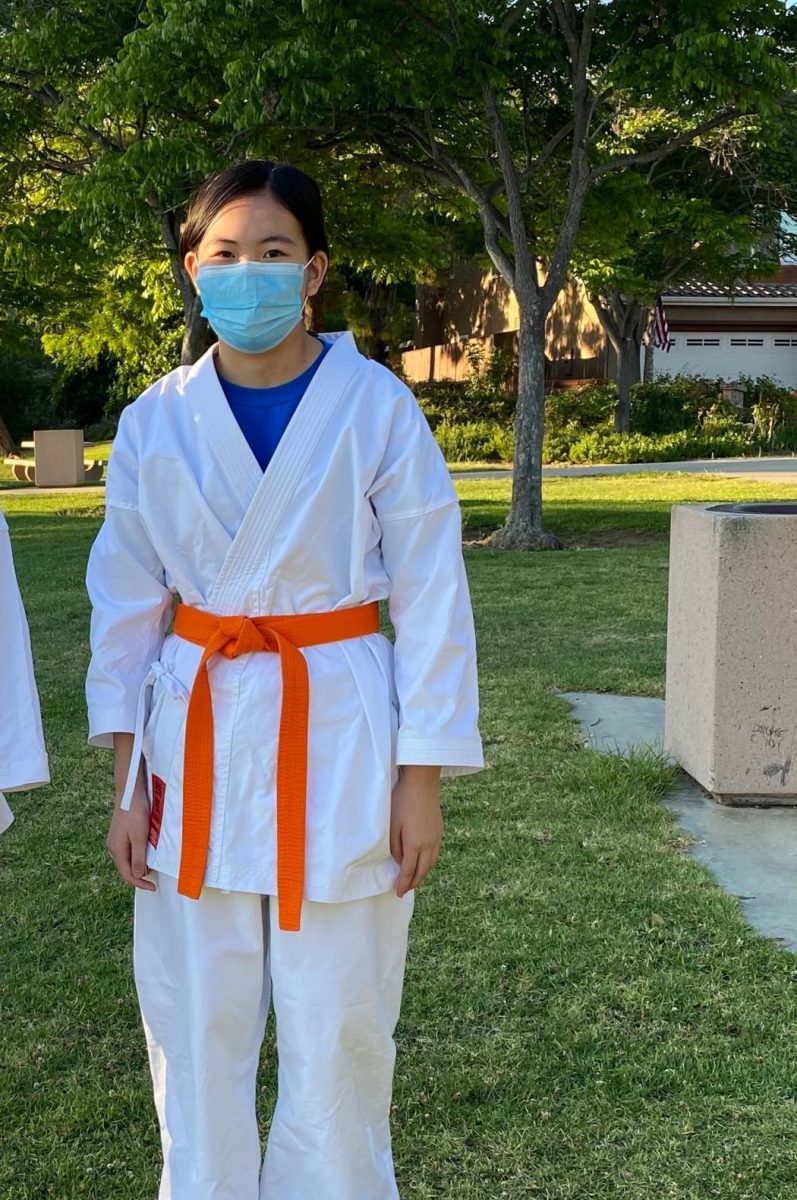
Lucy Huang (12) practiced martial arts during lockdown. She took her belt test outdoors. Photo courtesy of Lucy Huang.

For some, quarantine led to a decrease in productivity. For others, however, 2020 and 2021 were the years their passions blossomed and motivation peaked.

“I think that’s where it’s hard to say what COVID did or didn’t do,” Hubbard said. “For example … Mrs. Calendar [said] that that year she had some of the best presentations she’d ever had for AP Seminar because students had a little bit more time [and] because they weren’t as [stuck with] this many hours in these classes all day. That works well for some students, for students who are intrinsically motivated, who are consistently responsible with doing their work. One population thrived, while a lot of other students really struggled. I saw some even of even my top students struggle with that lack of structure. It’s kind of one of those things where certain students ran with it and did amazing things.”

Zhang has similar viewpoints.

“For creatives, before COVID, if you’re more introverted, it probably gave you more ideas, because now you just have way more time to be alone with your thoughts,” Zhang said. “But for the people that liked being social and stuff, it could have probably hampered that, because you don’t really have people to talk to, draw next to or share ideas [with] in person.”

As the pandemic left people worldwide idle and bored at home, many picked up new skills.

“At first it just started [with] me vicariously watching people do things to feel like I was doing something too,” Zhang said. “Like, I’ll watch [some] guy cook a thing I can never cook because I don’t have the money for it, but it feels like I’m cooking it. Or watching art tutorials to feel like I’m getting better at art. But then, at one point I was kind of just like, ‘oh, well, if I’m consuming all this stuff, I might as well try putting it to good use.’”

Beron and Huang also pursued more non-academic hobbies during quarantine. While Beron honed her skills in sports and spent more time painting, Huang got into what she describes as more “niche hobbies,” such as juggling and martial arts, as well as practicing the cello more often.

Chloe Khanna (9) felt “more productive” in fourth grade, the year she attended school virtually. Khanna thought the “curriculum was really weak” and that she would have “suffered a lot more” if she were in middle or high school. Overall, she felt that online school was “really fun.” She was more motivated and became an avid reader during that time.

“[Reading during quarantine] made me a really good writer,” Khanna said. “Like, my writing was probably the best in fourth and fifth grade. I loved to write. I would write for fun. My vocabulary was better. I read so many books. All my favorite book series [are ones] I read during COVID.”
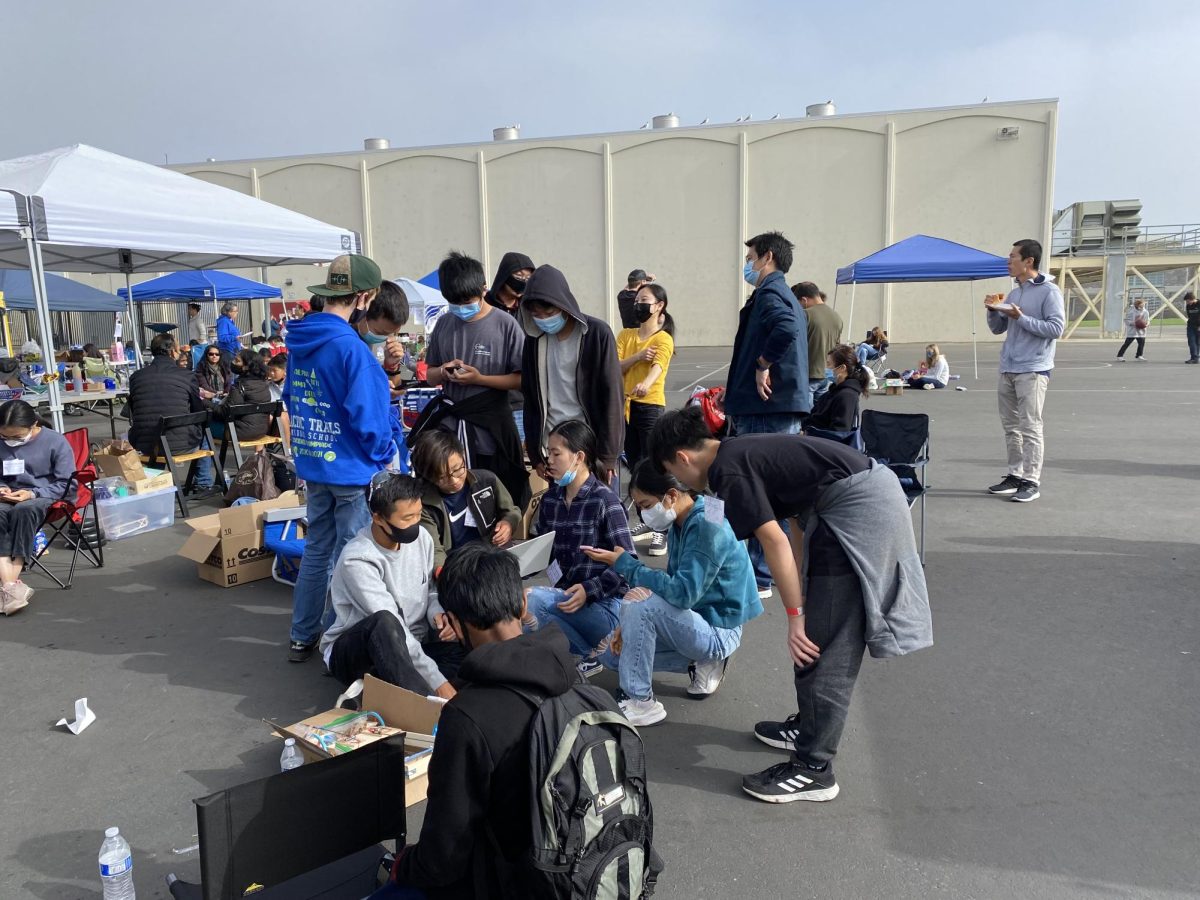
According to Lucy Huang (12), Science Olympiad competitions were held online during the 2020-21 school year. “There was definitely a change in team spirit and competitive morale as we didn’t get to see the other teams and have a proper awards ceremony,” Huang said. Photo courtesy of Lucy Huang.

The 2021-22 school year was fully on site, though SDUHSD began an Online Learning Program (OLP). Back on campus, students and staff wore masks and tried to return to a “normal” school atmosphere.

“I had a good friend who’s a middle school principal, and one of his jokes when we came back was ‘The kids are feral!’” Hubbard said. “And I don’t blame the students. A lot of what happens here at school is there’s a lot of social learning that goes on as well that doesn’t happen as much when we’re at home and we’re isolated and we’re only thinking about ourselves and our needs. There’s a community that you have at school. I think we’re getting past that. I don’t see that as much. It was kind of the first two years that we were back.”

Wade agrees.

“This might sound weird, but so much is learned as a freshman based off of the role modeling of the juniors and the seniors of what’s expected at Torrey Pines,” Wade said. “How do you act? How do you not act? What behavior is okay? What’s not okay? The students themselves tend to guide each other through.”

Many students noticed shifts in behavior amongst their peers.

“It was horrible for all of us,” Beron said. “A lot of my classmates, I feel, lost basic human decency, like what you do or don’t do around people. Everyone was just so excited to see everybody that I think, our class at the time was sixth grade, we were acting more like third graders.”

Beron attributes this to the lack of structure in online learning. She saw that kids were “way rowdier” than before.

“People didn’t have to show up and necessarily present [themselves] around other people,” Beron said. “They could sleep through class, turn their camera off, mute their teacher, right? They didn’t have to pay attention. There was no structure. They tried to provide it. But, I mean, we’re a bunch of kids, we’re not going to necessarily want to follow structure. Being around people and being in front of people kind of forces you to act a little bit more presentably.”

Even just during class lectures, many teachers noticed changes in students’ attitudes.

“[Students didn’t recover] immediately, but it’s gotten better over time,” DeVico said. “I think it was hard for kids to come back and sit in class and pay attention for classes as long as they are, especially if you’re in your AP and Honors classes where you’re listening to lectures for that whole time. Kids just weren’t prepared for that. They fidget all the time and need to get up and have breaks.”

Nonetheless, many saw that students and staff alike were excited to be back onsite for school.

“I feel like the biggest thing coming back from COVID was really just seeing the positive energy that students had to want to be back at school,” Wade said. “And it’s one of those things where maybe [we] all took it for granted of what it means to be a part of a really amazing place like Torrey Pines. Once it’s taken from you, you really understand and feel like how important it is to your day to day life. And so coming back from COVID, I just saw a very positive energy [from] kids. They were feeling good [that] they were back.”

As the years rolled by, the pandemic’s effects seemed to smooth out over time. However, after six years, teachers still see changes in the education system.

DeVico notices that many kids “learn things to get homework done or take a quiz, and then they hit the delete button in their head [to] make room for the next chunk of knowledge,” which becomes a problem in math classes where students need “all those foundational skills” as they move up each level. She also believes there is an overall decrease in mastery of topics, though she also attributes this to the rise of Artificial Intelligence (AI) and general societal trends, not just quarantine. 

“I don’t see [this] happening in Honors [classes] so much, but in other [classes], they are cutting off what they’re learning,” DeVico said. “Like in College Prep [math classes], they don’t do all the conic sections anymore. They do a limited number of them, but not all of them. They don’t do the graphs for all the trigonometry functions, all six of them.”

English teachers see similar changes.

“I’ve never taught middle school or elementary school, but I think one of the things that we kind of talk about when we talk about our students is: where were they when COVID happened?” Hubbard said. “A lot of our students right now were in middle school or upper elementary school, and those are important years in terms of changes in how we read and how we teach reading. In the earlier grades of elementary school, you’re learning to understand, comprehend, but you really start getting into inferences and more detailed analysis as you move up in those grades. Unfortunately, those were [the] years where a lot of our students were online, and they weren’t getting that in person instruction, and they weren’t put in the position where they had to kind of work through it a little bit more.”

The aftermath of online learning overlapped with AI entering the education system, making it unclear what changed students’ mindsets the most. According to Hubbard, she began to see AI usage in academics before teachers saw “extent of the COVID deficits.”

“I think there’s been a loss of intellectual resilience, [but] not across the board,” Hubbard said. “I have fantastic students, but I’m seeing that sometimes students, even in AP classes, [are] more interested in just getting it over with instead of, ‘Hey, we have the time. Why don’t we kind of unpack it and work on it?’ That patience for digging into texts is not as strong as it once was.”

Hubbard also shifted her own teaching style by implementing methods that worked during online learning. For example, she started using Google Classroom more for activities such as signing up for class discussions. For a while after COVID-19, she also gave students videos of her notes and comments on example essays, though now she has gone back to doing this activity through lectures.

Many also believe the pandemic either caused or accelerated the integration of digital tools into education.

“It definitely changed the way curriculum is taught,” Huang said. “I don’t know if [the] materials itself changed, but I think that the way it’s taught, a lot of people are reliant on just watching videos and self studying, which I think [is] a great skill to have. I also do think that I personally prefer the way it was before, when it was more like teachers engaging the entire class through projects, hands on stuff, and just really learning it through experience, rather than just learning [content] through a video.”

The pandemic also fueled the rise of short-form content on apps like TikTok. Some think that the decrease of academic accountability coupled with hours of scrolling on online platforms resulted in shortened attention spans across the young generation.

“You go from having to sit in a classroom listening to a lecture for like, maybe an hour at most to having basically your phone right next to the thing that you’re learning with no real incentive to actually pay attention,” Zhang said. “[COVID] definitely kind of contributed to that, but [it] didn’t cause the boom of short phone content and everyone’s attention spans shortening.”

Zhang sees this increased immersiveness into the digital world seep into social aspects of peoples’ lives.

“A lot more conversation, especially like small talk, is more centered, at least from my experience, around the stuff that happens online, like some trend or meme or, god forbid, a new kind of brain rot that everyone seems to know except you,” Zhang said. “[This] doesn’t make it harder to make new relationships, because I feel like methods for that have adapted [with] the increased use of technology, but I feel like it’s harder to actually deepen the relationships you have. It’s so much easier to talk to a ton of people now, so [now] you’re more likely to have a bunch of people that you’re kind of friends with but not that close to, versus, I feel, before COVID, you’d have less [friends] but you’re way closer with each person.”

Still, many people, such as Wade, think that kids’ behaviors have largely “re-normalized.” Huang believes that it depends from person to person.

“For the majority, though, I think a lot of people were able to bounce back, because especially for my grade, I think a lot of people returning back to eighth grade realized, ‘Oh, this is what I need to be a middle schooler,” Huang said. “Whereas, for some people, it was kind of like, ‘oh, well, if I could get by it during online school, I can get by it now,’ especially because I know that right now there’s still the Online Learning Program going on, and I actually have some friends that are still doing it online because they found it to really work for them.”

DeVico emphasizes the value of teachers having in-person interactions with their students.

“With the accelerated class, I see the kids every single day, and I think it does make a difference when you stand out the door and welcome them and check in and say, like, ‘Hey, how’s it going?’ or if you knew they had a competition, you say, ‘How did it go?’ or ‘tell me about what happened,’” DeVico said. “I think kids like knowing that you care about them and you have a more of a personal relationship, so they’re more invested in you and you’re more invested in them. I don’t think online you could do that. I was looking at a screen where each kid was represented by a square that was like the size of a quarter, and you can’t just talk to them. Everybody’s got their microphones off, or else you hear all the background noise from their siblings online and whatnot. So now that we’ve returned, you can kind of see that kids do like having an emotional connection with their teachers, and I think it’s for the better.”

Looking back, it is hard for students and staff to generalize the consequences of COVID-19 in education. Some believe that the education system has made a full recovery, while others see extensive effects that still linger.

“I can definitely say [it] left a mark on me, and not a favorable one,” DeVico said.

Donate to The Falconer

Your donation will support the student journalists of Torrey Pines High School. Your contribution will allow us to purchase equipment and cover our annual website hosting costs.
More to Discover
Donate to The Falconer