
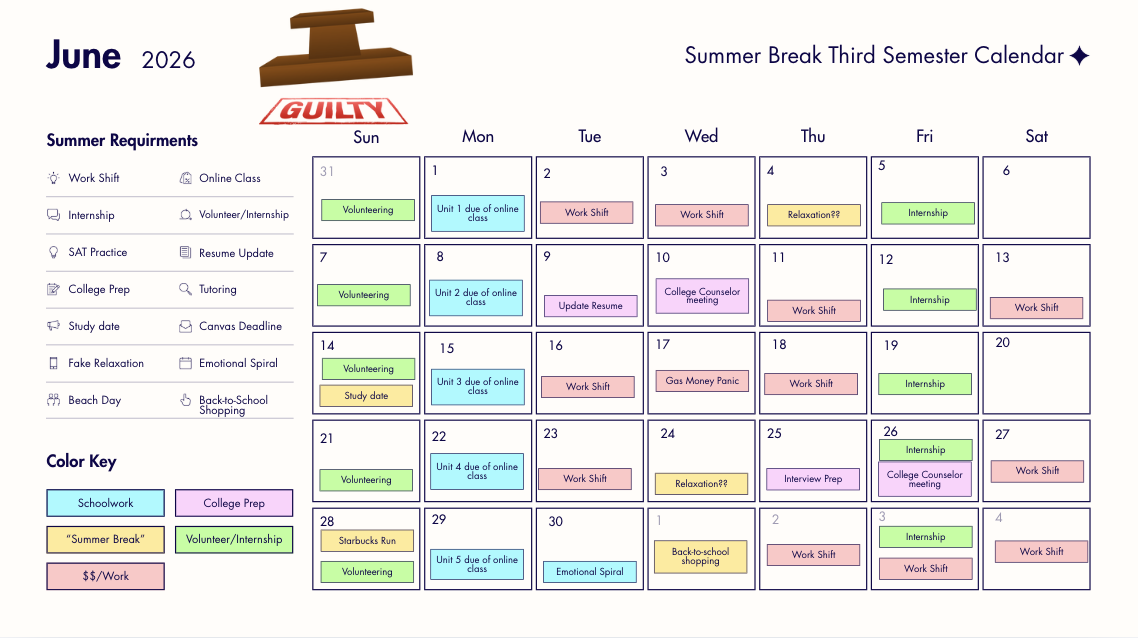
With summer break running from June 1 through Aug. 10, students at the school officially entered the yearly challenge of trying to fit Southern California beach days, vacations, internships, online courses, volunteering, work shifts and enough rest into just over two months.
Within hours of the final bell, students reported their ambitious summer plans. However, the confidence of May quickly turned into the panic of June.
“I woke up at noon and somehow felt like I had wasted summer,” one student said. “It was June 2.”
For many students, summer has become less of a break and more of a third semester with hotter weather and fewer teachers physically present to witness the emotional damage of school-induced stress. Instead of periods, students work shifts. Instead of homework, they take online classes. Instead of grades, they have the silent judgment of college admissions officers they never met.
“Summer is basically school in disguise,” one student said. “It puts on sunglasses and sunscreen, calls itself an internship and ruins your sleep schedule.”
While television shows and movies continue to promote summer as a season of beach bonfires, camp friendships, color wars, spontaneous road trips and emotional self-discovery, many students said their actual summer plans looked slightly different.
“Coming into high school I thought summer was supposed to be like ‘The Summer I Turned Pretty,’” a student said. “But apparently, the summer I turned pretty is also the summer I took two online Advanced Placement (AP) classes, applied for three jobs and studied hours on end for the Scholastic Assessment Test (SAT) that I am taking in the fall.”
For “locked-in” students, summer became less of a vacation and more of a seasonal productivity internship sponsored by anxiety.
“Why would I spend my summer making memories when I could be building my college application?” another student said. “Some people go to camp and learn how to socialize. Personally, I think it’s more valuable to spend eight hours in a lab wearing safety goggles and forming deeper relationships with chemicals in test tubes than with actual humans.”
Students said this shift made fictional summer experiences feel less like entertainment and more like documentaries about a lost civilization.
“I watch shows where teenagers spend summer falling in love, going to parties and sitting around bonfires roasting marshmallows,” one student said. “Then I close my laptop and remember I have a volunteer shift at 8 a.m. and a scary SAT practice test looming ahead of me.”
According to several students, summer now requires a careful balance between having fun, appearing well-rounded, gaining experience, earning money and somehow returning to school in August as a healthier, smarter, more attractive and more emotionally stable version of oneself.
Students preparing for summer jobs and internships can also consult The Falconer’s Adulting 101 guide on how to interview, because nothing says “summer break” like rehearsing professional strengths and weaknesses while your friends are posting sunset beach photos.
“It’s not enough to just have a summer anymore,” one student said. “You have to have a summer that demonstrates leadership, initiative, personal growth, time management and maybe a slight interest in public service.”
Some students said they tried to schedule relaxation into their calendars but found the concept difficult to justify.
“If I sit down for too long, I start feeling like I should be earning community service hours,” one student said. “I can’t even take a nap without wondering if I should add it to my University of California activity list as independent wellness research.”
For other students, the problem was not a lack of plans, but the sudden realization that every plan seemed to require a mode of transportation, an outfit or money they did not possess.
“I need to find a summer job,” another student said. “Mostly because back-to-school shopping somehow gets more expensive every year, and I need to financially prepare for the academic stress I’ll endure next school year with endless retail therapy.”
As summer plans grew, students said their bank accounts began facing challenges of their own.
“I keep telling myself I need a job for gas money,” one student said. “But, realistically, it is also to support my addiction to Strawberry Acai Refreshers, random 2 a.m. Amazon orders and shopping for a new outfit every time I create plans.”
Many students also reported a familiar tension between wanting independence and still needing to ask their parents for money every time they left their house.
“There are only so many times you can ask your parents for $20 before they start looking at you like you need to be a full-time employee,” one student said.
Even students without packed schedules said summer created its own type of pressure, especially as Instagram made it seem like everyone else was either having a “Euro summer,” working, taking online classes, volunteering abroad or becoming a completely improved version of themself from spring.
Teachers said the same pattern appears every year as students often leave campus expecting summer to feel much longer than it actually does.
“When I was in high school, summer felt like a real break,” one teacher said. “Students went outside, saw their friends and came back in the fall with maybe one slightly questionable haircut decision. Now they come back with LinkedIn experience, internship trauma and an even more concerning caffeine dependency. When a student tells me they are taking two online courses, volunteering, working part time and shadowing someone in a medical office, I’m supposed to say, ‘That sounds like a great opportunity,’ instead of, ‘Are you okay?’”
Despite the stress, some students said they remain committed to experiencing at least one traditional summer activity before school begins again.
“I’m hoping to go to the beach at least once,” one student said. “Not for fun, of course. I’m going to frame it to college as a wellness initiative and possibly write a supplemental essay about my experience.”
Others said they accepted that their summer memories may come mostly from watching other people have summer on screen.
“At this point, I’m outsourcing my summer experiences to fictional characters like Rafe Cameron (Drew Starkey) in ‘Outer Banks’ and Isabel Conklin (Lola Tung) in ‘The Summer Turned Pretty’,” one student said. “They can enjoy beach bonfires, Fourth of July parties and barbecues. I’ll be here clocking in, submitting AP United States History assignments and pretending my internship lanyard is truly a summer camp friendship bracelet.”
When asked, the school’s administrators confirmed that summer break remains a time for students to rest, recharge and enjoy being young, provided they can complete all required relaxation, financial planning, career exploration, personal growth, volunteer service, online coursework and emotional recovery by 11:59 p.m. Aug. 10.
College counselors encouraged students not to put too much pressure on themselves, while also gently reminding them that summer can be a valuable time to explore interests, gain experiences and build a stronger application.
“If I’m going to be honest, we do want students to relax,” one college counselor said. “But if they happen to relax while completing an internship, volunteering, taking a class, working a job, starting a nonprofit and discovering their life’s purpose, that certainly wouldn’t hurt.”