
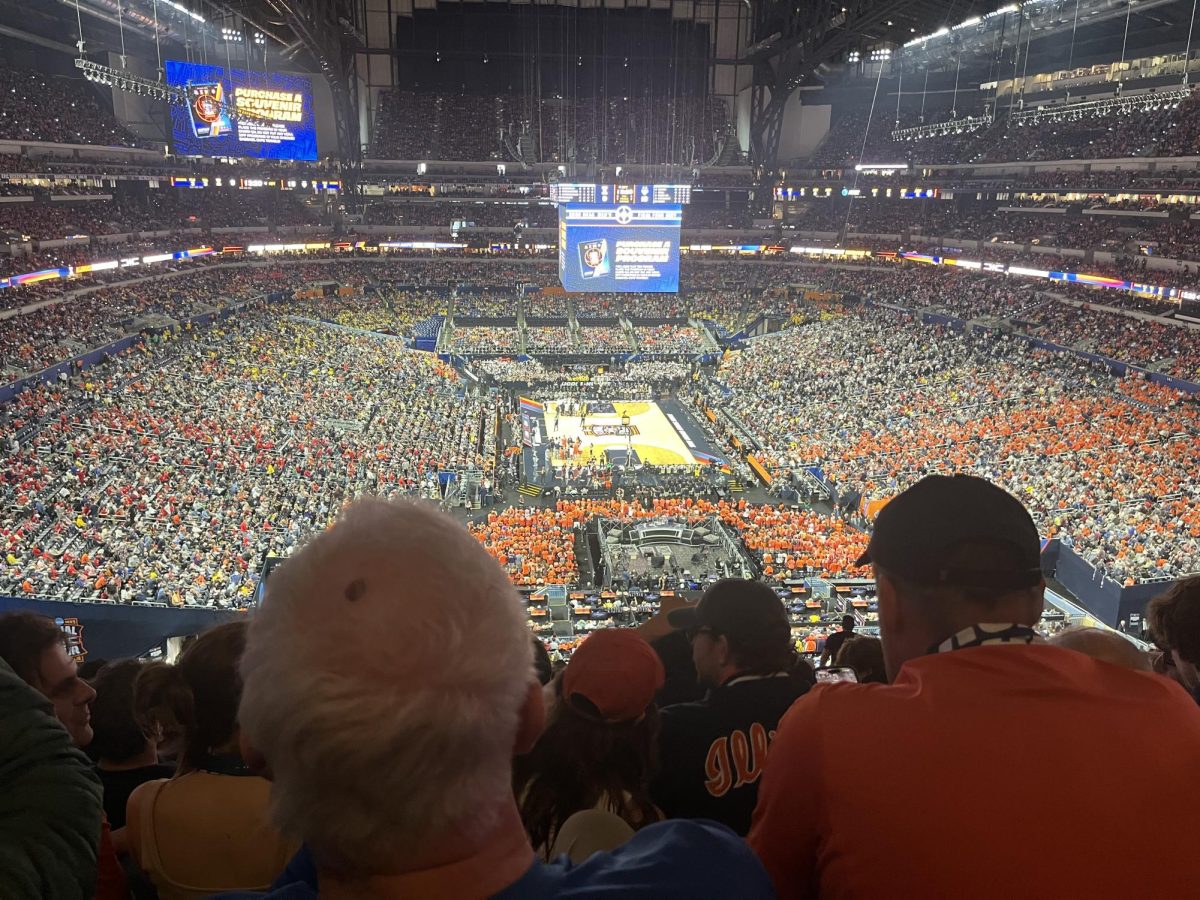
The University of Michigan Wolverines (37-3) defeated the University of Connecticut Huskies (34-6) on April 6 to win the National Championship for the National Collegiate Athletic Association (NCAA) Division I Men’s Basketball Tournament. The game took place in Lucas Oil Stadium in Indianapolis, Ind., and ended with a final score of 63-69.
This game concluded the three-week tournament, known as “March Madness,” that featured 68 teams from across the country. The first two games took place between teams known as the First Four, narrowing the pool to 64 teams. Then, the first round brought the number down to 32, and the second round determined the Sweet 16, which decided the Elite Eight. After the third round, the Final Four consisted of the Huskies, Wolverines, the University of Illinois Urbana-Champaign Fighting Illini and the University of Arizona Wildcats, with the championship game featuring the Huskies and Wolverines.
With 67 games played total, the tournament produced storylines and highlights.
Top moments included Huskies guard Braylon Mullins’s game-winning shot against Duke, University of Texas at Austin’s Tramon Mark’s play while injured and various upsets, like Texas defeating Gonzaga University and Iowa State University’s win over University of Florida.
Colton Sallaway (10), traveled to Indiana during Spring Break to watch the Final Four and shared his favorite moments from his trip.
“It was a great overall experience with the Fan Fest [special events],” Sallaway said. “I was able to see a lot of Indianapolis, and the entire environment of the stadium was amazing.”
Sallaway also spoke about his favorite highlights from the tournament in general.
“[Wolverines forward] Yaxel Lendeborg, Michigan’s best player, went down with an injury early,” Sallaway said. “Michigan still ran away with [the game]. They completely dominated for the entire tournament.”
Jacob Gilliam, College Preparatory English 10 and English 12 teacher and boys varsity basketball assistant coach, enjoys watching March Madness.
“I love watching March Madness,” Gilliam said. “It’s always the best time of the year, the best event in sports, in my opinion, and there [are] always crazy games. I remember [University of] Kentucky was playing Santa Clara [University], and I had it on in the classroom during break and there were back-to-back-to-back shots at the end and a buzzer-beater, and some of the guys in here were watching it and we went crazy.”
One of the most discussed games of March Madness was the Elite Eight matchup between the Huskies and the Duke University Blue Devils.
“I was watching at home with my buddies when Duke blew a big lead,” Gilliam said. “Connecitcut hit a buzzer-beater shot to go to the Final Four.”
Gilliam described the Huskies’ win as an “amazing moment.” However Ryder Krems (9), a member of the freshman basketball team, did not feel the same way.
“I liked watching Duke this season,” Krems said. “They were doing really well, and I was sad to watch them lose in the tournament.”
In college sports, one of the most controversial topics is the transfer portal, which allows players to move teams and find better opportunities, while allowing coaches to find better players. The effects of the transfer portal were on full display during March Madness, as all five starters on Michigan’s championship team come to the team through the portal.
“Transfers are the way of the game now,” Gilliam said. “Transfers allow programs to get older players, more experienced players, more physically gifted players and have success that way. It’s the way to win now … I think the mission of college athletics and the graduation track of these kids has been really dismayed, but I understand that, for the coaches, the best way to develop their program is to have players that are transfers.”
On the other hand, Sallaway believes that the transfer portal puts smaller teams at a disadvantage.
“[The portal] is giving the smaller teams less of a chance to find diamonds in the rough,” Sallaway said. “Larger teams with more money will just scoop them away. I think that players should be able to transfer if they’re not getting the playing time they want, but it should be limited to a certain amount.”
Another argument against the portal is that high turnover rates can be detrimental for teams, as hundreds of players already entered the portal after the conclusion of March Madness.
“I think there’s a little misconception that [coaches] are just going and buying players and there’s no culture being built,” Gilliam said. “I think it’s actually important to have a strong culture because as you get transfers in, you have to have a culture that is steadfast … and a culture around togetherness and playing for the guy next to you.”
While March Madness offers diehard fans an opportunity to cheer on their teams, millions of people, including casual fans, fill out brackets every year.
“There were a lot of upsets,” Krems said. “The first day, High Point [University Panthers] and [University of] Wisconsin and UConn over Duke ruined my bracket.”
Though Gilliam’s bracket was also ruined by the UConn-Duke matchup, he “didn’t mind” because “the moment was so good.”
For Gilliam, March Madness is particularly special for personal reasons.
“I’ve had the fortune of working with a lot of players,” Gilliam said. “Whether it’s guys that I coached here [at the school], or guys I have coached in travel basketball, so I always root for those guys when they’re playing.”