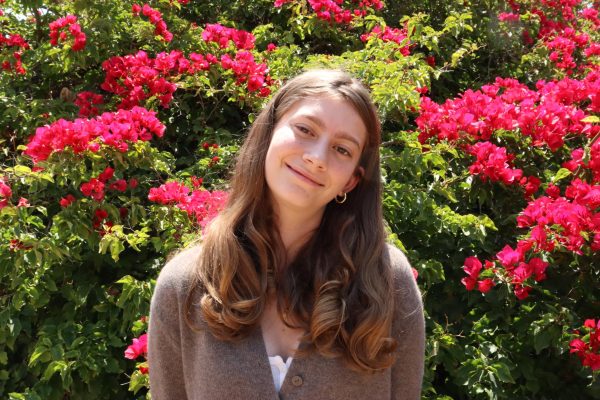

With the sun peeking above the skyline behind her, Maddy Hall (12) smoothes her flyaways into a slick-back bun, preparing for competition day at West Coast Elite Nationals, which occurred March 5-7.
“Friday is the biggest day of the competition,” Hall said. “ That is where we have the majority of our group dances. Our first dance [that day] was at 8:30 a.m., so our call time was around 7:30 a.m. and 20 girls in medium contemporary had to all be up at 6 a.m.”
After rolling out of bed and getting ready, the dancers practiced choreography for around an hour where they could find free space, then perform on stage. This routine repeated over the course of the weekend.
“We started at 7:30 [a.m.] as our first call time, and we ended at 6:00 p.m.,” Hall said. “Literally, it’s just eat, dance, perform, repeat. We may clean up some of the dances in between, just so we have those corrections before we go on stage for the last time.”
On Friday, the team performed a Medium Lyrical Gold performance to “My Immortal,” an Extra Small Gold performance to “Where Are You,” a Small Jazz Gold performance to “Question of U,” a Large Contemporary Silver performance to “Sweet Dreams,” a small Hip Hop Gold performance to Kaysteye, a Medium Hip Hop Gold performance to NSYNC, a Small Lyrical Gold performance to “Big White Room,” a Dancer of the Year Dance Off and awards. Gold signifies that the dance was highly technical, while Silver signifies that the dance was on a more beginner technical level.
Before each performance, the dancers who go on stage practice a tradition called a facial circle to get their energy back up.
“There are 50 of us, and we get into a circle, turn the music on in the middle with a giant speaker, and we all stare at the person next to us,” Hall said. “We bring the [team’s] energy up just with our faces by showing what expressions we’re going to have while we dance.”
In the following minutes, Hall addressed her fellow dancers as a captain of the varsity hip-hop team and contemporary team. She reminded them that “nobody but us and our parents want us to win” and as they step off the stage, they should “act like [they] already won because of all the hard work [they] put out in the floor, not because of the score they got at the end of the day.”
“I think that was one of the most memorable speeches I would have given to the team, because I was listening to myself,” Hall said. “I was just so glad I got to dance with the team one last time, because it will never be the same ever again.”
For Hall, her energy increases significantly while on stage compared to practice.
“When we’re practicing in the room, I would say I have 20 [percent] less energy than I do when I’m on stage, because I know people are counting on me to do well,” Hall said. “I feel like I could say the same for almost all my teammates …We always say that the stage adrenaline is 20 times more exciting than the performance adrenaline.”
Head coach of the Junior Varsity Hip-hop team and co-coach of the Varsity Hip-hop team, Ysa Penarejo, took a special notice to how dancers preserved during the competition.
“Unfortunately one of our dancers got really sick the day before they performed and he couldn’t come up to compete with the team,” Penarejo said “I had to reblock and prep our JV medium team with any formation changes as well as any choreography they would need to learn last minute. Something with this quick of a turnaround isn’t the easiest adjustment especially when you have to dance on stage the next day. But, they did amazing on that stage and they ended up placing 2nd place out of 19 schools in their category. I believe that’s such a big achievement, given the circumstances they were in!”
Dancers also spend at least one evening together with a team dinner during nationals, which often involves the “parents coming together [to] try to get snacks that [dancers] can eat together.” This time, it was pizza.
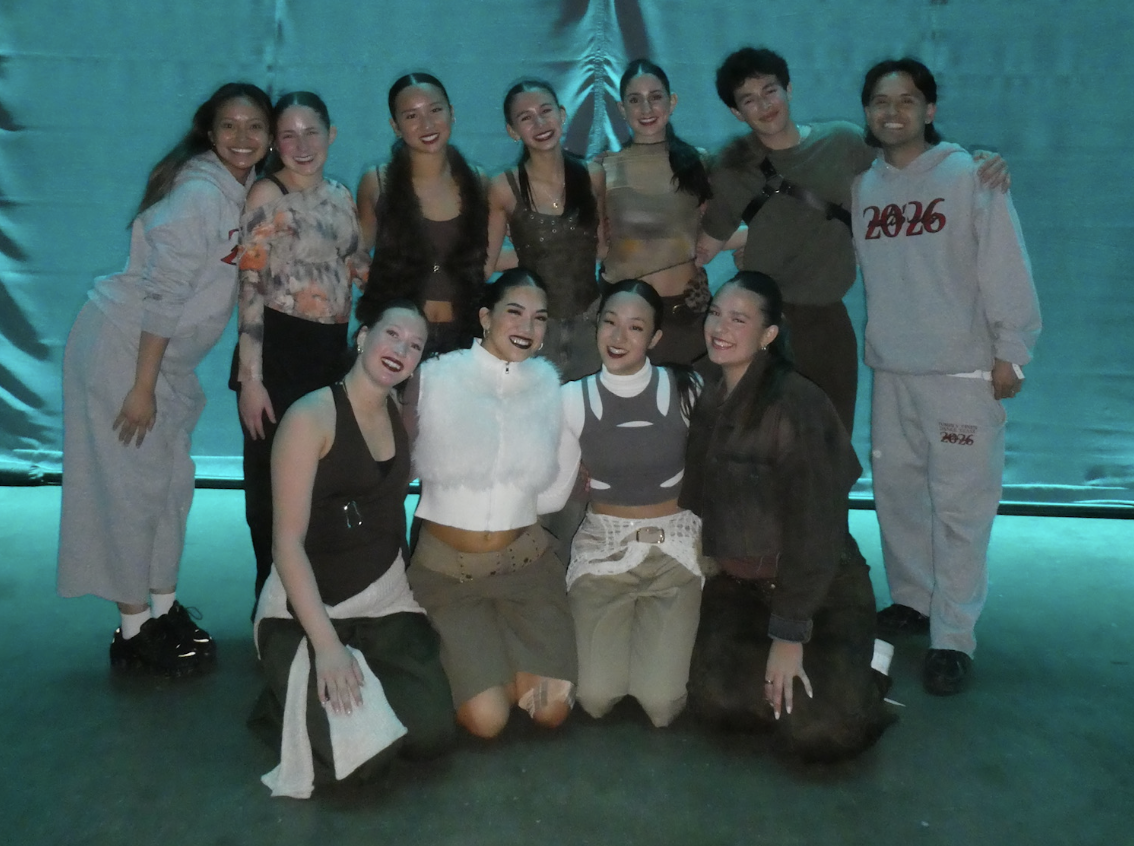
“Throughout the day, we enjoyed getting ready together, eating together and practicing,” Shea Faassen (12), member of the Varsity Hip-hop team, Varsity Large Hip-hop Competition team, Varsity Medium Hip-hop Competition team, and Varsity Small Hip-hop Competition team, said. “We built such a great bond and had a great experience together.”
Penarejo hopes to foster this sense of unity through her own teachings.
“Francis [my co-coach on Varsity Hip-hop] and I instill this value that you are just not dancing for yourself in the space, you are dancing with a group of people and for each other. We emphasize this as it builds a sense of camaraderie within the dancers and they use that trust in each other to push through those challenges.”
Some dancers preferred heading to bed, after spending all day on their feet, as opposed to going out.
“I’m on junior varsity and varsity teams for] contemporary and [both] teams on hip-hop,” Hall said. “So at the end of the night some people are like, ‘Let’s go out to dinner.’ I’m like, ‘I would love to take a shower instead.’”
Throughout the competition, the dancers experienced a range of emotions, from post-dance adrenaline to a sense of sadness for the approaching loss of the senior dancers’ last nationals.
“Towards the end, we started to get emotional because we realized it was our last time dancing together,” Faassen said.
Above all, Hall carries a sense of pride in both herself and her fellow teammates.
“The whole team was delighted with how we did coming off the stage, no matter what score we got,” Hall said. “There have been numerous years where we even won and weren’t proud of ourselves, but it was a really, really good year this time.”
Penarejo also echoed the importance of a sense of internal pride no matter the score.
“Watching the last few performances at nationals, you can see and feel that these dancers were leaving their hearts on the floor and that’s all you can really ask for,” Penarejo said. “As long as they were happy and they did everything they could do when they danced, thats when you know all of that hard work was worth it.”