


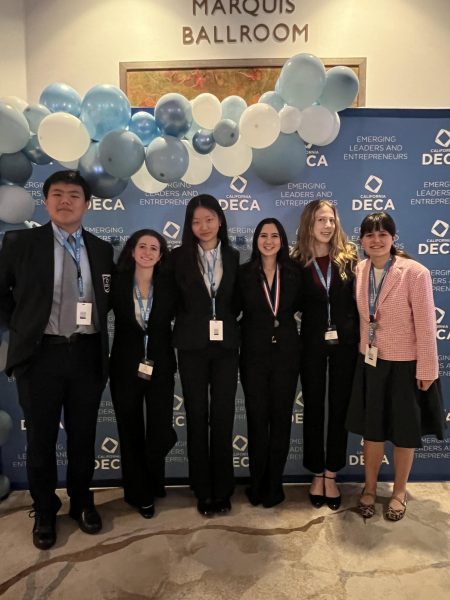
The school’s chapter of Distributive Education Clubs of America (DECA) attended the State Career Development Conference at the Anaheim Marriott from Feb. 26 to March 1.
TPDECA President Stella Phillips (12), an overall finalist, will compete at the DECA International Career Development Conference (ICDC) in Atlanta from April 25 to 28. Isabel Ji (11), third place in Roleplay 1 in Accounting Application Series and Phillips, third place in Roleplay 2 in Business Services Marketing Series were both medalists. Competition Preparation Officer Shir Haim (11), Evangeline Cato (10), Simon Liu (10), Danika Balden (9) and Gordon Zhang (12) were finalists in their respective events: Accounting Applications Series, Principles of Entrepreneurship, Business Finance Series, Financial Operations Research and Human Resources Management Series.
In DECA, students select a cluster to compete in — marketing, finance, business management and administration, entrepreneurship or hospitality and tourism — each containing different events.
“I think each of those [categories] prepares you for a totally different path within the business world, whether that is finance or marketing or human resources, you name it,” Intro to Business and Advanced Business Management teacher Alesha Billmeyer said. “And so, I think it’s prepping students to get to specify and dive into that sooner than maybe you would if you weren’t doing something like DECA.”
Competitions vary, but typically consist of a “cluster-specific exam that correlates to their individual series event” and one Roleplay for Prinicples and team decision-making events or two Roleplays in other individual events.
“Some students have the option to compete in a written event where they normally prepare a written entry and presentation on a business idea or concept,” Phillips said.
Roleplays are “random, real-world scenarios” in which students receive a scenario and have 10 minutes to brainstorm an idea and prepare visuals, then 10 minutes to pitch their idea to a judge, where they are scored on various factors like industry knowledge, terminology and presentation skills.
At SCDC, the top three scorers from exams and the two Roleplays receive a medal. In California, the top six overall scorers across roleplays and their exam receive a medal, places fourth through sixth, or a glass, places first through third, on the final night and advance to ICDC.
“In the past two years, we always had someone that qualified to ICDC, so I do think that everyone was a little disappointed from that, of course,” Haim said. “But, I think we’re all super proud of everyone who came to compete, and we still had a lot more people who were finalists overall than years before and we’re just proud of the effort of everyone. I would say it could have gone better, but it could always go better.”
The remaining top 10 scorers in a given event serve as alternates in case a primary qualifier declines their spot.
“You can only compete in one event [at ICDC], so sometimes people drop from certain events,” Haim said. “… Let’s say someone drops, you might be pushed up and then go on to compete.”
Philips placed eighth overall in the Business Service Marketing Series and moved up to compete at ICDC. Her event included a 100 question multiple choice exam and two roleplay events, all of which contributed to the overall score. At DECA events, while contestants compete under their chapter, achievements are “all based on individual performance,” according to Phillips.
“Some highlights from this year’s state competition were definitely the opportunity to meet other chapter leaders and DECA members from around the state,” Phillips said. “On top of competing, I was also a voting delegate, meaning I got to vote for our next state officer team, and was a part of the campaign team for the newly elected DECA state president.”
This year, for the first time, all members who wanted to attend SCDC were allowed to go. According to Haim, “understanding how to work all the structuring of who manages which people and how would that work as officers” was a challenge.
“I am very proud of the effort that each of our members put in this year, leading up to states and our regional Minicon,” Phillips said. “Our chapter performed well at the Minicon, where we had multiple finalists and glass winners. While we didn’t get the overall results we wanted at States, I am still proud of my officer team and all 65 of our competitors, which is more than double the number of people we have brought to competitions in the past.”
The Minicon took place at Canyon Crest Academy on Nov. 15, with over 300 participating students from across seven schools.
For the conference, Phillips handled a lot of “behind-the-scenes work” such as registration, budgeting and planning and communication between advisers, parents, chapter officers and students.
“I had a team below me who handled most competition prep and other minor tasks, which significantly reduced my workload and allowed me to focus on my individual tasks without being overwhelmed,” Phillips said.
Two competition preparation officers handle “chapter-wide preparation” and “ensure competitors feel prepared for all their roleplays, presentations, and exams” according to Phillips.
“Individually, we encourage students to do practice exams and study cluster or area-specific vocabulary,” Phillips said. “We also hold a lot of one-on-one roleplays to give people practice and live feedback.”
As a competition prep officer, Haim answered questions and provided students with exams and Roleplay practice meetings, where students could be tested and receive feedback.
“At the beginning of the year, we made a video that [described] what Roleplay is to all the new people,” Haim said. “Because I think that one of the hardest parts of starting DECA is that you really don’t understand a lot, it’s such a complicated competition. So making sure that people understand what they’re going into, especially before the mini competition that we had for SoCal … was very helpful [for] getting people to understand what they were getting into.”
Billmeyer was a chaperone during the trip and judged Roleplays during one of the conference days.
“I didn’t get to see any of our students in action, but I was a judge one of the days,” Billmeyer said. “… I feel like I was very impressed by students who were able to thoughtfully communicate on the spot about hard ideas, like my topic, which was human resources.”
Judges graded content and presentation skills based on a rubric, which Billmeyer described as “well rounded.” Billmeyer believes students learn to “communicate ideas clearly, connect authentically and [have] quick critical thinking” through DECA, which “puts the material to the test.”
“I think it’s very different studying material in a classroom and then being in front of a judge, given a problem and having 10 minutes to find a solution and communicate it,” Billmeyer said. “… It’s almost like the classroom is the training grounds and then DECA is the competition.”
Billmeyer said that the business department will continue working to make “that bridge a little bit shorter.”
“From chaperoning, I feel like it’s such an incredible experience that I wish I had in high school and didn’t have,” Billmeyer said. “And, I think major props to all the kids who signed up and did it because it’s definitely tough, and I think it’s just another tool in the toolkit that’s gonna be really helpful later on.”
Haim agreed that the impacts of DECA extend beyond industry knowledge.
“I think the most important impact would be confidence and presentation wise,” Haim said. “A person who’s doing a written event is not only going to learn about like researching the market, researching a business, finances, a balance sheet, they’re also going to learn about how to stand in front of a judge, how to present, how to be confident about that, or even like how to write a paper, which are tools that people are going to use for the rest of their lives, no matter what job they even go into. And then role plays as well, it’s just like you have to face your fears and know how to talk to someone in a confident way so that you can communicate your knowledge to them.”
From her time as president, Phillips gained leadership and networking skills and “significantly developed” her “critical thinking skills, presentation and speaking abilities and … overall confidence.”
“Between all the behind-the-scenes work, leading at competitions and being the figurehead of the chapter, I’ve definitely learned how to conduct myself in a more professional manner as well as know when I need to be in ‘president’ mode versus when I need to be in ‘competitor’ mode,” Phillips said.
As the DECA season comes to an end, TPDECA prepares for next year.
“So we’re planning to just get started on, well, first of all, summarizing the whole year, just looking over everything that we did, and thinking what we could have done better, what we could have studied better,” Haim said.
They will start work on written events, since they “are projects that take a lot of time, and usually people who compete in them will start months prior,” according to Haim.
“It’s a lot of work, and that’s usually something we’re kind of weak at, so we’re trying to strengthen that,” Haim said. “And then just overall, DECA would focus more about, like learning business in general, like we want to get a guest speaker, and we’re still in the planning phase of that.”
For Phillips, this year being her last DECA season is “definitely bittersweet.” ICDC will be Phillips’ official last competition.
“As someone who has been in the club and a state competitor since freshman year, I found it surreal to be at my last state conference,” Phillips said. “But also, having been president for 2 years, this club holds a special place in my heart and really shaped my high school experience, so having it ‘end’ definitely brings strong emotions.”
Phillips feels “confident” in current officers and the club’s ability to “thrive next year and in the years beyond.” She was “especially proud” of the team’s initiative and proactivity, as they had a lot of responsibility this year and “all stepped up and into their role and then some.”
“In a sense, it feels like I’m handing off a big project, so yes, I am apprehensive about leaving it, but I know I’m leaving it in good hands,” Phillips said. “Like most things in senior year, I knew this was coming; it just hits you hard sometimes, no matter how well you prepare yourself emotionally.”
Phillips’ main goal is to set the club up for success.
“Jack [Norman, TPDECA Vice President,] and I poured a lot into this club when we took over, and managing its rapid growth took a lot,” Phillips said. “As we leave, we have to hand off the torch to a new team. So our goal as we approach the end of the year is to select an incoming officer team we know will have the chapter’s best interests at heart, and to train them so they are equipped to manage the club. We essentially want to leave the club in good standing and on a stable foundation to ensure future success.”