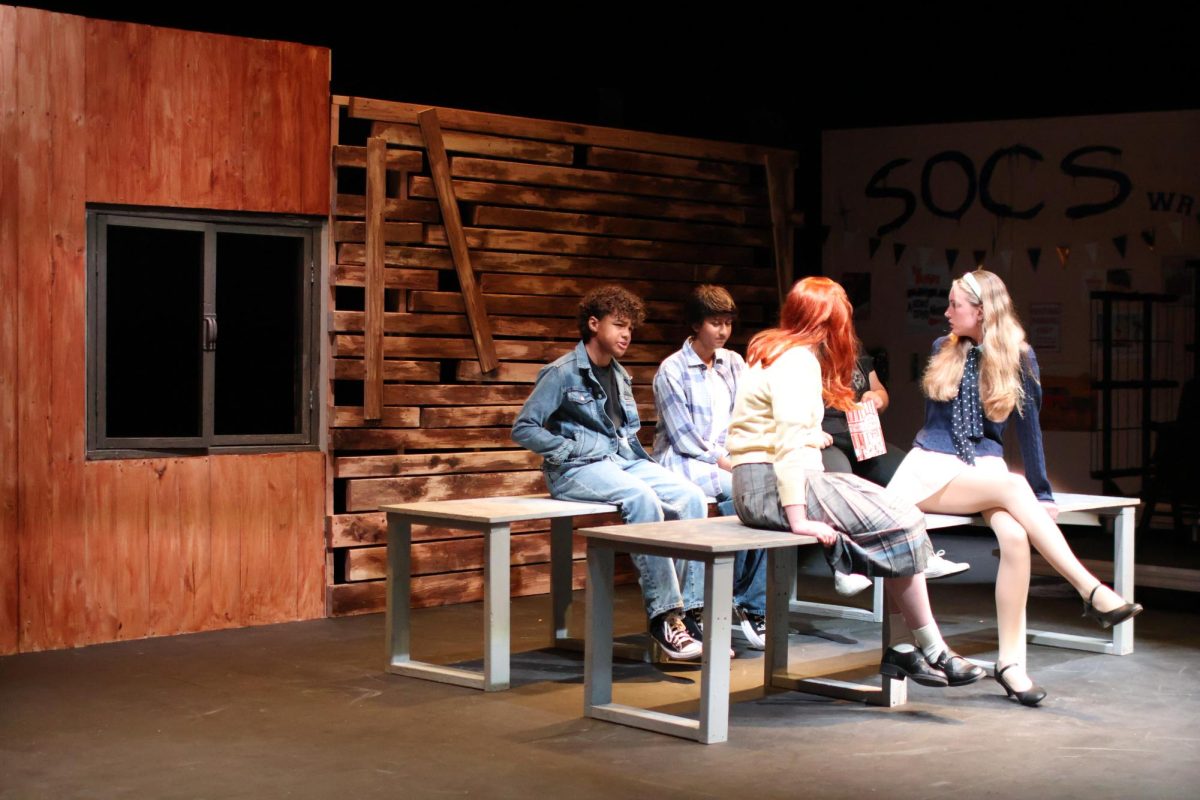


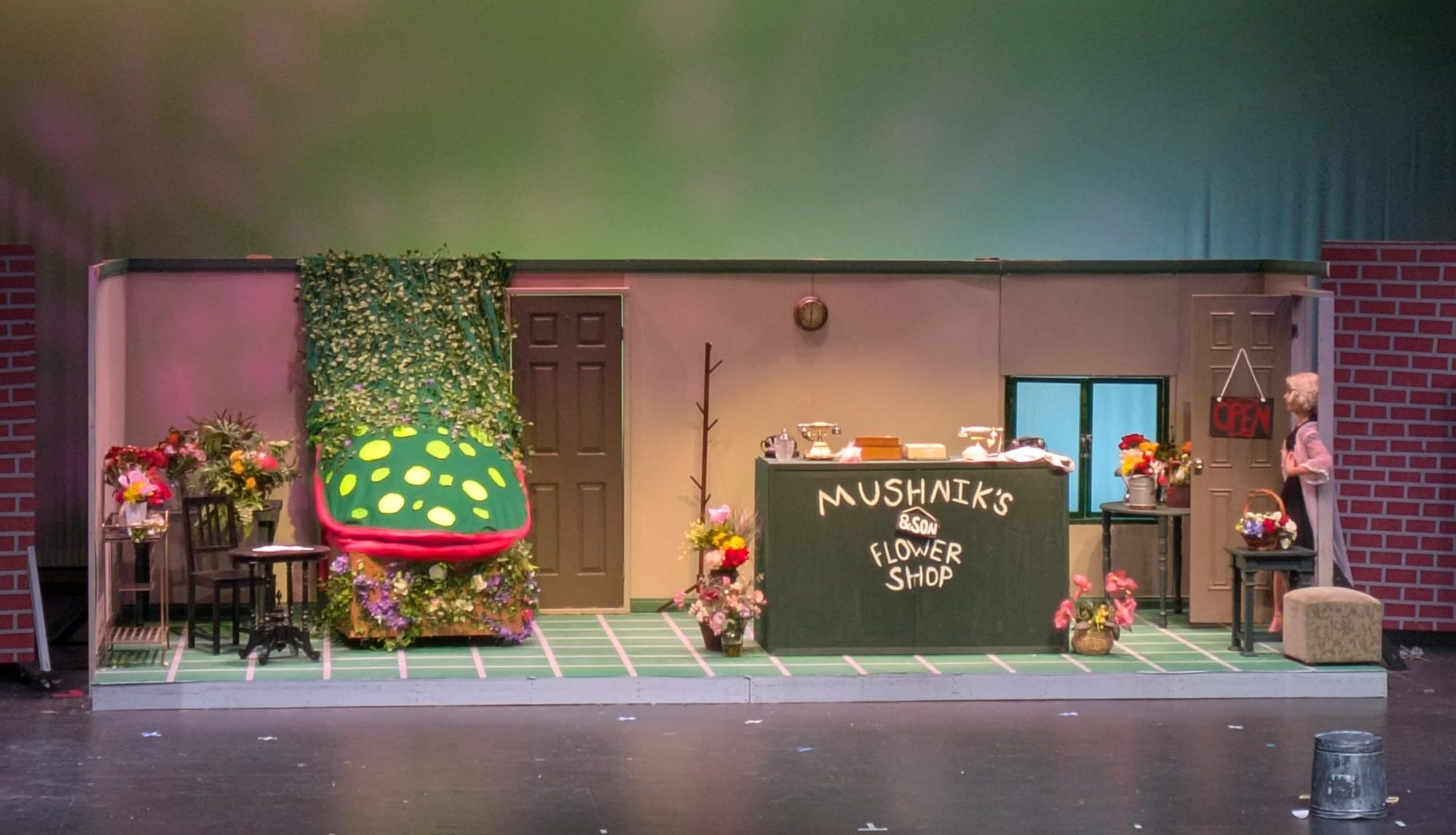
Torrey Pines Players built four different carnivorous plant puppets for their “Little Shop of Horrors” show, which they performed last week and this Thursday, Friday and Saturday.
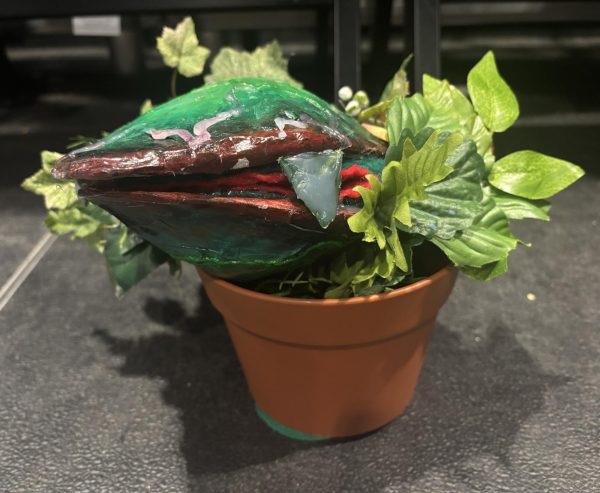
The puppets are each a different version of the carnivorous plant character Audrey II as she grows larger and larger throughout the story. Audrey II grows from a seedling to a towering stalk that sings of her insatiable desire for human flesh and blood in songs like “Feed Me (Git It!).”
“Obviously, it would have been easier to rent it,” Introduction to Professional Theatre, Intermediate Professional Theatre, English 10 and AVID 10 teacher Sandra Geminiani said. “It is kind of expensive to rent puppets. But more than that, I thought the experience of having to be creative and come together to figure out how to make it could be more fun and just provide a more enriching learning experience for the students. So I thought it’d be worth doing.”
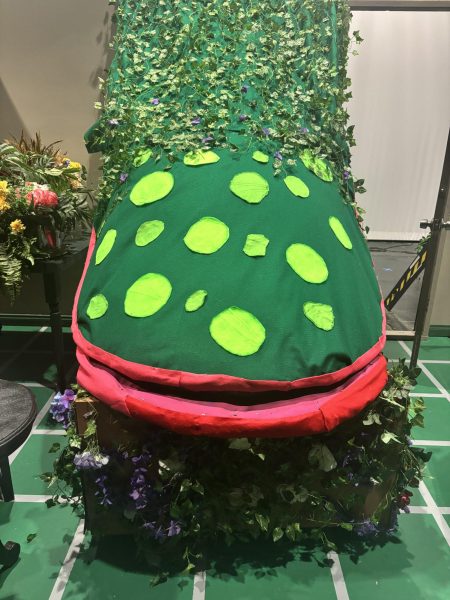
The two smaller puppets are hand puppets for the role of Audrey II’s infancy. Puppet Three, according to Geminiani, is a full body suit with “two pieces of the plant’s mouth to make it move and talk and sing and look like it’s eating.” The largest and bloodthirstiest puppet, Puppet Four, was designed to swallow entire people and is made of wood, PVC pipes, zip ties and chicken wire. Student directors Hailey McInnis (12) and Mateja Schmidt (11) control Puppet Four backstage to unhinge its jaws, revealing a cushioned tongue for actors to jump onto and slide out the back.
“In the back, there’s a curtain,” Schmidt said. “The curtain covers where me and the other puppeteer are standing, so when they jump in, we close the lid and then lift the curtain and they can get out and through a hole [to the] backstage.”
Aiden Roffey (10) and Jasper Lo (9) designed and constructed the puppets. Building the puppets took “about a month of classes” plus “two set building days on the weekend” and one “emergency building day on one of the Fridays,” according to Lo.
“We started with a couple sketches,” Lo said. “We tried looking at a couple of books, but the main one we were looking at [was] how to build an Audrey II. It wasn’t very helpful because it required a lot of things that we couldn’t really have access to. So we decided to just figure things out as we went. We knew that the first one could be a sock puppet and the second one could be a bigger sock puppet, but for the third and the fourth… Aiden [was] throwing out ideas, and he suggested chicken wire, so we worked with that, and it’s been really helpful.”

Human-eating Puppet Four, however, required a stronger interior structure.
“When people get eaten, you don’t want the thing to collapse and fall over,” Roffey said. “So a wood structure was the most safe design.”
To decorate, they covered the puppet’s exterior in dark green felt fabric and adorned the sides with plastic vines. Puppet One, the smallest puppet, is the only one covered in paper mache, hot glue (for the sharp teeth), paint and clay. The tops of each puppet are spotted with neon green splotches. Opening Audrey II’s mouth reveals a blood red interior.
“I really liked decorating and putting all the fake plants on the puppets,” Roffey said. “I thought that was really fun.”
Lo also controls and voices Puppet Two. He makes chewing sounds for when Audrey II eats human body parts in the play. For Lo, participating in the puppet’s building process helps him “know how long [it takes] to open the mouth and close it” and thus “know how long I have to make those [noises].”
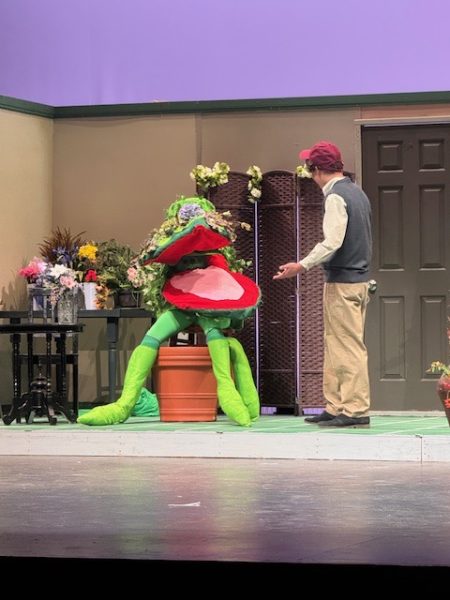
Aside from maneuvering Puppet Four with Schmidt, McInnis wears and controls the Puppet Three costume. Her arms act as the top and bottom of Audrey II’s mouth, opening and closing to talk, sing and eat human hands.
“We were able to customize it to my size,” McInnis said. “The leg attachments we made based on how tall I was and we picked the pot size based on how tall I was. I think if we had been using a rented puppet, it would have been less flexible.”
While he was building Puppet Three, Lo was concerned that the chicken wire would accidentally cut one of the actors or that the puppet would not be able to support so much weight. According to Geminiani, “everything [has] gone really smoothly with the puppets so far.”
“In Puppet Four, the actors have to go inside and look like they’ve been eaten,” Geminiani said. “When [an actor] jumped in, the tongue fell out. But other than that, it’s been pretty smooth. And you can’t really tell that it’s people maneuvering it because they’re hidden pretty well.”
In the end, Lo was satisfied with the results.
“I think seeing [the puppets] all put together and seeing the actors actually be able to use them was a very rewarding experience,” Lo said.
Though the experience was “way out of [his] comfort zone,” Roffey thinks they “ended up doing pretty well.”
Geminiani was afraid Puppet Four would look “cheesier” from the audiences’ perspective, but was glad to find that “it really doesn’t.” She applauds the students’ work.
“I think the coolest part is just that they’re handmade, the fact that students made them [and] that they used their ideas, their designs,” Geminiani said. “None of us are puppet designers, but we were able to create something on our own just using some really basic materials.”
Roffey and Schmidt encourage students to join stage crew since ensemble and makeup students currently help with stage crew.
“It’s a really good opportunity because you don’t just learn how to build stuff and use tools, you also learn things like sound and lights and a bunch of other things that help you in real life and can open job opportunities,” Schmidt said.
She hopes to direct more “shows that are big and bold” in the future.
“I think that when you have something ambitious like this [for] a group, you really have to put your heads together, so I think it’s made this process very student centered and student focused,” Geminiani said.
She believes these hand-made props help gather traction for TP Players.
“Those visuals are some of the things that get people excited and get them coming in the door,” Geminiani said. “Maybe people who don’t necessarily know theater that much, but they just see something that’s kind of amazing, and the fact that students created it impresses them enough to want to maybe come in the door for the first time. That’s my hope: that it’s just generating buzz around the community about what we’re doing.”