
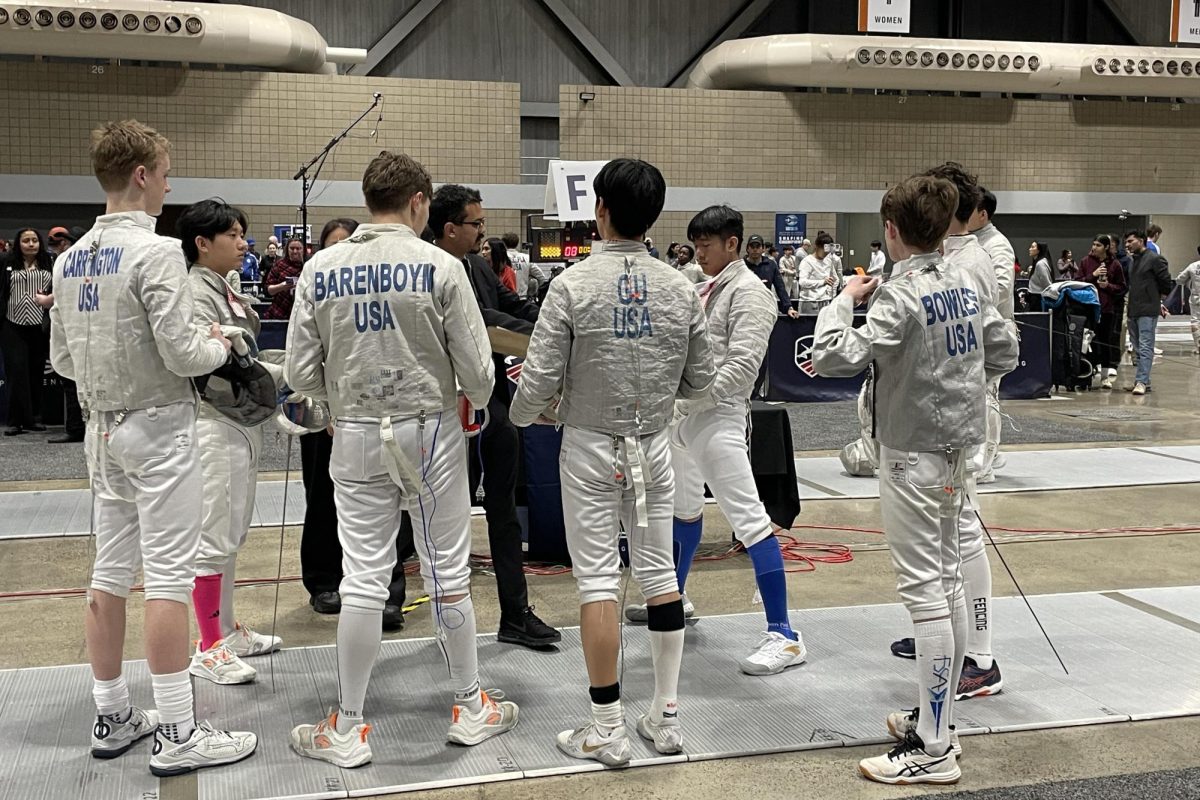
Kevin Gu (11) discusses his experience participating in a non-California Interscholastic Federation (CIF) sport: fencing. He currently fences at La Jolla Fencing Academy, specifically called SPARTAK Club competitively.
How has participating in a non-school sport like fencing impacted you?
“Because fencing is like one of those sports where you [compete through] a club outside, I don’t get to interact within a school team. But one thing I like about having a club outside is that I get exposed to a lot of people that I wouldn’t usually interact with, because in my club, I’m the only person that goes to [this school]. There’s people from private schools, like boarding schools, and also abroad. We have people who practice with us that come from Australia, which is kind of crazy … Honestly, beyond just the type of people from the school. I get exposure to a wide range of ages. There’ll be … very young kids [at] club events too, and there’s also senior [citizens] at events.”
What initially drew you to fencing and how does it differ from other sports you may have considered or participated in?
“Honestly, what initially drew me to fencing was that it was a very niche and unique sport. I feel like from other sports, it’s more [of] a team sport. [For a lot of sports,] you practice with the club, but you fence by yourself. Like when you lose, you only blame yourself in individual sports. I liked how unique it was and I just thought it looked fun.”
Can you describe the training regime for fencing?
“It will change from person-to-person … Our practices are split into … weekday practices and one weekend practice. So weekday practices are on Tuesday, Thursday, and Friday, and our weekend practice is Saturday. How our practice works, it’s about three to three-and-a-half hours long from like 6 p.m. to 9 p.m. Basically, for the first hour, [we’re] working on footwork and fundamentals. At 7 p.m. it’s basically what we call open fencing, which is where everyone gears up and you can fence freely for two hours straight, [called open fencing]. Literally anyone can join, even if you’re not part of the club. I’ve seen people who are 6 years old come and fence and [there are] people from different kinds of colleges come to the club and fence with us … Then on the weekend in the morning, it’s all strength building. It’s like core exercises [and] lateral drills, but we still make time for open fencing. I know a lot of people honestly that just [do not focus on] fundamentals and strength training and just go for open fencing because that’s honestly where you get the most practice.”
Do you think there are any misconceptions about fencing as a more unique sport?
“There is a huge misconception … Fencing is the broad term, [and] it is actually split into three different weapons: there’s épée, there’s foil and there’s saber. I do saber, and the main misconception is that, when people go to the Olympics, they only compete in foil and épée, and those are very, very slow-paced styles, where [competitors are] being patient and, like, seeing opportunities. But saber, which is the one I do, is literally the opposite, where it’s like all instinct, reflex and speed. I feel like a lot of people don’t actually know the difference. Foil is pretty popular and saber isn’t as encouraged. A lot of people think it’s only one weapon inside of the title fencing, but there’s actually three different ones.”
Are there any differences in the rules between different weapons?
“I think honestly the main difference is the amount of targets you have available and obviously the weapon. So épée, foil and saber all have different [builds] and blades.”
- Épée: Features a stiff, triangular blade with a V-shaped groove (fuller) and a large, bell-shaped guard. It is designed purely for thrusting.
- Foil: Has a flexible, light blade with a rectangular (or quadrangular) cross-section. It has a smaller, circular hand guard.
- Saber: A shorter, 105cm weapon with a flat, V-shaped blade that is flexible. It is designed for both cutting (using the edge) and thrusting. The guard is larger and curved, designed to protect the hand from slashes.
“[In] epée and foil, [competitors] can only hit their chest and their head. But [for] saber, you can hit everywhere except the legs. The point systems are also completely different.”
What are your future aspirations in fencing and how do you like to navigate the competitive landscape? Is it different from competing at schools or going abroad?
“There’s different levels of tournaments and … as you go up those levels, there’s better and better fencers and the better you do, basically, the [higher] your ranking [is], and eventually, the top ranked people will get recruited to colleges, at least for high school … There’s local tournaments, regional tournaments, super regional tournaments and national competitions. [Specifically,] there’s one called the Junior Olympics, then there’s summer nationals, and then once you get really good, you go to World Cups. When you start, you’ll go to local [tournaments] because that’s where all the beginners go … The rating system is based on how you do, so there’s unrated, Es, Ds, Cs, Bs and As … Within the national competitions, … there’s clubs from all over the country that come. But once you get to an international level, you basically represent your country or a college, and you go out and compete with people from other countries. The World Cup is [composed of] people from all kinds of diverse backgrounds.”