
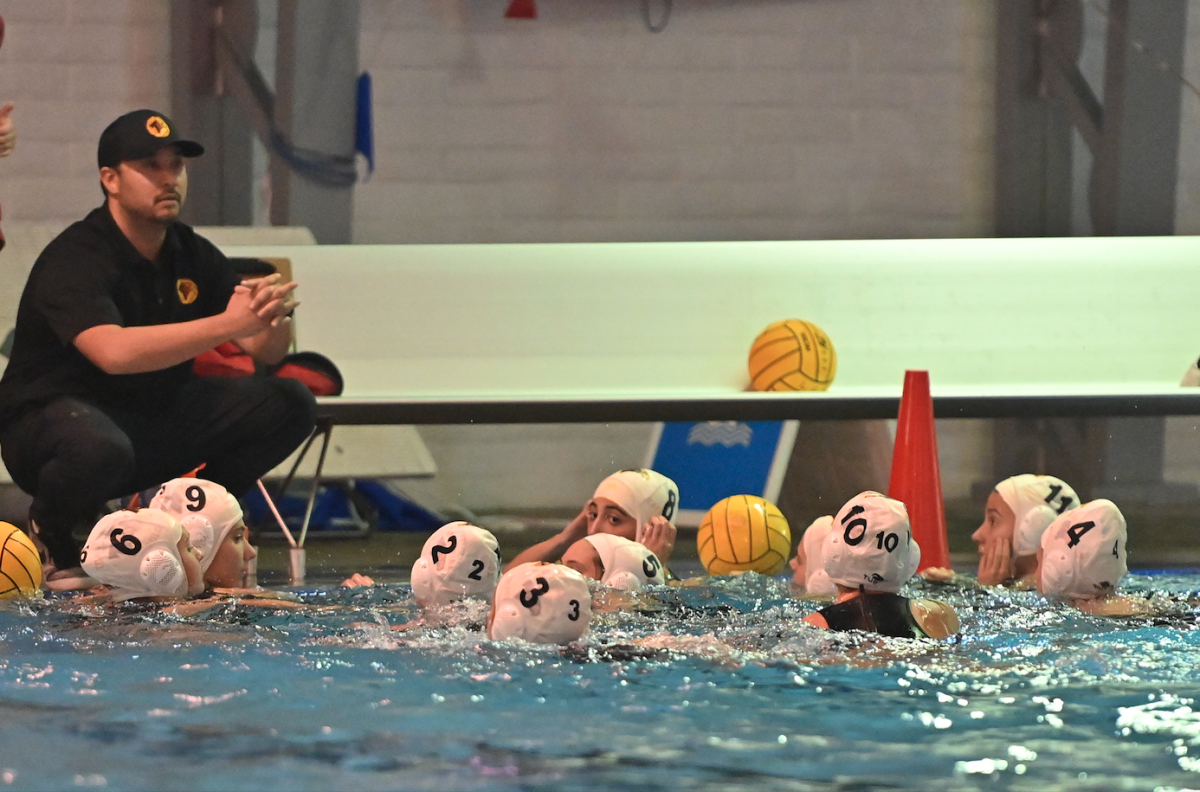
Returning to the birthplace of his water polo career, new girls water polo head coach Alex Williams (‘06) prepares to bring his passion and years of accumulated experience back to this school.
After graduating from this school, Williams played club at the University of Arizona from 2006 to 2010. He began coaching “mostly girls [water polo]” with “a few seasons of boys” at this school from 2013 to 2018 and was the club coach at San Diego Shores Water Polo Club from 2016 to 2018. For the past six years, he was a Division I National Collegiate Athletic Association (NCAA) water polo coach in New York at Iona College and Siena College.
“I just really wanted to come back to San Diego and be part of the best athletic department I’ve ever been part of,” Williams said. “So that’s why I wanted to coach at Torrey Pines again. [This is] where my best memories are, and I have the best relationships with our athletic staff, and it’s just a really enjoyable place to work with.”
During his time coaching, Williams saw that college sports placed “huge emphasis on winning, finances and scholarships.” He finds high school coaching to be “a lot more pure.”
“[High school athletes] are doing it not for scholarships but doing it because they love it,” Williams said.
Williams appreciates the work ethic he sees in students at this school.
“The students are really high achieving [and] hard working,” Williams said. “They have a strong desire to be excellent and that’s been a constant. There’s a high expectation and standard for athletic excellence as well. I find Torrey Pines to be very serious about all things: serious about academics, serious about athletics. It’s really fun to work with people who are just as enthusiastic and passionate about their sport.”
Williams recalls memories of playing on the boys’ water polo team during high school.
“Going back to when I played for Torrey, I remember being part of the boys team that won our first title,” Williams said. “I want to say that was 2003 or 2004. We won a league title and we were also the first team to make it to a Division I final.”
He also valued the friendships formed from water polo.
“People in the sport accepted me,” Williams said. “They didn’t make me feel like I didn’t belong or that I was too different or not experienced enough. I just remember it being a super welcoming community.”
Now, Williams constructs a similar environment as a coach.
“[Coach Williams] really prioritizes the team’s community and making sure that it’s a positive environment,” varsity girls water polo team captain Madeline Fletcher (12) said.
Finn McNamara (12), varsity girls water polo team captain, also highlights Williams’s focus on team building.
“He emphasizes a lot of communication,” McNamara said. “He really wants the whole team to be on the same page. He emphasizes playing up to our standard and being consistent in that. He measures the game by [whether] we play up to our standard rather than if we win or lose.”
According to Williams, their team motto is to “honor the process.”
“I always tell them I don’t judge the outcome of the game, but I will judge the process of the game and how we went about our business,” Williams said. “[That means having] the right attitude and treating each other the right way … That means everybody says ‘what’s up’ to each other before the game and everybody high-fives after the game and they cool down together.”
Williams looks for athletes with a “team-centric mindset,” athletes who are “able to quiet the little voice in [their] head that wants [them] to shoot prematurely” instead of being patient for the team. He also stresses the importance of mental strength.
“Ability matters, your aptitude for the game matters, but I think what matters more is your mental approach to the game,” Williams said. “I value mental toughness, which I define as what you do after something bad happens. So we’re looking for mentally tough players, players with resilience.”
Williams recognizes that these qualities are “not always things that are just there,” but rather skills built through many practices and games.
“If people have the heart for that kind of work, then there’s always a spot for those people in our program,” Williams said.
Practices under Williams’s coaching are usually split into thirds: one third is focused on strength and conditioning (swimming or leg strength), one third is spent working on technical skills (shooting, passing, counterattacking, etc.) and one third is used to practice team strategies (running certain drills or simulating specific situations).
“Some practices weigh more in a certain category than others,” Williams said. “This late in the season right now… it’s like 40% conditioning and technical, then about 60% strategic technical teamwork.”
Williams has set many goals for this season, each of which are categorized into one of “two types of scorecards:” the inner scorecard and the outer scorecard.
“The outer scorecard: we want to win our league,” Williams said. “We haven’t won our league in a really long time; it’s probably been about 18-20 years. And then we want to make the Open Division for CIF. The inner scorecard is how we go about that. I want to see leaders and captains who played not for themselves but in the service of their team members. I want to see role players who work hard during practice, find their role, take great pride in it and execute that. And I want to see people respect each other and have a good time.”
Looking back at his time playing water polo at this school, Williams values his coaches’ support. He hopes to emulate that same energy and “be part of something meaningful.”
“I remember my Torrey Pines coaches, Rob Tilburg [and] Glenn Busch, always showing that they cared about me,” Williams said. “They coached me fiercely and they cared about me fiercely.”
Fletcher and McNamara believe that Williams is also a source of mental support.
“I definitely think you can come to him with any of your problems,” Fletcher said. “He’s definitely a safe space, and I feel like that really helps the team culture.”
Williams aims to bring out the full potential of every athlete, promising that he “won’t let [any athlete] be anything less than the best version of [themselves].”
“I would say I know when there’s a time to play and I know when there’s a time to win,” Williams said. “When it’s winning time, when it’s time to work, there’s a standard that I live by and I expect the players to live by a certain standard, and I don’t take anything less, and neither do the players.”
McNamara agrees.
“Obviously, he wants us to work hard and stuff, but he also wants us to have fun,” McNamara said.
Even with the school’s new buildings and a new pool soon to open, Williams finds it to be a place of familiarity. In fact, his assistant coach Michael Rall was his chemistry teacher during high school.
“It feels like riding a bike,” Williams said. “[Being at this school] feels pretty similar. It’s about how I remembered it and it’s everything I hoped it would be.”