
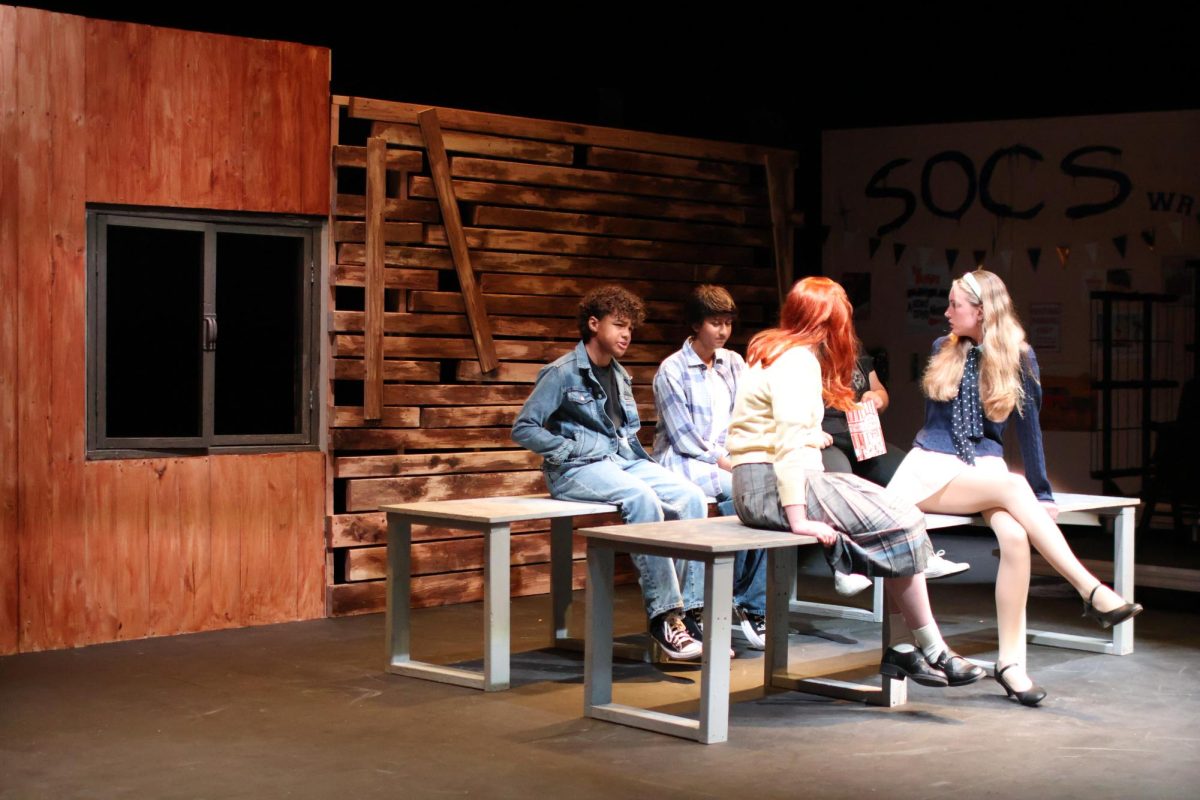
The theatre program presented “The Outsiders,” taking a different approach with the more quaint ‘black box theatre’ allowing them to move away from their traditional proscenium stage for the first time this year, performing the weekends of April 23–25 and April 30–May 2.
The theater change created an intimate environment for both actors and audience members, challenging performers to adapt and push their acting style while staying true to the generational story.
The play’s director, Introduction to Professional Theatre, Intermediate Professional Theatre, English 10 and AVID 10 teacher Sandra Geminiani, chose “The Outsiders” because of its “popularity and emotional impact.” As this was Geminiani’s first year teaching at a high school after previously teaching at Carmel Valley Middle School, her goal was to select a production that would appeal to students who have yet to participate in drama before.
“I knew when I got here that I wanted to pick shows that were very high interest,” Geminiani said. “It’s a popular story among all the students I’ve ever had for the last 10 plus years.”
The production was inspired by the Broadway musical rendition of “The Outsiders,” which Geminiani saw live in New York City; however, she chose the play version over the musical version.
One of the largest obstacles was adapting the production to the smaller, ‘black box theater,’ a more experimental performance space in comparison to the school’s main stage.
“You can’t fake emotions when you’re that close to people,” Geminiani said. “It’s kind of like acting for the camera because you are up so close.”
Actors adjust their performance style to match the smaller stage space for this show. Haley McInnis (12), who played Cherry Valance, explained “the space changed both the emotional delivery and the logistics of performing.”
“The black box is a really intimate space with the audience, which is great for facial expressions and getting the emotions out,” Mcinnis said. “It’s kind of difficult because we don’t really have any backstage area.”
Actors had to remain silent and highly organized in tight spaces while awaiting their cues, since they were always within earshot of the audience.
“There is no in between,” McInnis said. “We’re either in the dressing rooms or out here [on the stage]. Everyone is kind of cramped together.”
She also explained that acting in this environment meant applying a different level of realism to one’s performance.
“With big stage acting, you can be really expressive because the audience is far away,” McInnis said. “But, when you’re right next to them, overacting can come off as cheesy. You just have to live in the scene and act more like a normal person.”
Despite challenges in adaptation, McInnis prefers the black box productions because of the immersive atmosphere, however a smaller space limits audience size.
“We did actually sell out two of the nights,” McInnis said. “So, there were a lot of people who didn’t get to see it that would have wanted to.”
Xavier Guzman (9), who played Johnny Cade, echoes similar thoughts on the benefits of a close audience.
“We were really close up to the audience, so they could see our every emotion,” Guzman said. “We had to make it seem really real.”
Guzman noted that the actors had to be more physically and emotionally precise as every moment was visible to the audience.
“You really had to be in touch with the scene and everything,” Guzman said. “You weren’t being yourself anymore, you were more of that character.”
Behind the scenes, the smaller grounded stage demanded creative staging and technical adjustments.
“Scene changes happened swiftly with limited space, often while narration was taking place,” McInnis said. “Lighting and sound often faced limitations that they wouldn’t on the main stage.”
This forced cast and crew to become innovative, and stage crew members often had to remain in tight corners of the theater for almost the entirety of the show, props and set changes had to be swift without disruption.
“The stage crew basically had to be waiting [backstage], all night,” McInnis said.
The production relied on creative solutions for fight scenes, choreography and props. All weapons and cigarettes used on stage were fake, but were meticulously crafted to look real.
Students with martial arts experience helped to paint realistic fight scenes through choreography. Due to the audience’s proximity, realism was key in execution.
“We had two students who are black belts who helped us to choreograph it so that it would actually look realistic for the audience,” Geminiani said.
According to Geminani, the production stayed faithful to the original novel, which she believes helped the audience connect when viewing the show.
“I think people were excited that it was true to the book,” Geminiani said.