


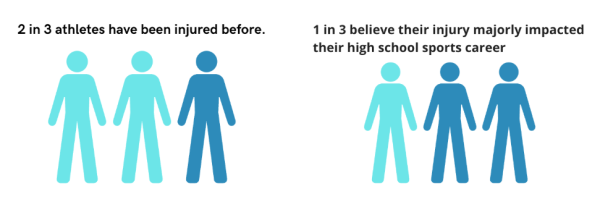
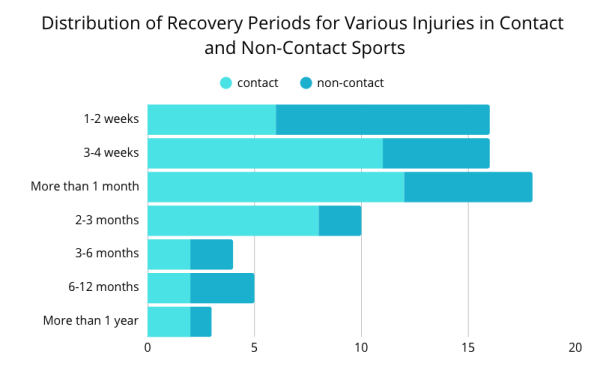
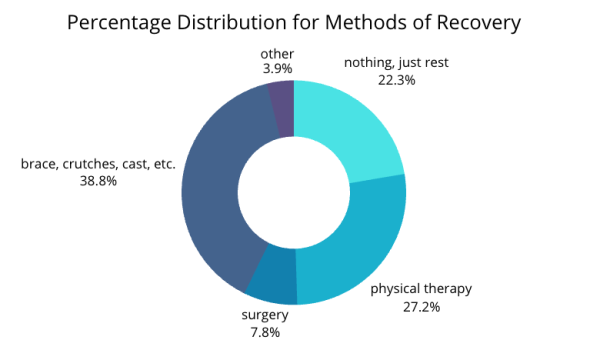
From concussions to sprained ankles, wrist fractures to muscle tears, injury recovery looks vastly different for each athlete. Taekwondo athlete Hailey Chang (11) tore her left anterior cruciate ligament (ACL) and meniscus in May of 2025. The next nine months for Chang were filled with surgical procedures, rigid leg braces and extensive physical therapy.
“During May, I was prepping for my black belt,” Chang said. “I was a candidate to test, and then during practice, I over-rotated my knee, and then it tore. I was immediately removed from the list because I wouldn’t be able to compete or test.”
Field hockey coach Courtney Kun, who also teaches Beginning Journalism and English 9 Honors at the school, dealt with athlete injuries over the years. According to Kun, the most common injuries in field hockey are “shin splints, ACL [tears], knee injuries and concussions.”
“For severe knee injuries, especially ACL tears, depending on when it happens, [athletes can be] out for a whole year, and coming back from that kind of injury can be really challenging,” Kun said.
According to Chang, there are many different ways to rebuild the ACL. One option is to replace the entire ACL with a donor graft (allograft). Another is a complete reconstruction of the ACL, or an ACL restoration. Chang opted for an autograft, where surgeons insert tissue from another one of her tendons (for Chang, it was her patella) to replace the torn ACL tendon.
“I wasn’t nervous about the surgery when I was getting prepped and everything, but when they were ready for me to go in, walking into a big white room with just a bed and a bunch of doctors around, sterilizing everything, prepping everything — I definitely got nervous,” Chang said. “Having to get up on the table, and then lie down, and when the anesthesiologist put the mask on, it was definitely kind of scary.”
After the surgery, more difficulties awaited.
“They give you painkillers before, so you’re kind of drugged the whole time and after for at least a day,” Chang said. “But then the second day, it [was] really painful. I couldn’t move my body, and it was really hard to feel anything, but it was just like all my senses were kind of coming back.
After a few days, Chang was on crutches, and for the next month, she could not put weight on her left leg.
Former varsity track and field athlete Baylin Tsai (11) also tore her ACL and underwent surgery in July of 2025.
“The first week I was just completely bedridden,” Tsai said. “I did not want to get up, and I didn’t want to do anything. The brace had to stay locked at 180 degrees.”
For both Tsai and Chang, physical therapy played a crucial role in injury recovery.
“For the first few months of physical therapy, they would massage [my] knee and all the muscles and stuff,” Tsai said. “But now that I’m more progressed, they kind of just have me start with small workouts to work up my muscles, build up my quad and glute muscles. I do a lot of body weight squats, single leg squats, step downs and step ups and some wall sits.”
Chang’s physical therapy is similar.
“I go [to physical therapy] twice a week for about two hours,” Chang said. “The first hour, I’m usually working with the physical therapist, where she’s helping me bend my knee and assessing what’s happening and testing my strength. Then the other hour, it’s me doing stamina exercises or strength training, so I’ll be lifting weights and doing a lot of leg exercises.”
According to Kun, having a deliberate recovery process rather than a hurried one is most effective in the long term.
“I think athletes [are] competitive in nature … and they want to get back out there as soon as possible, so sometimes they rush it, which ends up leading to further injury or not actually properly healing, which causes more damage down the line,” Kun said.
Kun believes that the most important factors of a successful recovery journey are “having the right people surrounding you and walking you through the step-by-step process in coming up from the injury” and overall health, which she describes as “what you’re putting into your body and what you’re doing for your body.” As for injury prevention, she stresses “proper warm up and proper cool down after all practices [and] games.”
Serious injuries can be a frustrating barrier, especially for high school athletes seeking college recruitment opportunities.
“I’d say [injuries are] an obstacle, but it’s not something you can’t overcome,” Tsai said. “I know so many really, really good athletes who get injured all the time, and they overcome it, and they get recruited to the best places they want to go to.”
Kun agrees.
“Everybody has their own timeline; you can’t compare it side to side,” Kun said. “Just because one person comes back in a week from something doesn’t mean you will. I think reminding them that everyone gets injured, and you know, if they love the sport, they’re determined to come back, they will.”

Viktoria Kiss • Jan 27, 2026 at 5:47 pm
Great job with this story, Joanne and Emily!