
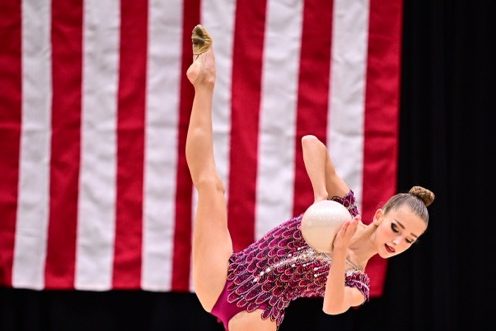
When Chloe Daymude (10) began rhythmic gymnastics at the age of 3, she quickly found a love for expressing herself through rhythm and dance.
“When I was really young, my mom wanted me to do gymnastics … so she put me in artistic gymnastics,” Daymude said. “But, I hated it … so then, she put me in rhythmic [gymnastics], and I really liked it … and I did that all the way until I was 14.”
She started competing when she was 5, and found inspiration in gymnasts she admired, such as Stiliana Nikolova and Sofia Raffaeli.
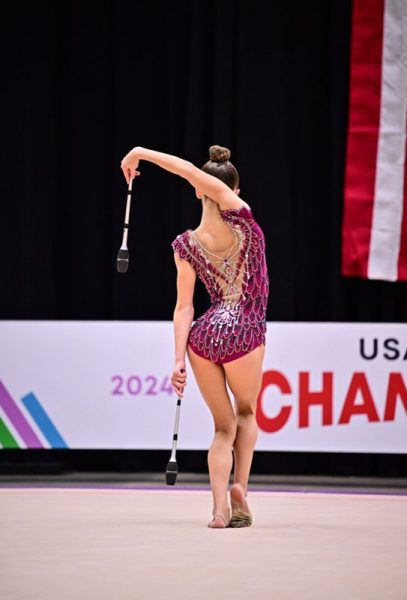
“I would train everyday from like 9 [a.m] to 3 [p.m.] and then do my schoolwork,” Daymude said. “My coach was the best coach in the United States, and she had the top club, [Pacific Stars] … I was part of the elite team there.”
The constant training took a toll on Daymude, both physically and socially.
“I [was] worn out, and you’re in a tiny world where all you do is train, sleep, eat and repeat,” Daymude said. “The only friends that I had were in that club and in rhythm, they’re your friends, but they’re always going to view you as competition.”
The rigorous training also left Daymude with no choice but to be homeschooled, which left her feeling devoid of typical “high school teenage experiences.”
“I always watched the movies, and I was like, ‘I can’t wait to live this experience,’” Daymude said. “High school has [allowed me to grow] in ways that rhythmic couldn’t.”
This year, Daymude decided to attend school in-person and transition from rhythmic gymnastics to a less demanding sport of contemporary dance, joining the school’s varsity contemporary dance team. While she has had lots of support throughout her athletic journey, her mom has always been there for her no matter what.
“[Throughout all the insanity], she’d be the person that held me in her arms after hard practices,” Daymude said. “I always knew she was there for me even if she wasn’t saying it verbally … quitting rhythmic after all these years [made me] nervous because I was like, what’s life like outside of rhythmic? She was definitely my biggest supporter throughout it all, helping me transition and keeping me happy.”
Daymude found a supportive community on the school’s dance team.
“The community is [great], all the girls are such good friends, and all of us feel like a family,” Daymude said. “At practice, everyone’s clapping for each other and hyping each other up … you don’t view each other as competition”
Taura Hall, Varsity Contemporary Dance teacher has noticed that, “Chloe is the type of teammate that gets along with everyone and provides a sweet and neutral energy flow for rehearsals.”
“Chloe is the type of teammate that gets along with everyone and provides a sweet and neutral energy flow for rehearsals,” Taura Hall, Varsity Contemporary Dance teacher said. “The impact on the team dynamic is less anxiety and [more] willingness to trust her whether it be in partnering or asking to go over choreography together.”
Angie Chen (10), Daymude’s teammate, agrees that Daymude brings positive energy to their practices.
“Chloe always wants what is best for her friends and isn’t judgmental,” Chen said. “She is very inclusive and always makes sure that everyone’s opinion is heard. She is also very friendly and is easy to talk to.”
For Daymude, transitioning from one style of dance to another came with its unique set of challenges.
“Dance and rhythmic have the same concepts, but many aspects are different,” Daymude said. “The turns are different, and your hands have to be in a different [position]. Doing 12 years of the same exact thing, [rhythmic], my body has gotten used to that … so it’s changing all that I’ve learned, but I think it’s going to get easier.”
Hall commended Daymude for her ability and willingness to learn and perfect new skills.
“The growth I’ve seen in Chloe this year has been exceptional,” Hall said. “In such a short amount of time she has miraculously transitioned from a competitive rhythmic gymnast to a dance team, where she had to learn new techniques, tricks, dance with large groups of people and essentially toss out methods she’s been perfecting all of her rhythmic career.”
Daymude also acknowledges that the skills she learned in rhythmic gymnastics are apparent in her contemporary dance.
“I feel like when you look at me as a dancer now, you’re still going to be able to see that [I was] a rhythmic gymnast,” Daymude said. “I’m just going to keep working at it.”
Her dedication to constant improvement was noticed by Hall.
“Her work ethic has made her a better dancer because not only has she had to learn many new skills, she’s built a dance haven at home to continue to perfect her dancing [and also] seeks outside dance training from studios,” Hall said. “This is the work ethic of a true pro.”
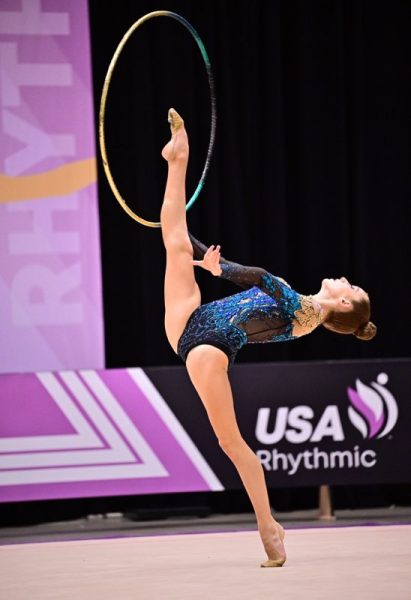
While Daymude is familiar with growth, she has also experienced numerous setbacks in her dance career.
“Right before nationals, I broke both my thumbs in the same week, and rhythm is a bunch of apparatus, and you have to really be able to use your hands for everything,” Daymude said. “I just had to let it heal, which was hard for me both mentally and physically … you get out of shape and then you think, ‘I’m not going to do well this season.’”
Daymude took the time to let herself heal, worked harder that following week, and placed 13th in the top 25 qualifiers out of a field of 130 competitors.
“I [also] got scoliosis from rhythmic, and your back plays a huge part in rhythmic because you have to be super bendy and flexible,” Daymude said. “Not using my back was hard, and it took two months to heal with a bunch of treatment.”
Chen has observed how this growth mindset has impacted her attitude during practice with the contemporary dance team.
“She is very hardworking and always tries her best,” Chen said.
While Daymude experienced lots of “mental blocks throughout [her] life,” she always makes sure to take the time for self care.
“I [have] had lots of sports psychologists and therapists that have really helped, I try to talk to one of them and express how I’m feeling, which helps me let it go,” Daymude said. “I also try to journal my thoughts … there’s no right way to do it, you just get a journal and a pencil and write how you feel … talking about it is one thing but writing it on paper is more therapeutic.”
Daymude also prioritizes listening to her body when it knows something is wrong, not putting too much on herself, slowing down to enjoy life and getting at least nine hours of sleep a night.
“I’m someone that needs to be busy all the time … I like to feel like I’m doing all I can with my life,” Daymude said. “I think sometimes it’s really important for us to just take a break and have a day of rest, your body needs it sometimes.”
Still, Daymude is constantly thinking about her future plans.
“I think I’ve decided I want to be a Dallas Cowboy Cheerleader for a couple years, and then go to college,” Daymude said. “I also [want] to be a pediatric surgeon … I’ve always loved working with kids, I’m going to say no kids are going to die on my watch.”
When not dancing, journaling or spending time watching Grey’s Anatomy with her mom, Daymude can be found working on Wednesdays, Thursdays, Fridays, Saturdays and Sundays at Grand Rhythmics teaching young children rhythmic dancing.
“I got this job because I was the top in the country,” Daymude said. “It’s given me a way to stay in touch with rhythmic and never really lose it. I love working with them and seeing their faces light up when they do something right.”
For Daymude, the Artist of the Month award is a nod to all the effort she puts into dance.
“I was shocked at first because I had just moved to this school, and I was like how the heck is this happening?” Daymude said. “I haven’t been dancing for even a year, and I know and believe I’ve worked hard, but getting the award made it more real … it showed that all my hard work has paid off, and I’m just very happy and grateful.”
Hall believes that Daymude deserves this award because of her dedication and attitude.
“Chloe deserves this award because she has had to work 3 times as hard as most dancers to catch up and has had the heart of gold while doing it,” Hall said. “She has always communicated her gratitude and shows up enthusiastic and always willing to learn even through her frustrations.”