
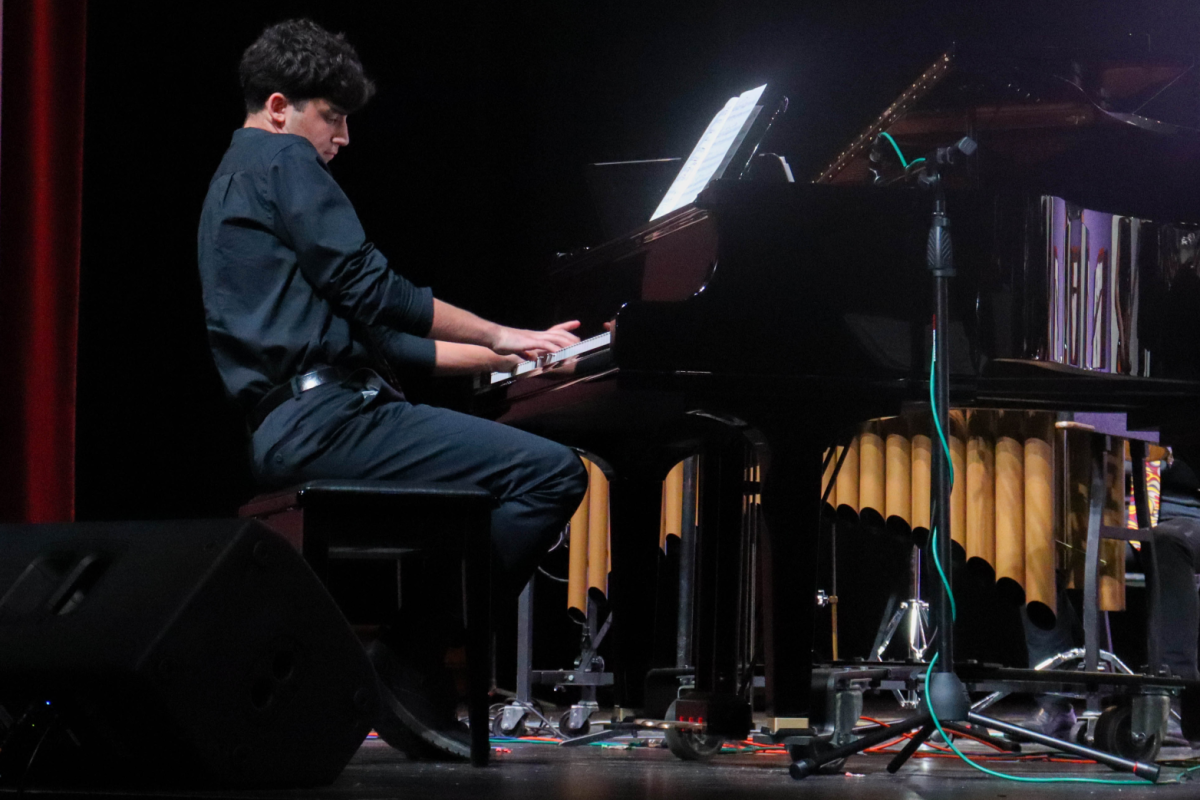
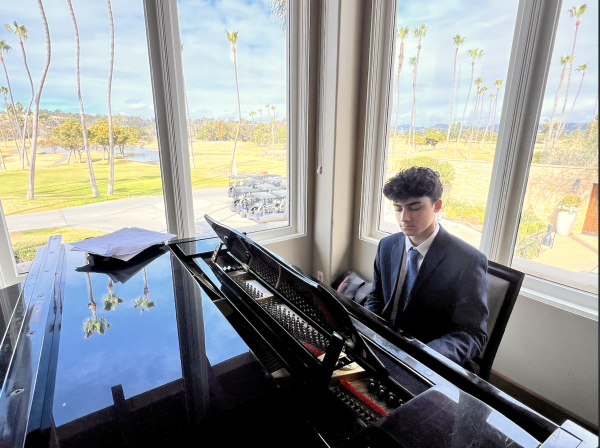
Before Arno Janoyan (11) ever performed with a jazz band, rock group or with a six-keyboard setup, he was a 5-year-old piano student who did not want to practice.
In some ways, his connection to music started before he ever touched the keys. Named after Armenian composer Arno Babajanian, Janoyan was introduced to piano at a young age, even if he did not immediately love it. Years later, the instrument he once resisted had become one of the biggest parts of his life. Now as a pianist in the school’s jazz band and the keyboardist for Gate 5, Janoyan has shaped his sound through classical training, jazz improvisation, progressive rock and Armenian musical influences.
As April’s Artist of the Month, nominated by the Associated Student Body (ASB) Arts Commissioner Avery Cooch (9), Janoyan spoke with The Falconer about his musical journey, performing in front of live audiences, balancing school with his band and the future he hopes to build within the music industry.
When did you first start playing piano and what do you remember about the beginning of your journey?
“I first started playing at five years old [when] my parents enrolled me in lessons. I remember at first I just absolutely disliked it. Practicing was a battle, they had to force me pretty much to practice. For the first three years of my playing, I was classically trained [where] I learned classical music theory. After that … I discovered rock music, and recently, just a few years ago, at Torrey Pines, I joined [the] jazz band, and that’s where I am now.”
How would you describe yourself as a musician to someone who has never heard you play?
“My style is really derivative of jazz, rock and classical, kind of a combination of the three because those are my three main influences in my playing. I would [describe] myself as a musician to someone who’s never heard me [as] very fast, very abrasive, [and that I use] a lot of staccato and a lot of left hand bass. I would be best compared to a player like Keith Emerson. [There are] a lot of jazz idioms in my playing, but [overall I play] kind of the speed of classical and the heaviness of rock.”
What kind of music do you enjoy playing the most and why?
“The music I enjoy playing the most at this point in my life [is] definitely jazz. I love playing jazz because of its improvisational emphasis. I love improvisation. I feel like it’s my language. When I sit down at the piano and, let’s say I’m with a band, and they call a tune and it’s a jazz standard, I know … I can come up with something on the fly. That’s been the number one thing I learned how to do at Torrey Pines, and I really have been working on my technique in that department. The music I’m best at playing is definitely progressive rock. I still have a long way to go in jazz, but when I discovered rock music about halfway through my playing career, I got really good at that, and that’s what I’ve played most in a live setting with all my bands.”
How did Gate 5 come together, and what has the band’s journey looked like so far?
“We formed on a Torrey Pines school-sanctioned trip. Five of our members go to Torrey Pines and two of our members go to San Dieguito Academy (SDA) … We [started] really taking the band seriously … on a trip to [the] New Orleans Jazz Festival in 2025. I play keys for our band. Our drummer is Elijah Abasta (11). Our guitarist is my brother Vaughn Janoyan (9). Our bassist is Keila Sime (12), she’s graduating and going to University of California Berkeley [in the fall]. Our trumpet player is Evan Krall (9). Our SDA band members include vocalist Aliya Laffler (11) and saxophone player Finn Rambur (12). We play all sorts of music, but mainly jazz rock since we have horns in the band. We play at all sorts of events: we’ve played festivals, we’ve played private shows and we even played at a wedding. We won the Encinitas Battle of the Bands last Saturday, that’s kind of our crowning achievement. We’ve been booked for a pretty big festival called Summer Fun on the 101 in Leucadia because of winning [Battle of the Bands].”
What do you enjoy most about performing for other people?
“I feel like the best thing about performing for other people is watching the crowd during my performances. I just love crowd work as a musician. I feel like stage presence is one of the most important things when you’re playing live, because you could be the most talented musician on the planet, you could be a virtuoso, a master, a genius, but if you play stiff on stage, people are going to be disinterested. I love getting the crowd going and I know it’s cliche, but I love it when the band gets a perfect take on a song. It’s really great when everything goes well, because when you’re playing live, you never really know what’s going to happen. It’s always a different setting out there than [when you] practice.”
What does your practice schedule look like between the school jazz band and Gate 5?
“Jazz band is a class [which is] second period. It’s run by [Amy Gelb], the music teacher. She’s amazing, she’s awesome, probably the best music teacher in the district. Our class operates sometimes three times a week, other times [twice] a week. We occasionally have practices outside of class, maybe once or twice a year for certain special events. The way [the class] works is we’ll get a set of pieces, we’ll practice those for a few months, and then we’ll have our concert, and on the day of the concert, or the day before, we’ll go into the Performing Arts Center (PAC), set everything up [and] do sound check. That’s how we have our four yearly concerts, including Jazz Fest, which is a once a year thing, where all the schools come to the PAC and perform.”
“With Gate 5, it does fluctuate based on our schedule, we recently had gigs on [May] 17, 19, 21 and 23. We had four gigs all right up in a row and that’s when we got together pretty much four times in preparation for all of those [gigs]. [That] realistically isn’t a lot, but we know the material pretty well. So it fluctuates gig per gig [the amount we practice]. During downtime and [when] we’re not practicing as much, what we’ll do is write originals and send those between each other.”
How has Gelb and the school’s music program influenced you as a musician?
“As a person in my life that has helped me with my music, she’s [in the] top three … I’m kind of a pompous player [and] I get in people’s ways sometimes when I shouldn’t in a band setting. She gives me a lot of room to be myself, express myself and [have] opportunities to do what I need to do. She’s also taught me a lot about music and the way that it works in a jazz setting, in particular. She’s great, all love to her.”
How do you balance school, work and music as a junior?
“My main focus this semester has been school. It’s pretty hard to balance the music with school, because there’s so many concerts, so many practices, and I know I speak for a lot of the band when I talk about work. I have a job, I work at Chin’s Szechwan in Encinitas. My drummer [and] my bassist [also have jobs] … So when all three of us have work, and we’re constantly trying to plan around schedules, it’s hard and also obviously with tests.”
What advice would you give to students who want to start a band or focus on music while balancing school?
“I’d say the number one thing to anyone who’s looking to start a band or focus on music while being a junior is knowing what you can sacrifice. I’ll give an example. If I have a math test a few days before a gig, I will say [to my bandmates] ‘Sorry guys, I can’t practice because I have to study for this test.’ In the short term it sucks, because we have one less practice, but math is a difficult class for me, so I have to ‘lock-in’ for that. [On the other hand] if there’s a day before a gig, where I have an Advanced Placement (AP) Psychology test, no hate to AP Psych, I’ll put [my] hand up and say, ‘guy’s forget about AP Psych, we’re practicing tonight.’ Just know what you want to sacrifice and really stay focused with all aspects of your life.”
Do you get nervous before performing, and what helps you stay calm?
“Stage fright or performance anxiety is something that I feel all musicians deal with at some point in their lives. My first performance ever was a piano recital at an old age home, and I don’t think I’ve ever felt more nervous in my entire life. I was about 5 years old, but as time has passed for me [and how I’ve] especially played live so many times in so many places to the point where there’s some degree of nervousness, but I’ll say this: for school, since we’ve done so many school practices and school concerts, there’s upwards of half a dozen every year, I tend to be less nervous for those.”
“Whereas with the band Gate 5, where we’re either on the clock, getting paid, or it’s a big show audience wise, it’s a different level of nervousness [since] someone has gone out of their way to pay for you to be there and perform for them. When I do get nervous my main way of coping is talking to my bandmates [since they] are all going through the same thing as me and we all know we’re ready. It’s good to talk it out with them and say, ‘we got this, let’s go out there [and] kill it. Whether it’s for a check or for audience purposes, I say, ‘let’s go and let’s do it.’”
Who are some artists, composers or musicians who have inspired you?
“In my classical training the main composer who pretty much shaped my entire playing style is a man named Arno Babajanian. My parents named me after him, ironically enough, and they enrolled me in piano lessons. Babajanian is Armenian, which I am [too], so he’s like a cultural influence on me, because along with genres like jazz, rock and classical, one of my main influences is Armenian music. I’ve been playing Armenian music since I was 7 or 8 years old, and I’ve played [Armenian music] live various times. Arno Babajanian was an Armenian composer and his technique combined a lot of jazz with classical. [His music is] very melodic, and naturally listening to him so much from a young age developed a lot of that.”
“One of my main rock influences was a rock band called Genesis. They’re a progressive rock band from the 1970s and they totally pioneered the genre of progressive rock. Their keyboardist Tony Banks inspired my love of different synthesizers, keyboards and technology. Right now, my current full setup is about six keyboards. It’s an addiction [and] I do not need that many … [I bought] a full console organ a few months ago, which is the same model that Genesis used and they have a lot of great records, so they’ve really influenced my playing style.”
“I’d say John Coltrane is my main jazz influence. [He] is pretty much the father or bebop [and] he’s so good. He’s actually a saxophone player so his recordings, Giant Steps in particular, I will sit down and just play along to it. I will never be as good as the pianist on that recording, but it really helps me get my jazz chops in tune.”
What does being named April’s Artist of the Month mean to you?
“It means a lot, because Torrey Pines is a school with so many great artists, whether they be from the music program or the sculpture department, the art department [or] dancers. There’s really talented people at this school. When I get nominated for something like that from ASB, it does mean a lot, and it feels great to be recognized for my work. I really appreciate that.”
How do you hope music continues to be part of your life in the future?
“I love music with every fiber of my being, and I’m going to try with every fiber of my being to keep it a part of my life in some way, shape or form. The sad reality of musicians today and the music industry as a whole is [that] there’s a lot of threats to the sustainability of music as a job and a career moving forward for even professional musicians. [This is] because of the advent of artificial intelligence (AI), and particularly music generation sites like Suno, where people can now just generate a song at the tip of their fingers without actual musical knowledge or talent.”
“My dream is to be a performing artist, play live, record albums and maybe even be in a band, as I am now … I’m open to being a member of the music industry [and the] production [side]. I’m interested in engineering, artist management [and] these types of roles. I think it’s just crucial that we keep them human in the music industry, as opposed to moving everything to AI, as it’s been happening now. So I think my goal and my dream is to be a performing artist and keep that as my life, but if that is not possible due to financial reasons or any other factor that plays into it, staying connected with music, whether it be through the industry or just through personal practice, is really important to me, [as I move] forward with the rest of my life.”